The suitcase has not moved in three months. You pull it out of the cupboard and, within minutes, your dog is following you from room to room, your cat has vanished, or your rabbit has stopped eating. You said nothing. You did nothing except retrieve a bag. And yet something shifted in the room that your pet registered before you were conscious of it yourself.
Pets read patterns, not words
Animals that live with people become extraordinarily good at reading behavioural sequences. A dog does not understand the concept of a holiday, but it does understand that a specific chain of events, suitcase out, clothes folded, shoes lined by the door, your voice on the phone, has, every time it has happened, ended with you leaving and the house going quiet for longer than usual. That chain is a pattern, and your pet has filed it.
This is associative learning: a neutral object (the suitcase) gets paired repeatedly with an outcome (your absence) until the object alone triggers the emotional response the outcome would have caused. The suitcase is not frightening in itself. It is frightening because of what it reliably predicts. Dogs in particular are sensitive to this kind of temporal sequence, they track what happens before what, and they remember it across months.
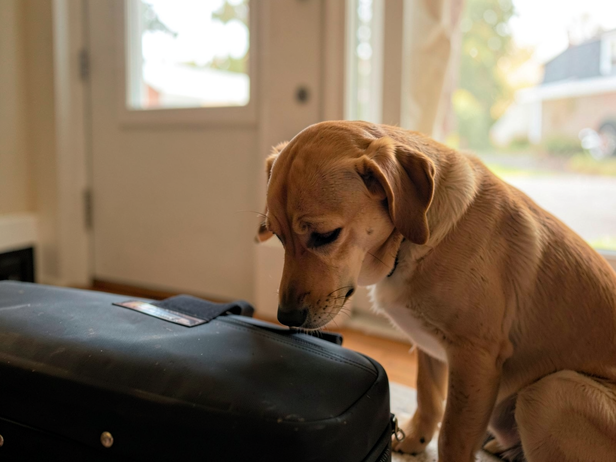
![Dog's Sadness by Suitcase]()
Dog's Sadness by Suitcase
Image credit : AI
My pet separation anxiety is evident as I watch the suitcase, dreading your departure.
What the body is actually responding to
The stress response you see, pacing, panting, clinginess in dogs; hiding, reduced appetite, over-grooming in cats, is the autonomic nervous system preparing for a threat. Cortisol rises. Heart rate goes up. The animal is not being dramatic. It is doing exactly what a nervous system is designed to do when it detects a reliable signal that something difficult is coming.
There is a second layer that owners often miss: you change too. When you are preparing to travel, your routine shifts. You move through the flat differently. You open and close cupboards at unusual times. You may be distracted, a little hurried, or anxious about the trip yourself. Pets, especially dogs, are highly attuned to the emotional state of the people they live with. Your cortisol is detectable to a dog's nose. Your posture and pace shift. The suitcase is the flag, but your changed behaviour is the confirmation.
Why some pets seem unbothered
Not every animal reacts visibly, and the difference usually comes down to history. A pet that has been left with a consistent, familiar caregiver and has had good experiences during previous absences builds a different association. The suitcase still predicts your departure, but departure no longer predicts distress. The emotional weight of the pattern is lower, so the visible response is lower.
Age and temperament matter too. A dog with a generally lower anxiety baseline, or one that has been gradually exposed to the suitcase as a neutral object during non-travel periods, is less likely to spiral. Cats that are more independent by temperament may register the change and simply wait it out rather than displaying it.
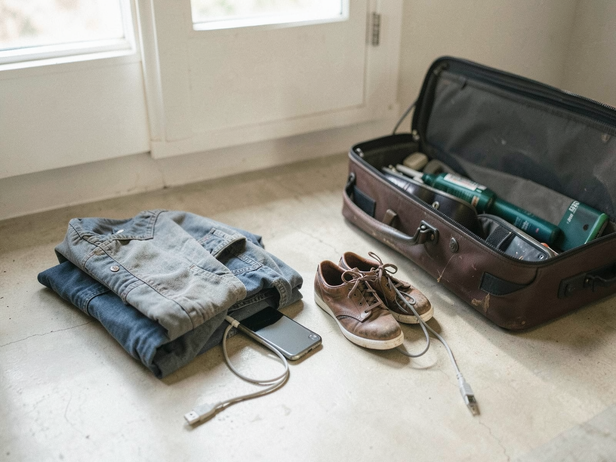
![Morning Light on Travel Prep]()
Morning Light on Travel Prep
Image credit : AI
Preparing for my trip, the suitcase is open, a reminder of the journey ahead. I hope my pet doesn't experience separation anxiety.
What you can do about it
The goal is to break the predictive chain, or at least reduce the emotional charge attached to it. A few approaches that work with the animal's learning system rather than against it:
Bring the suitcase out on ordinary days. Leave it open in the living room for a week when you have no travel planned. Let your pet investigate it, sleep near it, ignore it. When the suitcase appears without the departure sequence following it, its predictive value drops. This is called latent inhibition, the signal loses its reliability as a predictor.
Vary your pre-departure routine. If you always pack the night before and leave at 8 a.m., your pet has a very precise internal clock for when the bad thing happens. Packing earlier, or in stages across several days, or leaving the bag in a different room, disrupts the sequence enough to reduce the spike.
Make the suitcase a source of good things. Hide a treat inside it. Feed your pet near it. A few minutes of play with the bag in the room. You are building a competing association, one where the suitcase predicts something pleasant rather than something stressful.
For dogs with significant separation anxiety, the suitcase reaction is often one signal among many. If your dog cannot settle when you leave for work, struggles with any change in routine, or shows physical symptoms of distress, refusing food, destructive behaviour, vocalising for extended periods, a qualified veterinary behaviourist is the right next step. A suitcase trigger alone is manageable at home; a broader anxiety pattern usually needs professional support to address safely.
The animal is not punishing you
Owners sometimes interpret the hiding cat or the clingy dog as a form of reproach, the pet knows you are leaving and is making a point of it. The research does not support this reading. What looks like sulking is almost always anxiety. The animal has no concept of blame. It has a nervous system that has learned a pattern and is responding to it.
That distinction matters practically. An animal in a state of anxiety needs calm, consistent reassurance, not correction, and not excessive soothing that inadvertently confirms there is something to be anxious about. A normal departure routine, carried out without drama, is usually the most stabilising thing you can offer. The suitcase will keep predicting your absence for as long as absences follow it. What you can change is how much weight that prediction carries.