Every dog owner has seen it: the window rolls down, the head goes out, and the dog looks like the happiest animal alive. That image is so familiar it feels harmless. It is not.
What the wind is actually doing to your dog's eyes and ears
At highway speeds, even small particles, grit, insects, a seed, a chip of dried mud, hit exposed eyes with enough force to scratch the cornea. Dogs do not blink fast enough to protect themselves from debris at 60 or 80 kilometres per hour. Corneal abrasions are painful, slow to heal, and can lead to ulceration if the eye is not treated promptly. A dog that comes home squinting, pawing at its face, or with a visibly red or watering eye after a car ride needs to see a vet the same day, not the next morning.
The ears take a different kind of damage. Sustained wind pressure forces the ear flap back and holds it there for the length of the journey. The blood vessels inside the ear flap are fragile. Repeated exposure over many trips can cause a haematoma, a pocket of blood that pools between the skin layers of the ear, or simply chronic irritation and swelling. Long-eared breeds like Cocker Spaniels and Basset Hounds are more vulnerable, but no dog's ear is built for extended wind exposure at speed.
![Dried Seed and Pebbles]()
Dried Seed and Pebbles
Image credit : AI
A close-up of a dried grass seed and pebbles on linen, bathed in soft morning light. Safe car travel for dogs is important.
The ejection and collision risk
A sudden brake, a swerve, a pothole at the wrong moment: a dog with its head or body out of the window has nothing to hold it in. Dogs have gone through windscreens of other vehicles, landed on roads, and been struck by passing traffic, not in dramatic accidents but in ordinary sudden stops. The dog does not understand what is about to happen and cannot brace for it.
There is also a risk to other road users. A dog that falls or jumps from a moving vehicle becomes an obstacle. In India's traffic conditions, where lane changes and sudden braking are routine, the margin for error is smaller than on an open highway.
What the dog is actually experiencing
The behaviour looks like pleasure, and some of it is. A dog's nose carries roughly 300 million olfactory receptors against a human's 6 million. The airstream outside a moving car delivers an extraordinary volume of scent information in a short time, and that is genuinely stimulating. The dog is not wrong to want it. The problem is that the dog cannot weigh that pleasure against the physical cost of getting it this way.
What looks like bliss can also be anxiety expressed outward. Some dogs hang their heads out because the interior of a car is stressful, the motion, the confinement, the unfamiliar smells of upholstery and exhaust, and the open window is an escape valve. If your dog is restless, panting heavily, or drooling inside the car before the window goes down, the root cause is motion stress, not a preference for fresh air.
![Dog harness on car seat]()
Dog harness on car seat
Image credit : AI
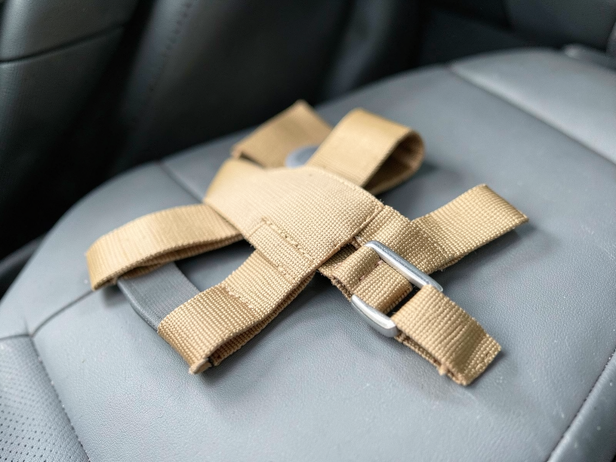
Ensuring safe car travel for dogs with a secure harness. Traveling with dogs in car India requires proper gear.
What to do instead
The straightforward fix is a well-fitted harness clipped to the rear seat belt anchor, or a secured travel crate in the boot or back seat. Either keeps the dog inside the car during a sudden stop and removes the head-out temptation. Crack the window two to four centimetres, enough for airflow and scent, not enough for a snout to fit through. Most dogs settle once they realise the window is not going further.
For dogs that are genuinely stressed by car travel, the window is not the solution. Short, positive trips that end somewhere good, a park, a walk, a sniff session, rebuild the association between cars and outcomes the dog wants. This takes time and consistency, and it works better than any single-session fix. If the anxiety is severe enough that the dog cannot settle even on short trips, a veterinary behaviourist can assess whether there is an underlying issue worth addressing before the next long drive.
The goal is a dog that travels calmly and arrives safely. A cracked window and a good harness get you most of the way there.