A dog who sleeps soundly at home can turn into a pacer the moment you check into a hotel. He sniffs every corner, circles his bed, pants without being hot, and wakes you at two in the morning for no visible reason. Before you conclude he's being difficult, it helps to know what his nose and nervous system are actually dealing with.
A hotel room is an overwhelming sensory environment
Every room a hotel turns over carries the scent history of dozens of previous guests, their pets, the cleaning products used between stays, and the HVAC system cycling air from other floors. For a dog, whose nose processes smell at a sensitivity roughly 10,000 to 100,000 times sharper than a human's, this is not a neutral space, it is a dense, unresolved archive of information. He cannot identify whether any of those scent signatures belong to an animal that poses a threat. Until he can, his nervous system stays on alert.
The sounds compound it. Hotels have thin walls, corridor traffic at irregular hours, lifts opening and closing, and the low hum of climate control units that cycle on and off through the night. At home, your dog has learned which sounds belong to his environment and can filter them. In a hotel, every sound is unclassified. Each one gets evaluated. That evaluation costs energy and prevents deep sleep.
![Resting Dog's Comfort Items]()
Resting Dog's Comfort Items
Image credit : AI
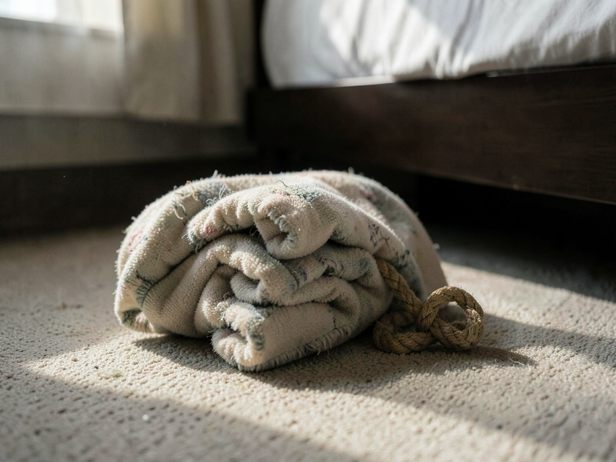
My dog's familiar comfort items, a well-worn blanket and rope toy, offer solace in a new hotel room, helping with dog anxiety new place at night.
His territorial anchor is missing
Dogs are strongly place-oriented. At home, your dog has a defined territory, a bed, a spot on the sofa, a corner of the kitchen, where his own scent is layered in over months or years. That scent is not just comfort; it is information. It tells him this space is his, it is safe, and nothing has changed since he last checked. In a hotel room, none of that exists. He is in a space that smells of strangers, that he has no claim over, and where the normal cues that signal safety are absent. Restlessness is a reasonable response to that situation, not a personality flaw.
What you can do before and during the stay
Bringing something that smells strongly of home, his usual blanket, a worn t-shirt of yours, his regular bed if it fits in the car, gives him one fixed olfactory anchor in an otherwise unresolved room. Place it in the spot where you want him to sleep, before he starts exploring. Let him investigate the room on lead first, at his own pace, before you settle in. A dog who has been allowed to complete his own survey of the space is calmer than one who is told to lie down before he's finished processing where he is.
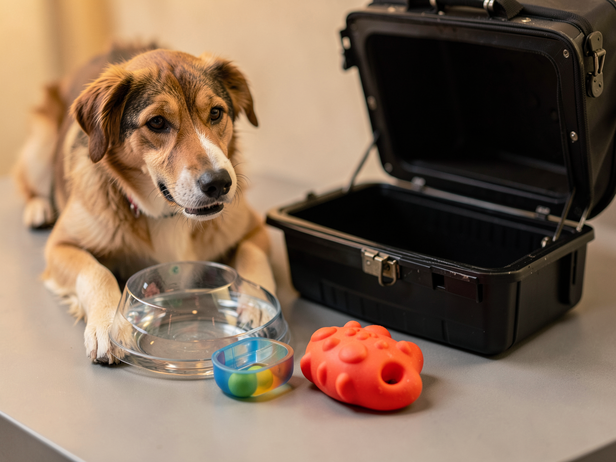
Keep his pre-sleep routine as close to home as possible. If he gets a walk before bed at home, give him one here. If he has a chew or a Kong before lights out, bring it. Routine is a signal that the rules of normal life still apply, and that signal matters more in an unfamiliar place than it does at home. A crate, if he is already crate-trained and uses one at home, can help significantly, it is a portable version of his territorial anchor. Bring it open, not as a confinement, and let him go in and out freely before you expect him to sleep in it.
![Dog's Travel Essentials Ready]()
Dog's Travel Essentials Ready
Image credit : AI
Preparing for a journey. My dog's travel crate is open, ready for him to settle in. He might be restless in a hotel room.
When restlessness points to something more than novelty
A dog who settles after an hour or two of investigation is adjusting normally. A dog who pants heavily, cannot lie down for more than a few minutes, drools, vomits, or shows diarrhoea is showing signs of acute stress that go beyond mild novelty anxiety. If he also has a history of separation anxiety, storm phobia, or has never travelled before, a hotel room at night can tip a dog who manages day-to-day into a stress response that needs proper attention.
If your dog's distress is severe enough that he cannot settle at all across multiple nights, or if the physical symptoms are pronounced, that is a conversation for your vet before the next trip, not a problem to manage with reassurance alone. A vet can assess whether anxiety management support is appropriate and what that looks like for your dog specifically. Never give a dog a human sleep aid or sedative without explicit veterinary guidance; several common human medicines are dangerous to dogs.
A dog who learns that travel ends in a settled night will become a better traveller over time. One who spends every hotel stay in unresolved stress does not habituate, he just repeats the experience.