Walk into almost any Japanese restaurant in Mumbai, Delhi or Pune and you will find it near the cash counter: a ceramic cat, one paw raised, sometimes battery-powered into a slow, continuous wave. Most people glance at it, register it as a lucky charm, and move on. The maneki-neko is one of the most widely recognised symbols in East Asian commercial culture, and almost nobody knows the stories that made it.
What the paw is actually doing
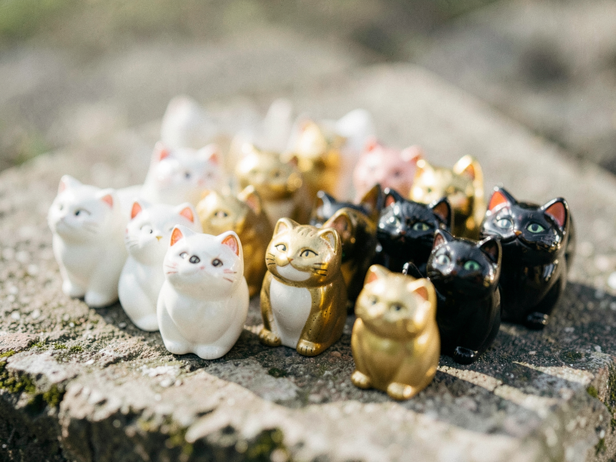
The name means beckoning cat in Japanese, but the gesture is easy to misread. In Japan, beckoning is done with the palm facing outward and the fingers pointing downward, the opposite of the Western wave. A raised right paw is said to call in money and good fortune. A raised left paw is said to call in customers and people. Some figures raise both, which traditionalists find greedy; the joke is that a cat with both paws up cannot defend itself. The colour carries meaning too: white for general good luck, gold for wealth, black to ward off evil, red for health. These associations are not ancient doctrine, they accumulated over the nineteenth and twentieth centuries as the figure became a commercial object, but they are now consistent enough across Japan that shopkeepers choose colours deliberately.
![Lucky Cats on Stone]()
Lucky Cats on Stone
Image credit : AI
I captured these maneki-neko, the beckoning cat, in soft morning light, their ceramic texture vivid against the stone.
The legends, told plainly
Two stories are told most often, and both are rooted in real places in Tokyo.
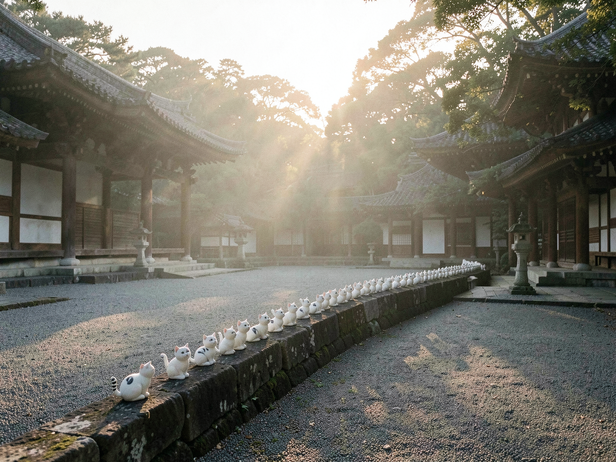
The first is set at Gotokuji temple in what is now Setagaya ward. A feudal lord, the telling usually names him as Ii Naotaka of the Hikone domain, was caught in a sudden storm while travelling and sheltered under a tree near a poor temple. A cat sitting at the temple gate raised its paw. Curious, he followed it inside. The tree was struck by lightning moments later. Grateful, Ii Naotaka became the temple's patron and funded its rebuilding. When the cat died, the temple made a figure in its honour. Gotokuji still exists, and its grounds hold hundreds of maneki-neko figures left by visitors. Whether the story is history or later invention, the temple has carried it for long enough that the two are inseparable.
The second story is set in Yoshiwara, the licensed entertainment district of old Edo. A courtesan named Usugumo kept a cat she loved. One night, the cat pulled at her kimono and would not stop. The house master, reading the behaviour as an omen, drew his sword and cut off the cat's head. The severed head flew to the rafters and killed a snake that had been coiled there, unseen. Usugumo grieved. A patron had a figure carved in the cat's likeness to console her. This version of the story is darker and less often told in tourist contexts, but it is the older of the two in some accounts, and it captures something the temple story does not: that the beckoning cat also has a protective meaning, not only a prosperous one.
What the cat is actually doing, biologically
The belief and the behaviour are worth separating. Cats do raise a paw in a motion that looks like a wave, it is part of grooming, typically washing the face. A cat sitting calmly and raising a paw to its face is doing nothing more than cleaning itself. The human tendency to read intention into this gesture is exactly the kind of pattern-recognition that produces folklore. That does not make the folklore less interesting. It makes it more so: a mundane feline habit, seen at the right moment by someone who needed an explanation for good fortune, became a symbol that spread across East Asia and eventually into every Japanese restaurant in the world. The cat was not beckoning. People decided it was, and that decision stuck.
![Temple Courtyard Dawn Mist]()
Temple Courtyard Dawn Mist
Image credit : AI
Dawn light illuminates maneki-neko figures in a serene temple courtyard, hinting at their beckoning cat Japan legend.
How it travelled and changed
The maneki-neko as a ceramic figure became common in Japan during the Meiji era, roughly the late nineteenth century, as urbanisation brought more commerce and more shops wanting symbols of prosperity. Chinese merchants adopted it and brought it into Chinese commercial culture, where it is now equally embedded. From there it spread through the Chinese diaspora into Southeast Asia, and through Japanese restaurants and shops into Europe, the Americas and South Asia. Each community that adopted it layered its own associations onto the existing ones. In some Chinese contexts the waving arm is motorised to keep the luck flowing continuously, a later addition with no basis in the original Japanese tradition, but now so common that many people assume it is original.
The figure that sits near the till in a Mumbai restaurant is the end point of a chain that runs from a rainstorm near a Tokyo temple, through a grieving courtesan in old Edo, through the Meiji ceramics trade, through the Chinese diaspora, and into a globalised visual shorthand for good fortune. The cat in the story was doing what cats do. Every layer of meaning after that was human.