The oldest surviving literature in any Indo-European language gives a dog a name, a mission, and a speaking role. Sarama appears in the tenth mandala of the Rig Veda, sent by Indra to find cattle stolen by the Panis, a group of demons who had hidden them in a cave beyond a great river. She crosses the Rasa, a mythic cosmic waterway, follows the scent, finds the herd, refuses the Panis' bribes, and returns to Indra with the location. The word the text uses for her is shvani, a female dog, and she is described as swift-footed and keen-nosed. Nothing about her is supernatural except the scale of the errand.
What the Rig Veda actually says
The relevant hymn is Rig Veda 10.108, a dialogue poem. The Panis speak to Sarama, try to convince her to stay, offer her a share of the cattle, and ask who sent her. She answers each question and declines each offer. The exchange is not a tale of divine power, it is a portrait of a dog who will not be turned. The text frames her loyalty to Indra as the reason she cannot be bought. Later Vedic texts expand the story: the Shatapatha Brahmana names Sarama as the mother of the two four-eyed dogs who guard the road to the realm of Yama, the god of death. Those dogs, the Sarameyas, appear in the Rig Veda itself, in hymns asking them to spare the dying. The lineage the tradition builds from Sarama is one of guardianship: the dog at the threshold, the dog who knows the way between worlds.
![Ancient Manuscript and Marigold]()
Ancient Manuscript and Marigold
Image credit : AI
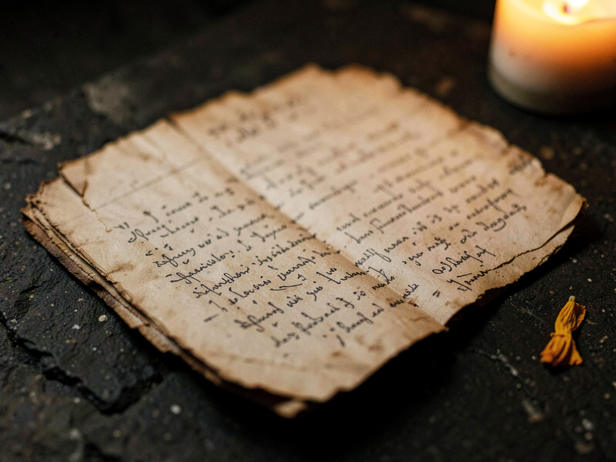
Ancient palm-leaf pages, script softened by time, with a single dried marigold petal. A glimpse into ancient Indian mythology.
The behaviour the myth is built around
Scent-tracking is the observable fact at the centre of the story. A dog's nose carries roughly 300 million olfactory receptors against a human's 6 million, and the part of a dog's brain dedicated to analysing scent is, proportionally, about 40 times larger than the equivalent region in a human brain. When the Rig Veda describes Sarama following the cattle across a cosmic river by smell, it is doing what mythology does with a real behaviour, scaling it to match the size of the story. The loyalty the text emphasises is also grounded in something observable. Dogs are social animals whose cooperation with humans is ancient enough that researchers who study animal domestication treat the dog as the earliest domesticated species, with the most conservative estimates placing the split from wolf populations at least 15,000 years ago and some placing it considerably earlier. A culture that had lived alongside dogs for generations before the Rig Veda was composed would have watched exactly the behaviour the hymn describes: a dog that follows a scent, refuses distraction, and returns to the person who sent it. The myth names what the behaviour looked like from the outside, fidelity that does not negotiate.
How the tradition held the belief
The belief that dogs have a connection to the boundary between life and death runs through several South Asian traditions and is stated as a belief within those traditions, not as a zoological fact. Dogs appear at the gates of Yama's realm in the Mahabharata as well, the Pandava brothers encounter a dog on their final journey, and the dog is eventually revealed to be Dharma, the god of righteousness, in another form. The Zoroastrian tradition, which shares deep roots with the Vedic one, treats the dog as a sacred animal whose gaze can drive away evil and whose presence at a deathbed is considered protective. What connects these beliefs across traditions is the same observable behaviour: dogs respond to the physiological changes that precede death, they return repeatedly to places associated with people they knew, and they are alert to things humans cannot detect. Ancient cultures built their theology around what they saw. The Sarameyas guarding the road to Yama's realm are the mythological form of a dog that will not leave a threshold.
![Dawn's Golden Dog]()
Dawn's Golden Dog
Image credit : AI
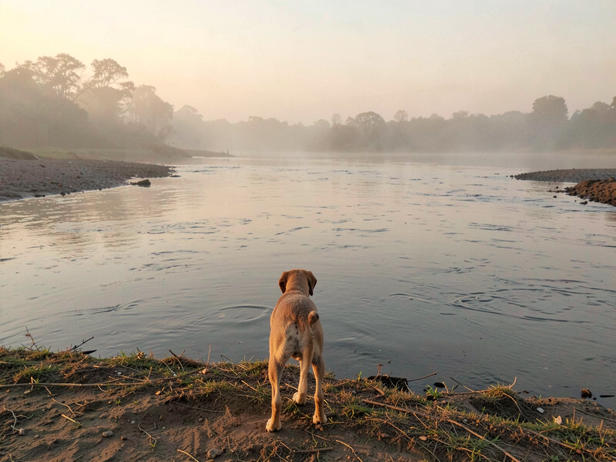
I watch the dawn break over the dry riverbed, a solitary figure in the mist. A divine dog of ancient lore.
Why Sarama is worth knowing by name
The history of dogs in India is not a recent import story. The subcontinent has native breeds, the Rajapalayam, the Mudhol Hound, the Chippiparai, the Kombai, the Kanni, among others, whose presence in the region is old enough that their origins are debated among researchers. The Indie, the free-ranging dog found across the country, is genetically distinct from European breeds and carries a lineage that predates most recorded history. Sarama sits at the beginning of the written record of that relationship. She is not a metaphor for loyalty in the abstract. She is a named dog in a named text, doing a specific thing, tracking, refusing a bribe, reporting back, and the tradition that produced her had clearly watched dogs do exactly that kind of work. The next time a dog at home follows a smell to its source and then looks back to see if you noticed, the behaviour has a 3,500-year-old written witness.