A dog named Bobbie walked roughly 4,000 kilometres across the United States in 1923 to return to his family in Silverton, Oregon. The case was investigated and verified by the Oregon Humane Society. It remains one of the most documented long-distance returns on record, and it raises a question that researchers have been quietly working on ever since: how does a dog know which direction home is?
The smell map that dogs carry everywhere
A dog's nose contains around 300 million olfactory receptors, compared to about six million in a human. More importantly, the part of a dog's brain dedicated to analysing smell is roughly 40 times larger, proportionally, than the equivalent in humans. Dogs do not just detect odours, they build spatial information from them. Wind carries scent in gradients, and a dog moving through a landscape is reading a continuous map of where things are relative to where it is. Researchers studying search-and-rescue dogs have observed that dogs can track a scent trail that is hours old, adjusting direction as the gradient shifts. A dog that has lived in one place long enough has an olfactory map of the surrounding area that it can navigate by, even without visual landmarks.
![Earthy Still Life: Dried Grass]()
Earthy Still Life: Dried Grass
Image credit : AI
I observe the subtle textures of dried grass and dust, a quiet moment of natural beauty. How dogs find their way home remains a mystery.
Magnetic sensitivity: what the research shows and what it does not
A 2013 study published in Frontiers in Zoology observed that dogs preferentially align their bodies along a north-south magnetic axis when defecating in calm geomagnetic conditions. The finding was replicated across 70 dogs of 37 breeds. This is not proof that dogs navigate by magnetism the way migratory birds do, but it does confirm that dogs can detect the Earth's magnetic field. Whether that sensitivity contributes to long-distance navigation is still an open question. The honest position is this: magnetoreception appears to be a real sensory capacity in dogs, and its role in homing is plausible but not yet established by controlled experiment. The documented long-distance cases are consistent with it being one tool among several, not a single magic compass.
What the verified long-distance cases have in common
Beyond Bobbie, a handful of other returns have been investigated with enough rigour to hold up. A dog named Pero walked 240 kilometres from Cumbria to his previous home in Wales in 2016, a case covered by BBC News and confirmed by the owner. In India, cases of dogs returning to earlier homes after rehoming are reported regularly, though most lack the systematic documentation of the Western cases. What the verified accounts share: the dogs had lived at the destination for a meaningful period before being separated from it. They were not navigating to a place they had never been, they were navigating back to a place whose smell, geography, and magnetic signature they had already encoded. A dog dropped in an entirely unfamiliar location with no prior exposure to the destination has a much weaker record. The homing instinct is real; it is not omnidirectional.
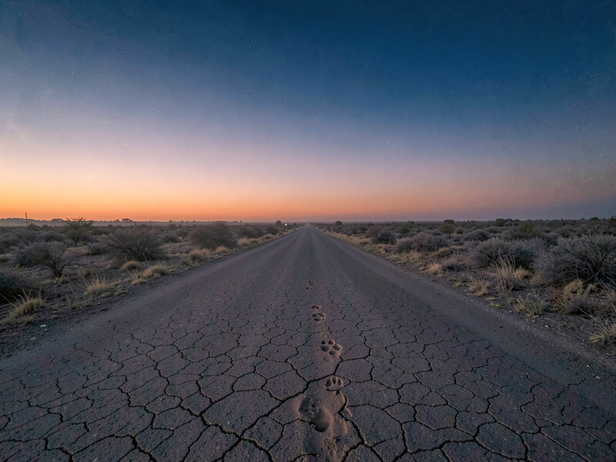
![Dusk Road, Paw Prints Lead]()
Dusk Road, Paw Prints Lead
Image credit : AI
The vast scrubland at dusk, a single set of paw prints in the dust. This scene evokes the mystery of how dogs find their way home.
The limits, and when a lost dog needs human help
Most lost dogs do not find their way home. The documented cases survive precisely because they are exceptional. A dog separated from its owner in a city it has lived in for three years is in a different situation from a dog lost in an unfamiliar district during a road trip. Stress, traffic, injury, and disorientation work against the dog's navigational systems. Research from the American Society for the Prevention of Cruelty to Animals suggests that lost dogs are most often recovered through direct human action, someone finding the dog and contacting the owner, rather than the dog navigating home independently. If a dog goes missing, the practical steps matter more than waiting: filing with local shelters, posting in area groups, and checking the surrounding streets in the first 24 hours. Microchipping is the single most reliable way to close the loop when someone finds the dog. The nose and the magnetic sense are real, but they work best when the dog is calm, uninjured, and in familiar territory. A dog that is panicked or hurt needs someone to find it, not a navigation system to carry it home.