The cat was fine in the old flat. Calm, routine, entirely herself. Three days after the move she was gone, slipped out of a window left ajar while boxes were still being unpacked. Neighbours two streets away found her a week later, walking in the direction of the old address. This is not a rare story. It is a predictable one, and the mechanism behind it is worth understanding before the boxes come out.
A cat's home is a place, not a family
Cats form attachments to territory in a way dogs typically do not. A dog's social bond is primarily with the people it lives with. A cat's sense of security is built around a mapped physical space: the corner where the afternoon light falls, the smell of the walls, the sound the pipes make at night, the routes between sleeping spots and food and the window that faces the right direction. When that space disappears, the cat does not grieve the loss abstractly. It experiences a concrete absence of every landmark that told it where it was safe.
This is why a cat that seemed perfectly settled can become agitated, silent, or escape-focused in a new home. The new flat is not yet mapped. The old one still is. The pull toward the old address is not stubbornness. It is the most direct route back to the only place the cat's internal map says is home.
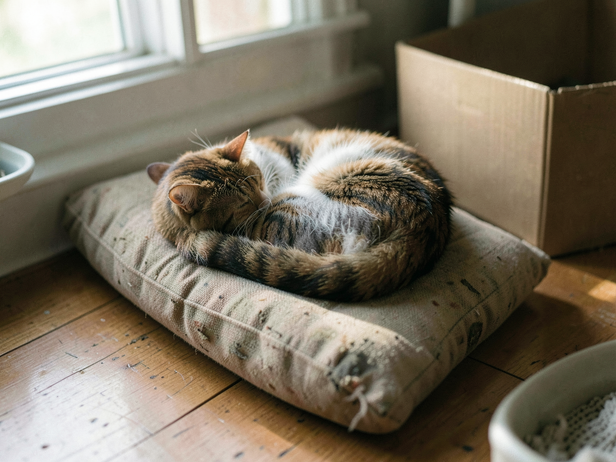
![Cat on Worn Cushion]()
Cat on Worn Cushion
Image credit : AI
My cat settles into a new home, a familiar cushion offering comfort. Navigating a new space is a journey.
How cats navigate over distance
The research on feline navigation is genuinely interesting without being fully resolved. Cats have been documented returning to previous addresses over distances that would require more than simple memory of a route. The leading explanations involve a combination of olfactory mapping, cats build detailed scent maps of familiar territory, and a possible sensitivity to the Earth's magnetic field, which may help them hold a directional sense even in unfamiliar terrain.
What this means practically is that a cat lost after a move is not wandering randomly. It is likely moving with intention, and that intention is pointed at the old address. Cats have been found days later at previous homes several kilometres away. The distance varies enormously by individual, by how long the cat lived in the old place, and by how disorienting the move itself was.
The highest-risk window after a move
The first two weeks in a new home are when most post-move escapes happen. The cat has not yet built a new map. Every unfamiliar sound or smell is a potential threat with no known safe retreat. A door left open during unpacking, a window without a latch, a gap behind a fitted cupboard that leads outside, any of these is enough.
Cats that were indoor-outdoor in the old place carry a higher risk than cats kept entirely indoors, because they have a stronger established habit of leaving and returning on their own terms. But indoor cats are not immune. Stress can drive a cat to seek escape from an environment it has not yet learned to read as safe.
The signs that a cat is not settling, hiding for more than three or four days, refusing food, vocalising at night, pressing against doors and windows, are worth taking seriously rather than waiting out. A cat in sustained high stress is more likely to bolt the moment an exit appears. If those signs persist beyond a week, a vet visit is worth making: prolonged stress in cats can tip into physical illness, and a vet can assess whether what you are seeing is adjustment or something that needs support.
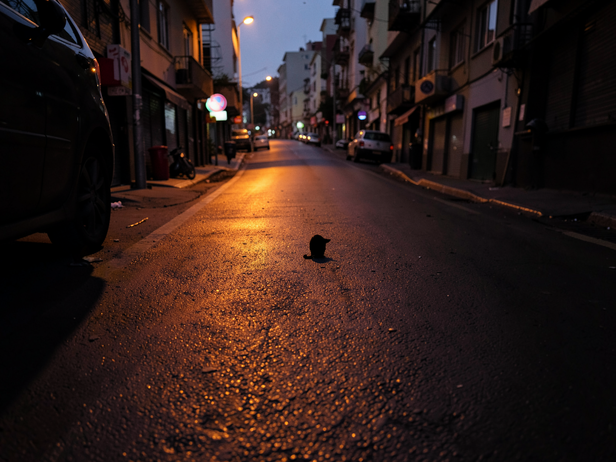
![Dusk Lane, Lone Cat Silhouette]()
Dusk Lane, Lone Cat Silhouette
Image credit : AI
A lone cat silhouette in a dusk lane, perhaps a sign of a cat escape after relocation. The warm street light casts long shadows.
What actually helps in the first two weeks
The goal in the new home is to give the cat something to map as quickly as possible. Confine it to one room at first, ideally the room where its litter tray, food, and a piece of unwashed bedding from the old place are already set up. Familiar smells reduce the threat signal enough for the cat to begin investigating rather than hiding. Expand access to the rest of the flat gradually, one room at a time, once the cat is eating and moving around the first room with some confidence.
Bringing items that carry the old home's scent, a worn cushion cover, a blanket, the cat's own scratching post, gives the new space anchor points the cat can recognise. Pheromone diffusers designed for cats are available from vets and pet pharmacies; the evidence for them is mixed, but some cats respond well, and they carry no risk. Do not wash the cat's bedding before the move.
Keep windows and doors managed carefully until the cat is visibly calm in the new space. In a flat with a balcony, assume the cat will attempt the gap you did not notice. The two-week window is not a rule with a clean end date, some cats settle in days, some take a month. Watch the cat, not the calendar.
If the cat does get out
Search close to the new address first, not the old one, in the first twenty-four hours. A recently escaped cat is likely hiding nearby, frightened, rather than already moving toward the old home. Check under cars, inside drainpipes, behind bins, in any dark enclosed space at ground level. Cats in flight go low and small.
If the cat is not found within a day, contact the residents of the old address and ask them to check their building and surroundings. Alert the local municipal animal welfare office and any nearby animal shelters. Post in neighbourhood groups for both areas, the new address and the old one. A microchipped cat that reaches a shelter or a vet can be traced back to you; if the chip details carry an old address or phone number, update them before the move, not after.