A cat that yowls from the driveway to the vet clinic is not being dramatic. It is responding, quite accurately, to a set of conditions that every instinct it has says are wrong.
Cats are territorial animals in a way dogs are not
A dog's social identity travels with the pack. A cat's identity is anchored to a physical space, the routes it patrols, the spots where it sleeps, the scent marks it has laid down over months. The moment a cat is lifted out of that space and placed in a moving box, it has lost the one thing that tells it where it stands in the world. The car smells of rubber, exhaust, and strangers. Nothing in the environment carries its own scent. From the cat's point of view, it has been dropped into unknown territory with no exits and no information about what comes next. The vocalising is not performance. It is a distress call made by an animal that genuinely does not know whether it is safe.
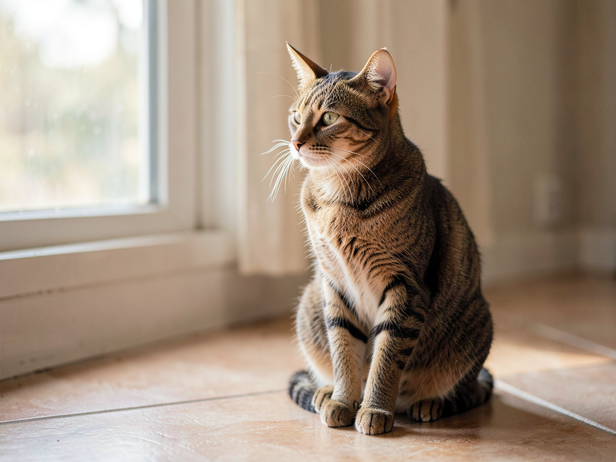
![Tabby Cat Gazes Out]()
Tabby Cat Gazes Out
Image credit : AI
My cat's curiosity peaks as he watches the world outside, perhaps contemplating his next adventure or avoiding car rides.
The vestibular system and motion sickness
Cats have a highly sensitive vestibular system, the inner-ear structures that track balance and spatial orientation. On the ground, this system is exquisitely calibrated: it is why a cat can land on its feet and walk a fence rail without looking down. In a moving car, the vestibular system receives signals it has no frame for. The body says it is stationary; the inner ear says it is accelerating, braking, and turning. The mismatch produces nausea in many cats, particularly kittens whose vestibular system is still maturing. Signs include drooling, repeated swallowing, lip-licking, and vomiting. A cat that seems to calm down after the first few minutes of a trip may simply have exhausted itself; one that vomits consistently on every trip is experiencing genuine motion sickness, not anxiety alone. The two often overlap, and each makes the other worse.
The carrier as a signal of bad things
For most cats, the carrier lives in a cupboard and appears exactly twice a year: before the vet visit and after it. The cat has learned this association with perfect reliability. The moment the carrier comes out, the cat's stress response activates, cortisol rises, heart rate climbs, before the car has even started. This is classical conditioning working exactly as it should, and it means that by the time the cat is inside the carrier and inside the car, it is already at peak distress. The carrier is not the problem; the association is. A carrier left open in the living room, with a familiar blanket inside and occasional treats placed in it on ordinary days, stops being a threat signal. It becomes a known space. This takes weeks, not days, and it needs to happen well before any planned trip.
![Cozy Cat Carrier Ready]()
Cozy Cat Carrier Ready
Image credit : AI
Preparing for a journey, I've made the carrier inviting with a soft blanket and treats to ease cat travel stress.
What you can actually do
Carrier habituation is the single most effective intervention, and it costs nothing except time. Place the carrier in a room the cat uses, leave the door open, and put something that smells familiar inside, a worn T-shirt, the cat's usual blanket. Feed the cat near the carrier, then eventually inside it, with the door still open. Once the cat enters voluntarily and rests there, begin closing the door briefly, then opening it. Short car trips with no destination, around the block and back, break the association between the car and the vet. The cat learns that a car ride sometimes ends at home. Covering the carrier with a cloth reduces visual stimulation and lowers arousal in many cats. Placing the carrier on the seat rather than the boot floor reduces vibration. Synthetic feline facial pheromone sprays, applied to the carrier bedding thirty minutes before travel, have evidence behind them for reducing stress-related behaviour in cats; they are not sedatives and they do not work for every animal, but they carry no risk. If a cat vomits on every trip or shows signs of severe distress, panting, uncontrolled elimination, self-injury against the carrier walls, that is a conversation for a vet before the next journey. Anti-nausea medication and short-term anxiolytics exist for cats and are prescribed based on the individual animal's health and the length of the trip. Do not give a cat any human travel sickness tablet or sedative; several common human antihistamines are harmful to cats, and some are toxic.