Cats earned their place on ships the same way they earned their place in grain stores and temples: by being very good at killing small animals in enclosed spaces. A wooden ship at sea was, from a rat's point of view, an ideal home, dark, warm, full of food, and impossible to leave. From a sailor's point of view, that was a catastrophe waiting to happen.
The real reason: rats and the cargo they destroyed
Rats on a ship did not just eat food. They chewed through rope, gnawed into barrels, contaminated water stores, and spread disease through their droppings. On a voyage lasting months, a rat problem that started small could become a survival problem. Cats were the most reliable solution available. They did not need training, they did not need much food themselves, and they worked through the night when rats were most active. A single cat could keep a ship's hold significantly cleaner than any trap or poison available at the time.
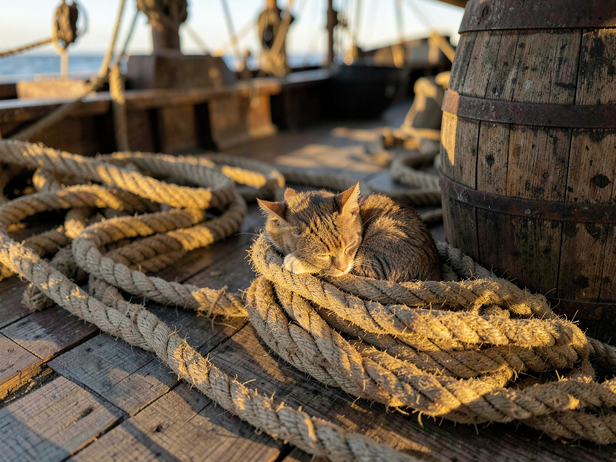
![Sleeping Ship's Cat]()
Sleeping Ship's Cat
Image credit : AI
A ship's cat, a vital part of maritime tradition, rests on deck. This feline guardian embodies the spirit of the sea.
How cats got onto ships in the first place
The domestication of cats is closely tied to the rise of grain storage in the ancient Near East. Wherever humans stored food in bulk, rats followed, and cats followed the rats. Sailors loading grain into a ship's hold were, in effect, recreating the same conditions. Egyptian, Phoenician, Greek, and Roman sailors all carried cats on trading vessels. By the time European maritime trade expanded in the medieval period, a ship's cat was standard. The practice was not a quirk of one culture, it appears independently across seafaring traditions because the problem it solved was universal.
Superstition layered on top of a practical truth
Sailors are famous for superstition, and cats accumulated a great deal of it. A cat that fell overboard was considered an omen of storms. A cat that walked toward a sailor was good luck; one that walked away was bad. Black cats were considered lucky at sea in British maritime tradition, even as they attracted suspicion on land. Tortoiseshell cats were prized on Japanese fishing boats. These beliefs did not create the cat's role on ships, that role already existed for practical reasons, but they reinforced it and gave sailors a cultural framework for valuing an animal that was already earning its keep. The superstition and the utility ran together for centuries.
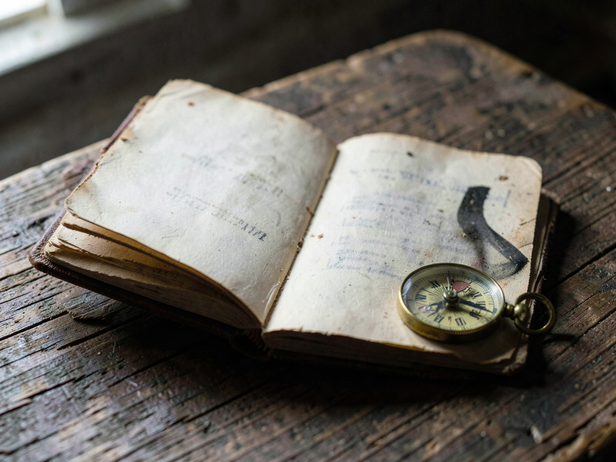
![Aged Logbook and Compass]()
Aged Logbook and Compass
Image credit : AI
I capture the essence of maritime tradition with this aged logbook and compass, a nod to the history of ship's cats.
Famous ship's cats and what they tell us
Several ship's cats are well documented. Trim, a black-and-white cat who sailed with the British navigator Matthew Flinders during his circumnavigation of Australia in the early nineteenth century, is among the most recorded. Flinders wrote about Trim with genuine affection, describing his character and his habits at sea. Simon, a cat who served aboard HMS Amethyst during the Yangtze Incident in 1949, was officially awarded the PDSA Dickin Medal, the animal equivalent of a military honour, for maintaining crew morale under fire and continuing to deal with the ship's rat problem during a prolonged and dangerous standoff. These are not invented stories. They are documented in naval records and historical accounts.
When the practice ended and what replaced it
Modern ships are made of steel, not wood. Cargo is sealed in containers. Refrigeration replaced open grain holds. The conditions that made rats a constant threat on long voyages no longer exist in the same form, and international biosecurity regulations now restrict animals on commercial vessels. The ship's cat faded as the problem it solved was engineered away. What remains is the record: centuries of logbooks, naval accounts, and sailor memoirs that treat the ship's cat not as a pet or a mascot but as a working crew member who happened to sleep in the sun between shifts. The cats did not know they were part of maritime history. They were just doing what cats do.