Oscar the cat lived in the Steere House Nursing and Rehabilitation Center in Providence, Rhode Island. Over several years, staff noticed he would leave his usual roaming and settle beside specific residents, often within hours of their death. The pattern was consistent enough that nurses began using his presence as an informal signal to call families. A physician at the facility, Dr David Dosa, documented the cases and published an account in the New England Journal of Medicine in 2007, later expanding it into a book. That much is on record.
What the documentation actually shows
Oscar's behaviour was observed and noted by medical staff over an extended period. The New England Journal of Medicine piece was not a controlled study, it was a clinical observation, a case report, but it was written by a practising physician describing a real pattern in a real facility. The number of correctly predicted deaths grew over the years of observation. This is not anecdote in the casual sense. It is systematic clinical observation, which is a legitimate form of evidence, particularly for a behaviour that cannot be studied in a laboratory.
![Morning Study Still Life]()
Morning Study Still Life
Image credit : AI
A quiet moment of reflection, perhaps contemplating animal behaviour in hospice care.
What cats can plausibly detect
The honest answer is that no one has isolated the mechanism, and several are possible. Cats have a highly developed sense of smell. The body undergoes measurable biochemical changes in the hours and days before death, shifts in ketone production, changes in skin chemistry, altered breath composition. Whether a cat can detect these specifically, or whether Oscar was responding to something else entirely, reduced movement, changed breathing patterns, quieter rooms, the behaviour of nursing staff, has not been tested. All of these explanations are consistent with what was observed. None has been ruled out. Cats also spend a great deal of time in environments that reward them for learning subtle cues. A cat who has lived in a ward for years has had thousands of hours to associate particular human states with particular outcomes, even without any conscious learning on his part.
What the story does not prove
Oscar's case does not prove that cats have a supernatural sense of death, that they choose to comfort the dying, or that they understand mortality. These are human interpretations layered onto a behaviour that may have a much simpler explanation. It also does not prove that your cat at home is detecting illness in you, or that a cat sitting close to an unwell family member is a reliable medical signal. A single observed pattern in one animal in one facility, however well-documented, does not generalise to all cats. The story also attracted a great deal of media coverage that went well beyond what the documentation supported, including claims about Oscar's emotional motivations that no observation could establish.
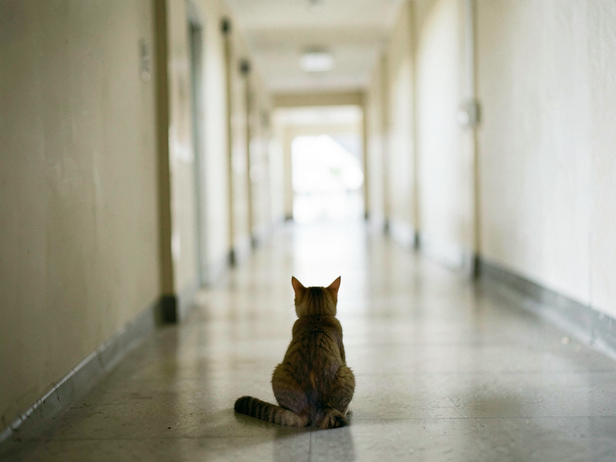
![Cat in sunlit corridor]()
Cat in sunlit corridor
Image credit : AI
A cat's quiet presence in a calm setting, perhaps observing. Can cats sense death?
Why the story still matters
What Oscar's case genuinely illustrates is that animals living closely with humans in particular environments can develop behaviours that are useful and real, even when the mechanism behind them is not understood. Trained medical alert dogs are the clearest parallel, decades of documentation, real clinical utility, and still an incompletely understood mechanism. Oscar was not trained. The behaviour emerged from his environment. That is interesting in its own right, without needing to be more than it is. The story also prompted serious researchers to ask whether animals in care settings pick up on physiological cues that humans miss, which is a legitimate scientific question. The answer is still being worked out. Oscar the cat was real. The pattern was real. The gap between what was observed and what was claimed about it is where careful thinking begins.