Swansea Jack was a black flat-coated retriever who lived near the North Dock in Swansea, Wales, during the 1930s. His owner, William Thomas, noticed early on that the dog had an unusual habit: when someone fell into the water, Jack went in after them. Over roughly six years, he was credited with pulling twenty-seven people from the dock, a number that made him, by any measure, one of the most documented animal rescuers in recorded history.
How the rescues happened
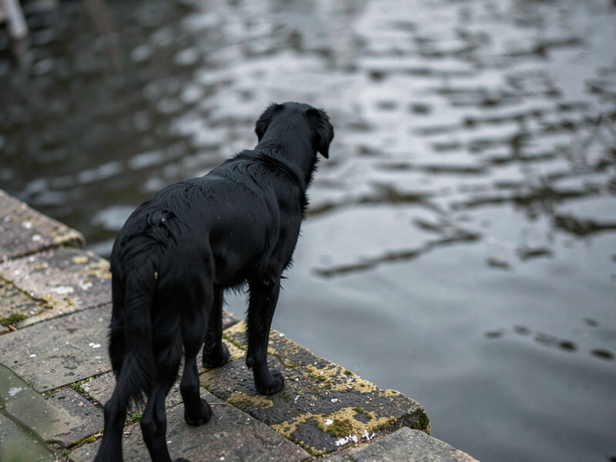
![Retriever's Morning Vigil]()
Retriever's Morning Vigil
Image credit : AI
A loyal flat-coated retriever, reminiscent of Swansea Jack, contemplates the water on a misty morning. A moment of quiet reflection.
Jack was not trained for water rescue. He was a dock dog, which meant he spent his days around the working waterfront, a place where accidental falls were common, swimming ability was uneven, and the water was cold enough to disorient a person fast. The first rescue, documented in 1931, involved a young boy who fell in near the dock. Jack entered the water and pulled him to the bank. The second followed shortly after, involving an adult. By the time local newspapers began covering him, the pattern was established: Jack heard a splash, went in, and brought the person to the edge.
Flat-coated retrievers were bred as working gun dogs, built to retrieve waterfowl in cold open water. They are strong swimmers with a dense, water-resistant coat and a strong retrieving instinct, the same instinct that makes them pick up a thrown ball also makes them go after something moving in water. Whether Jack understood he was saving lives in any cognitive sense is a question the behaviour itself cannot answer. What is documented is that the behaviour was consistent, repeated, and effective.
What the records show
The number twenty-seven comes from contemporary newspaper accounts and the records of two awards Jack received: the bronze medal from the National Canine Defence League (now Dogs Trust) and a silver cup from the Lord Mayor of London. He also won the Bravest Dog of the Year title twice. These are not informal honours, they were awarded by organisations that required documented accounts of the incidents. The awards exist. The newspaper coverage from the period exists. The number itself may carry some inflation across retellings, but the core of the story is verifiable.
Jack died in 1937. A memorial to him stands in Swansea's Riverside Park, and a pub in the city still carries his name. He is one of a small number of animals, alongside Hachiko in Tokyo and Greyfriars Bobby in Edinburgh, whose stories have remained in public memory long enough to be checked against their sources and still hold up.
What the story is actually about
The Swansea Jack story tends to get told as a tale of heroism, which is not wrong, but it flattens what makes it genuinely interesting. A dog with a strong retrieving instinct, living in an environment where people regularly fell into water, expressed that instinct in a way that saved lives. The behaviour and the outcome aligned. That alignment, repeated over years and across strangers, is what made him remarkable, not a single dramatic act, but a pattern.
For anyone who keeps a retriever, or any dog with a strong working instinct, the story points at something worth understanding: those instincts run deep, they are not easily switched off, and in the right, or wrong, circumstances, they express themselves in ways the dog's owner never anticipated. Jack's owner did not teach him to rescue people. The dock, the water, and the breed's history did.