In August 1914, a tiger-striped tabby cat walked up the gangplank of the Endurance and settled in as though the ship had always been his. He belonged to the ship's carpenter, Harry McNish, and McNish's crewmates named the cat after him, Mrs Chippy, because chippy is the old maritime term for a ship's carpenter. The crew discovered their error about his sex early on and never corrected the name. He sailed with Ernest Shackleton's Imperial Trans-Antarctic Expedition into the most hostile stretch of ocean on earth, and the record of what happened to him is one of the more unsettling chapters in the history of polar exploration.
What Mrs Chippy actually did on board
The Endurance carried twenty-eight men, sixty-nine sled dogs, and one cat. Mrs Chippy's role was functional: a ship's cat controlled the rodents that would otherwise work through provisions and rope. He was recorded doing exactly that. He was also documented climbing the rigging, walking the deck rails in heavy weather, a feat that alarmed the crew and impressed them, and falling overboard at least once. The ship turned around to retrieve him. He survived the water and climbed back aboard without apparent distress, which the crew found remarkable enough to record in their diaries.
He was sociable with the men and wary of the dogs, which was sensible given the ratio. Frank Hurley, the expedition's photographer, photographed him. Crew diaries mention him by name. He is not a rumour or a legend attached to the voyage after the fact; he is in the primary record.
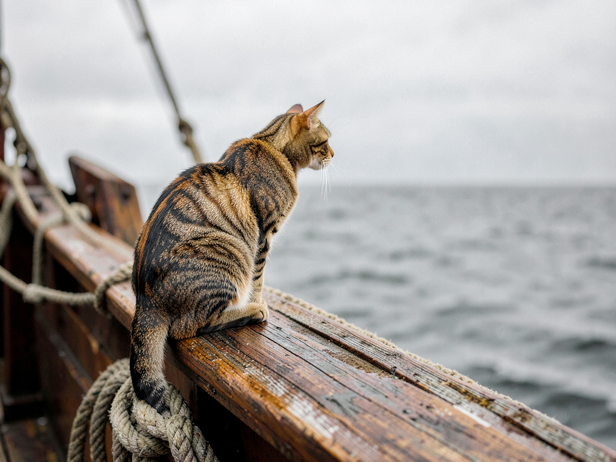
![Tabby watches grey sea]()
Tabby watches grey sea
Image credit : AI
This tabby cat, reminiscent of Mrs Chippy, watches the open sea from the ship's deck.
When the ice closed in
The Endurance became locked in pack ice in January 1915 and never broke free. The ship drifted for months, crushed slowly by the pressure of the ice, and Shackleton eventually gave the order to abandon her. The crew camped on the ice and later took to the lifeboats in one of the most documented survival stories in polar history.
On 29 October 1915, before the ship was abandoned, Shackleton ordered all animals put down. The expedition's five kittens had already been killed earlier in the voyage. Now Mrs Chippy and the weakest of the sled dogs were shot. Shackleton's reasoning was the same logic that governed every decision on the ice: the lifeboats could not carry extra weight, and he could not feed animals he could not carry. It was not a casual decision, and it is not recorded as one. McNish, who had kept Mrs Chippy since before the voyage, never forgave Shackleton for it. The two men's relationship deteriorated further during the escape from the ice, and McNish was one of four men Shackleton declined to recommend for the Polar Medal after the expedition returned.
What the record says about McNish and the cat
Harry McNish's carpentry kept the lifeboat James Caird seaworthy enough to make the 1,300-kilometre open-ocean crossing to South Georgia, the crossing that ultimately saved the expedition. He was not awarded the Polar Medal. Whether Shackleton's decision about Mrs Chippy was part of that calculation is not established in the record; the reasons Shackleton gave were about discipline during the escape. McNish died in Wellington, New Zealand, in 1930, in poverty.
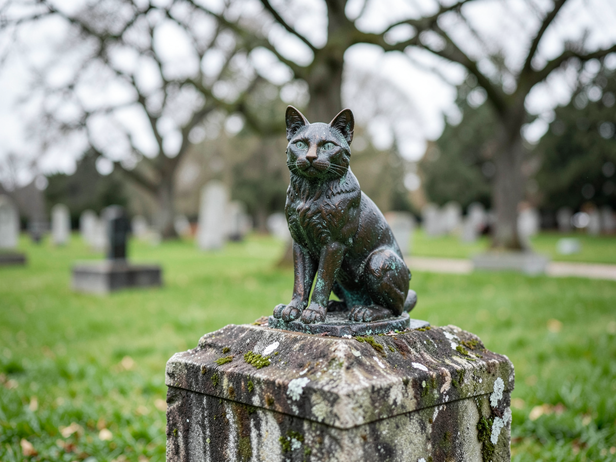
In 2004, the New Zealand Antarctic Society placed a bronze statue of Mrs Chippy on McNish's grave in Karori Cemetery, Wellington. The statue was funded by public subscription. It shows the cat in a walking pose, which is accurate to how he was described on the ship. The grave now carries both names.
![Bronze Cat on Grave]()
Bronze Cat on Grave
Image credit : AI
A bronze cat sculpture, reminiscent of Mrs Chippy Shackleton, guards a weathered grave marker in a peaceful cemetery.
Why this story holds up
The Endurance expedition is one of the most documented voyages in polar history. Hurley's photographs survived. Crew diaries survived. The ship itself was located on the seafloor in 2022, largely intact. Mrs Chippy appears in that record not because anyone was trying to make a point about animals, but because the crew wrote about what they saw and he was there.
What the story actually shows is how animals functioned on long voyages before the age of GPS and freeze-dried provisions, as workers, as company, and as a problem when the logistics turned lethal. McNish's grief was real and lasted the rest of his life. The bronze cat on his grave is not sentiment invented after the fact. It is a correction made seventy-four years late, by people who read the record and thought the original accounting was wrong.