In 1942, a family in Pleasantville, New York, donated their pet to the Dogs for Defense programme. The dog was a mixed-breed shepherd-collie-husky named Chips, and within a year he would be the most decorated war dog in American military history, and then, officially, not decorated at all.
What Chips actually did in Sicily
![Worn Military Keepsakes]()
Worn Military Keepsakes
Image credit : AI
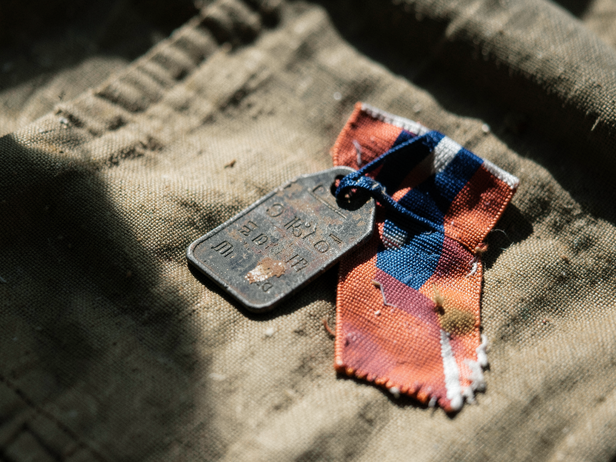
A poignant reminder of service: a military ID tag and campaign ribbon, evoking memories of war dogs and their vital roles.
On 10 July 1943, during the Allied landings on the southern coast of Sicily, Chips was working with his handler, Private John Rowell, when the unit came under fire from a camouflaged pillbox. Chips broke free of his handler and attacked the position. The crew, four Italian soldiers, came out and surrendered. Chips was burned by a gun barrel and grazed by a bullet. He was treated at a field station and returned to duty the same day. Later that night, he helped alert his unit to the approach of ten more enemy soldiers, who were also captured. The sequence of events is documented in US Army records and is not disputed.
The medals, and why they were taken back
Chips was awarded the Distinguished Service Cross, the Silver Star, and the Purple Heart. The citations were genuine. The revocation came from General George Marshall, who ruled that military honours could not, under existing regulations, be awarded to animals. The decision was administrative rather than a judgement on what Chips had done. The medals were taken back. His unit gave him an informal theatre ribbon and a battle star anyway, which had no official standing but stayed with his record.
The argument that followed
![Golden Hour on Elm Street]()
Golden Hour on Elm Street
Image credit : AI
Golden hour light illuminates a quiet American street. This scene evokes a sense of peace, reminiscent of simpler times, perhaps even a moment before the **war dog** era.
The revocation drew criticism at the time, including from the American SPCA, which gave Chips its own Exceptional Courage medal in response. The core disagreement was not really about one dog. It was about whether military service performed by an animal, directed by a human, on behalf of a human objective, carries the same moral weight as service performed by a person who chose it. Supporters argued that Chips acted under fire and that courage does not require a commission. Critics of the award, including the editors of Stars and Stripes, the US military newspaper, argued that giving a dog a Distinguished Service Cross cheapened the honour for the soldiers who earned it. Both positions were sincerely held and neither was obviously wrong.
What the record shows
Chips returned to his Pleasantville family after the war and died in 1946, about six months after coming home. He had served in eight campaigns across North Africa, Sicily, Italy, France, and Germany. The US Army's war dog programme, which ran throughout the conflict, used roughly 10,000 dogs in roles including sentry, messenger, mine detection, and search. Most were returned to their owners after the war; some were not. The programme's records are held at the National Archives. Chips appears in them as a working dog who performed his function and was injured doing it. The medals question is a footnote to that record, not the record itself.
Why the dispute still comes up
Chips has been the subject of a television film, several children's books, and recurring news pieces whenever animal military service is discussed. The story resurfaces partly because it is well documented and partly because the medal revocation gives it a clean dramatic shape: act of courage, official recognition, official withdrawal, informal reinstatement by the unit. That shape is satisfying in a way that most military animal histories are not. The actual question the story raises, what obligations humans have to animals they put in danger for human purposes, tends to get less attention than the medals themselves. It is the harder question, and it does not have a clean ending.