In Bengal, the cat is not just a household animal. It is a vehicle for a goddess. Shashthi, worshipped on the sixth day after a child's birth, and on the sixth day of each lunar fortnight, rides a cat as her vahana, her divine mount. She is the protector of children and mothers, the one invoked when a newborn is fragile and the household holds its breath. That a goddess of such consequence rides a cat, rather than a lion or an elephant, is worth understanding on its own terms.
Who Shashthi is, and what she guards
Shashthi's name comes from the Sanskrit for six, and her worship is tied to the sixth day after birth, when a child was historically most vulnerable to infection and neonatal illness. She is part of the folk tradition of the subcontinent, older than temple Hinduism in many of her forms, embedded in household ritual rather than in formal scripture. In Bengal, she is depicted seated on a cat, holding a child, surrounded by other children clinging to her. She is propitiated by mothers for the health of their children and by women hoping to conceive. Her festivals are domestic, low-key, and persistent across generations in ways that larger public festivals are not.
The belief around her is specific: a woman who mistreats a cat risks Shashthi's displeasure and, with it, harm to her children. This is not a vague moral injunction. It is a direct causal link, held within the tradition, between how a household treats its cat and the wellbeing of its young.
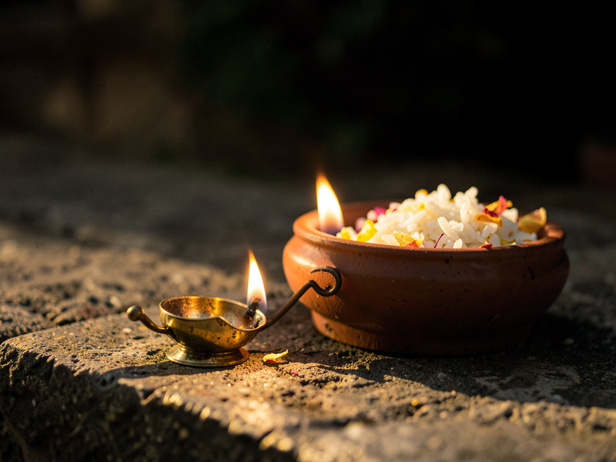
![Golden Hour Oil Lamp Still Life]()
Golden Hour Oil Lamp Still Life
Image credit : AI
The steady flame of the oil lamp illuminates offerings, hinting at ancient traditions and the sacred role of the cat vahana.
Why a cat, and not another animal
The choice of the cat as vahana is not arbitrary, and it is not unique to Bengal. Across South and Southeast Asia, cats appear in proximity to the divine feminine and to the protection of the home. Several explanations circulate within the tradition, and they are worth naming as what they are, beliefs held within a living religious culture, rather than as fact.
One reading connects the cat's nocturnal alertness to the idea of a guardian that never sleeps. A cat in a household watches the dark in ways a dog, which sleeps heavily, does not. Another reading points to the cat's association with fertility and with the protection of grain stores, a cat that hunts rodents protects the food that keeps a family alive. A third reading, specific to the Shashthi tradition, holds that the cat is associated with the theft of children's food and breath in older folk belief, and that Shashthi's riding the cat is a form of divine mastery over that threat: the goddess tames and redirects the animal's dangerous power toward protection.
None of these readings is the single authoritative explanation. They sit alongside each other in the tradition, and different communities weight them differently.
What the cat actually does that made it remarkable
The behaviours that made cats sacred in many cultures are the same behaviours that make them distinctive animals. Cats are crepuscular and nocturnal hunters. Their eyes have a tapetum lucidum, a reflective layer behind the retina, that makes them glow in low light, a quality that has, across many cultures, read as supernatural. They are intensely territorial and return to a home even when removed from it, a navigation ability that remains only partially understood. They are largely silent hunters, appearing and disappearing without warning. They are attentive to infants in ways that have been observed and documented: cats in households with newborns often position themselves near the child, drawn by warmth and sound.
These are not magical qualities. They are biological ones. But they are qualities that, to a household in any century before electric light and veterinary science, would have looked like something beyond the ordinary animal. The goddess who rides this creature is, in one reading, a goddess who commands the inexplicable.
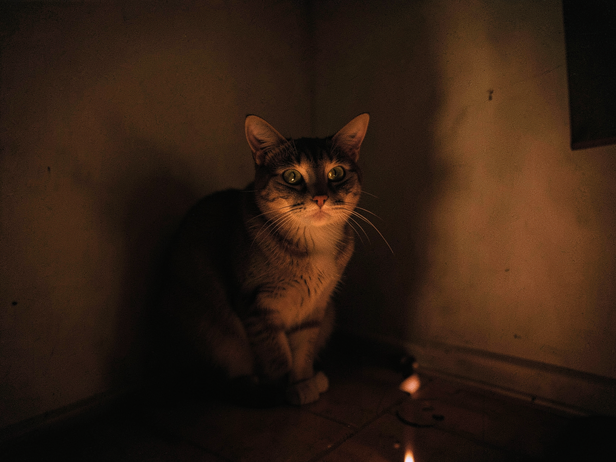
![Feline Vigil in Shadow]()
Feline Vigil in Shadow
Image credit : AI
A cat, a vahana for Shashthi goddess, sits alert, its glowing eyes the sole focus in the warm, deep shadows.
The tradition in practice today
Shashthi puja is still performed in Bengali households, both in West Bengal and in the Bengali diaspora. The rituals are domestic: a clay image or a symbolic representation, an offering of food, a prayer for the children of the house. The cat's role in the iconography persists even in households that keep no cat. In some communities, the ritual includes leaving food for any cat that comes to the door on Shashthi's day.
For a household that does keep a cat, the tradition frames the animal differently than pet culture does. The cat is not a companion in the modern sense. It is a creature with a connection to the sacred, and its treatment is a matter of consequence. Whether or not a family holds the belief literally, the cultural weight of it shapes how the animal is regarded, with a seriousness that has nothing to do with breed, cost, or social signalling.
The science and the belief point in the same direction, from different starting points. A cat in a home is a vigilant, perceptive, behaviourally complex animal. The tradition that made it the mount of a goddess of children was not wrong about what it was looking at. It was using the tools it had to say something true.