In the summer of 1917, a short-legged, brindle-coated stray with a stubbed tail wandered into a training camp at Yale University in New Haven, Connecticut, where the 102nd Infantry Regiment of the United States Army was preparing for deployment to France. The soldiers fed him scraps. Private J. Robert Conroy taught him to salute by raising his right paw to his brow. When the regiment shipped out, Conroy smuggled Stubby aboard the troopship SS Minnesota in a coal bin. That decision would make the dog a figure in military history.
What Stubby actually did on the Western Front
At first, Stubby was a morale animal, something warm and familiar in the mud of the Chemin des Dames sector. But he quickly became operationally useful in ways no one had planned for. Dogs have a sense of smell estimated to be between ten thousand and one hundred thousand times more sensitive than a human's, and Stubby used it. He learned to detect the faint odour of mustard gas before it reached concentrations that triggered human senses, and he would run through the trenches barking to wake sleeping soldiers. In at least one documented instance, this gave the men enough time to put on their gas masks before the cloud arrived.
He also developed a habit of moving into no man's land after bombardments to find wounded soldiers. Dogs orient to sound and smell in ways that cut through the visual chaos of a battlefield; Stubby would stay with a wounded man and bark until stretcher bearers located them both. His handlers reported he could distinguish English-speaking voices from German ones, a plausible behaviour, since dogs are sensitive to phonetic patterns in speech they have been exposed to repeatedly.
The spy incident, which is the most dramatic story attached to Stubby and the one most often questioned, is recorded in contemporary military reports. A German soldier entered the American trenches, apparently to map their layout. Stubby detected him, chased him, and bit into the seat of his trousers, holding on until soldiers arrived. The account appears in the regimental records and in Conroy's own later testimony. It is the basis on which Stubby was informally promoted to sergeant by the men of his unit, a rank the army never formally conferred but never formally disputed either.
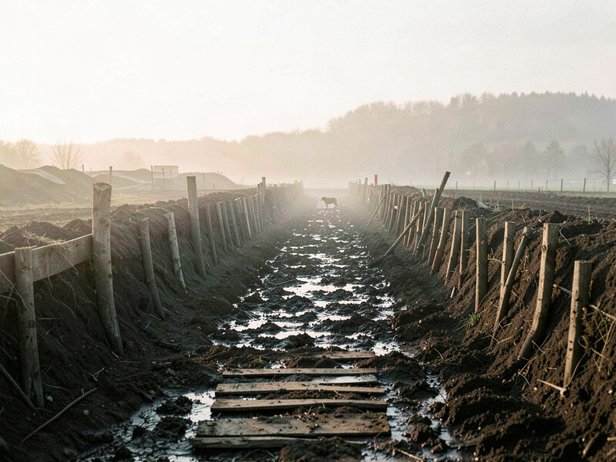
![Dawn Over WWI Trenches]()
Dawn Over WWI Trenches
Image credit : AI
A lone dog, a silent sentinel, surveys the dawn over WWI trenches. A true story of dogs in war.
The injuries and the coat of honours
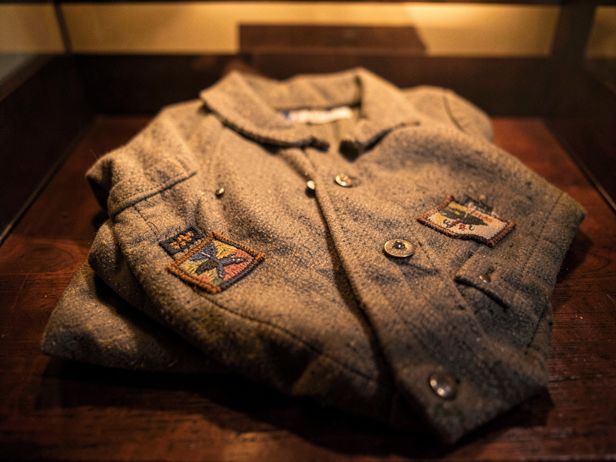
Stubby was wounded twice. In one engagement he took shrapnel to a foreleg; in another, he was caught in a gas attack that damaged his respiratory tissue before he could clear the area. Both times he was treated in field hospitals alongside the men, and both times he returned to the front. The women of a French town he had helped defend sewed him a chamois coat on which his medals and unit patches were pinned as the war progressed. By the armistice in November 1918, the coat carried a Yankee Division YD patch, a wound stripe, three service stripes, and several unit citations.
After the war, Conroy brought Stubby back to the United States. He met three sitting presidents, Woodrow Wilson, Warren G. Harding, and Calvin Coolidge. He became the mascot of Georgetown University's football team, where Conroy was studying law, and he led the team onto the field at halftime for years. When Stubby died in 1926, the Associated Press ran an obituary. His remains were preserved and are held at the Smithsonian Institution's National Museum of American History in Washington, D.C., where they can be seen today.
What his story tells us about dogs and soldiers
Stubby was not the only animal to serve in the First World War. Horses, mules, carrier pigeons, and dogs were all used by multiple armies. The British Army alone deployed over one hundred thousand horses on the Western Front. Dogs served as messengers, sentries, and casualty locators across French, German, British, and American units. What made Stubby unusual was not his species or his role but the degree to which he was documented, in regimental records, in press coverage, and in the personal testimony of the men who served with him.
The behaviours attributed to him, gas detection, casualty location, distinguishing friend from enemy by voice, are consistent with what is known about canine sensory capability and learning. Dogs trained for search-and-rescue work today use the same olfactory sensitivity Stubby appears to have applied without formal training. The difference is that modern dogs are taught through structured reward-based conditioning; Stubby learned by living in the environment and being rewarded, informally, by the attention and food of the soldiers around him. The mechanism is the same.
![Worn Chamois Coat Display]()
Worn Chamois Coat Display
Image credit : AI
Examining a WWI Western Front dog mascot's coat, rich with history and subtle wear.
A note on what is documented and what is legend
Stubby's story has accumulated embellishments over a century of retelling. Some accounts give him a specific gas-attack date that does not match regimental records. Some credit him with more battles than the seventeen his unit actually fought. The core facts, his presence with the 102nd Infantry, his gas-warning behaviour, his wound history, his post-war life with Conroy, and his current location at the Smithsonian, are all verifiable against primary sources. The spy incident is documented in contemporary records, though it has the quality of a story that improves with retelling.
For anyone visiting the Smithsonian, Stubby is displayed in the Price of Freedom exhibition. His chamois coat, with its accumulated medals and patches, is intact. He is mounted in a standing pose, which is either dignified or slightly melancholy depending on your disposition toward taxidermy. Either way, he is there, and the coat is real, and the records exist. That is more than most soldiers from that war left behind.
A stray with no papers and no breed name ended up better documented than most of the men who served alongside him. The 102nd Infantry returned home. Conroy became a lawyer. Stubby became a museum exhibit. The gas attacks he warned against killed thousands of soldiers in other sectors that winter. The distance between those two facts is where his story actually lives.