Some animals attach themselves to a place. Owney attached himself to the mail. A small, rough-coated terrier mix, nobody recorded his exact breed, he turned up at the Albany, New York post office sometime around 1888, apparently drawn by the smell of the mailbags. Postal workers let him stay. When a mail sack was loaded onto a Railway Post Office car, Owney climbed on with it, and that was how it started.
How a post office dog became a railway dog
Railway Post Office cars were where postal clerks sorted mail in motion, transferring bags at each stop. The cars smelled of canvas and paper and the particular warmth of a working space. Owney found them comfortable. He rode one car, then another, then began moving between routes entirely on his own, transferring between trains the way a seasoned clerk would. Postal workers across the country recognised him and fed him. Nobody turned him off a train.
The Postmaster General of the United States eventually issued an unofficial order that Owney be allowed to ride any mail car he chose. This was not a ceremonial gesture. It was a practical acknowledgment that the dog was already doing it and the postal service had adopted him as its own.
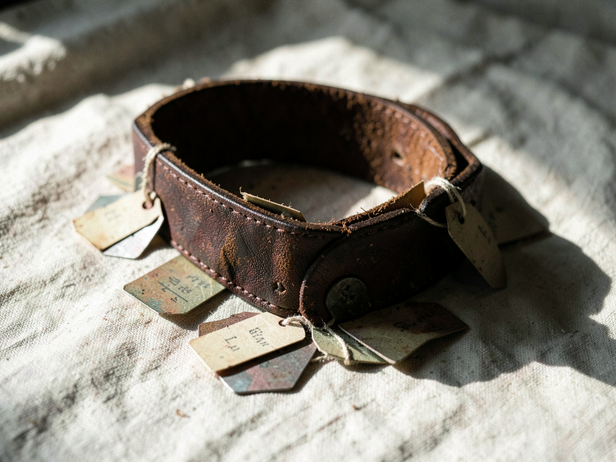
![Postal Dog's Worn Collar]()
Postal Dog's Worn Collar
Image credit : AI
This worn postal collar, once belonging to a famous travelling dog, tells tales of journeys past.
The baggage tags
Owney wore a collar, and postal workers began attaching baggage tags to it, the same paper and metal tags used on the mailbags themselves, to mark each city or route he passed through. The tags accumulated. At one point the collar was so heavy with them that the Postmaster General had a special jacket made so the tags could be distributed across it without weighing down his neck.
By the time his travels were tallied, Owney had covered an estimated 143,000 miles across the continental United States, and in 1895 he crossed the Pacific on a steamship, travelling through Japan, China, and several other countries before returning to the US. The journey was documented partly because postal workers sent telegrams ahead of him, and partly because newspapers picked up the story at various stops.
What the record shows
Owney is not a legend in the sense of a story that grew in the retelling. He is documented. The Smithsonian Institution's National Postal Museum in Washington, DC holds his taxidermied body, preserved after his death in 1897, along with a collection of the original tags. Photographs taken during his lifetime survive. Contemporary newspaper accounts from cities across the country describe his arrivals. The Postal Record, the journal of the National Association of Letter Carriers, covered him repeatedly.
He was not trained to travel. He was not working in any formal sense. He followed the mailbags because he wanted to, and the people who moved the mail let him, and then actively helped him keep going. That combination, an animal's preference and a community of humans who decided to honour it, is what made the journeys possible and what kept the record intact.
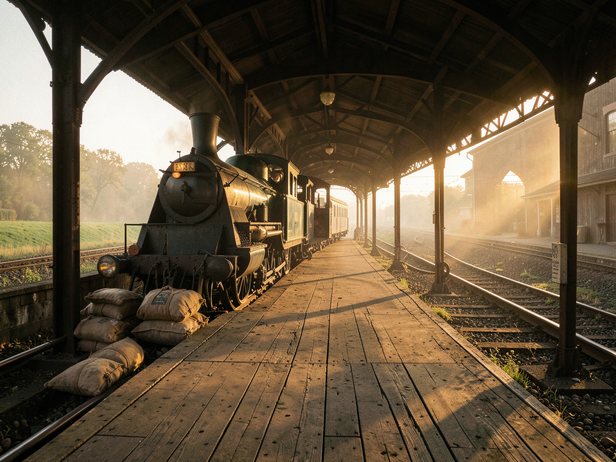
![Golden Hour Train Platform]()
Golden Hour Train Platform
Image credit : AI
I watch the steam engine idle, a familiar sight for Owney the postal dog. The warm amber light paints a scene of adventure and connection.
Why this story holds up
Stories about animals and transport tend to blur over time, acquiring details that improve them. Owney's story is unusual because the documentation is institutional rather than personal. The tags were physical objects that were kept. The telegrams were sent through a federal system. The Smithsonian acquisition in 1911 fixed the physical record before the last people who knew him were gone.
What the record does not tell you is what Owney made of any of it, the noise of the cars, the changing landscapes, the succession of strangers who fed him and attached another tag and sent him on. Animals do not file reports. But the postal workers who rode with him wrote enough that the outline is clear: a dog who found his people in a moving workplace, and travelled with them until he could not anymore. The tags are still there if you want to count them.