Your dog hits the edge of a wetland and every instinct fires at once, the reed smell, the mud, the rustling ahead. What looks like a harmless run through open ground is, from a bird's perspective, a predator moving at speed through a space where eggs sit in shallow scrapes and exhausted migrants are trying to eat enough to survive the next leg of a journey that may span thousands of kilometres.
What ground-nesting birds are actually doing in that grass
Several species that breed in or near Indian wetlands, pratincoles, lapwings, sandpipers, and various waders, nest directly on the ground or in low vegetation. The nest is often nothing more than a shallow depression lined with a few plant fibres, placed where the bird can see approaching threats and take off fast. That strategy works against most natural predators, which move slowly and predictably. A dog running at full speed, nose down, covers fifty metres in seconds. The bird flushes before the dog is even close, and the nest, eggs or chicks, is left exposed. Exposed eggs chill quickly in the shade or overheat in direct sun. Chicks that scatter may not find their way back. A single flush event can end a clutch. If the dog returns, or if other dogs follow the same path over days, the adults may abandon the site entirely.
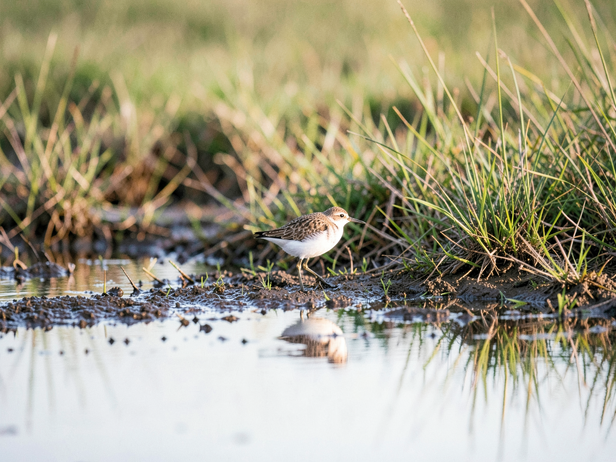
![Shorebird's Morning Reflection]()
Shorebird's Morning Reflection
Image credit : AI
A shorebird pauses at the water's edge, a moment of peace before the day's activities. Responsible travel ensures these habitats remain undisturbed for migratory birds.
Why migratory birds are especially vulnerable at stopovers
Wetlands along India's major flyways, the Central Asian Flyway passes through Rajasthan, Gujarat, and the Indo-Gangetic plain, function as fuel stations. A bar-tailed godwit or a common sandpiper arriving after a long overwater crossing has burned through most of its fat reserves. It needs to feed continuously for hours or days before it can move on. Every flush, every moment it takes to the air because something alarmed it, costs energy it cannot easily replace. Research on shorebird energetics shows that repeated disturbance at a stopover can leave birds in energy deficit by the time they leave, reducing their survival odds on the next leg. The bird that looks like it is just standing in the shallows is working. The dog that charges through the shallows, even briefly, can disrupt that work for the rest of the day as the flock resettles repeatedly.
The mechanism is disturbance, not attack
Most dog owners watching their pet run through a wetland see no harm done, no bird caught, no nest destroyed that they can see. The damage is subtler. Disturbance ecology distinguishes between lethal and non-lethal effects. A dog that never catches a bird still imposes a cost every time it causes a flush: energy spent on escape, time lost from feeding, and, for nesting birds, the thermal and predation risk to unattended eggs. Studies on waterbird colonies show that even brief, repeated human-with-dog disturbances reduce nest success rates compared to undisturbed sites. The dog does not need to be aggressive. Its presence alone, the size, the speed, the unpredictability, is enough to trigger the alarm response in species that evolved to treat any fast-moving ground predator as a threat.
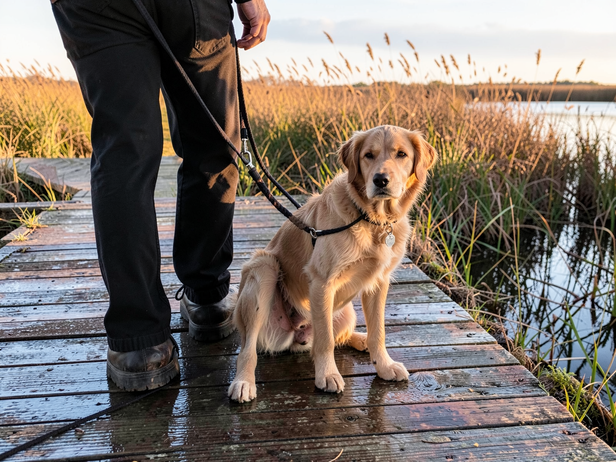
![Calm Dog on Wetland Path]()
Calm Dog on Wetland Path
Image credit : AI
A dog on a lead enjoys a peaceful moment on a wetland boardwalk, a reminder of responsible travel with pets.
What a wetland visit with a dog can look like instead
Keeping a dog on a lead is the single most effective change. A leashed dog walking at human pace on a defined path causes a fraction of the disturbance of the same dog running free. Stay on marked trails where they exist; the vegetation on either side is doing ecological work. Keep distance from reed beds, mudflats, and open grassy margins during the breeding season, broadly speaking, the warmer months for resident species, though timing varies by location. During peak migration, the same margins are critical for feeding birds, so the principle holds year-round. If a bird alarm-calls, raises its wings, or runs ahead of you, you are already too close, move back and give it room to settle. This is not about banning dogs from natural spaces. It is about the difference between a dog that moves through a habitat and one that disrupts it.