A thirty-kilometre-per-hour collision throws an unrestrained ten-kilogram dog forward with the force of roughly three hundred kilograms. That number is not a scare tactic, it is basic physics, and it applies to every unsecured dog on every back seat on every expressway between Delhi and Gurugram. The three main restraint options, a crash-tested harness, a secured crate, and a seat belt tether, each solve a different part of the problem. Choosing between them is less about preference and more about understanding what each one actually does.
What an unrestrained dog experiences in a car
Dogs do not brace for impact. In a sudden stop, they become projectiles, a risk to themselves, to passengers, and to the driver whose reflex is to reach out and catch them. Beyond crashes, an anxious dog moving freely between seats is a distraction that creates the conditions for the crash in the first place. Even on a calm drive, a dog hanging its head out of a fully open window is at real risk from road debris, insects, and the sudden lurch of a lane change. Restraint is not about making the journey unpleasant. It is about keeping the dog in the same physical state at the end of the trip as at the start.
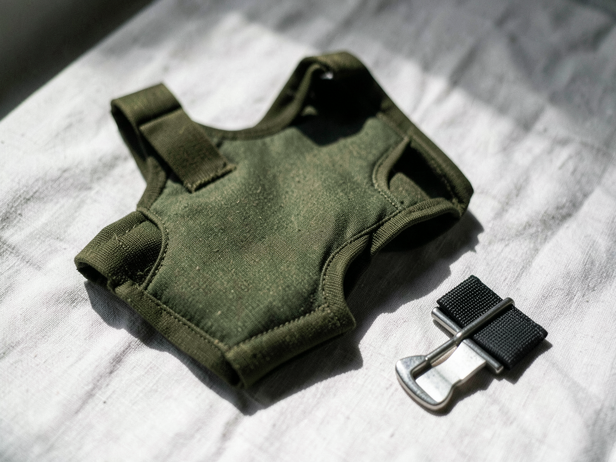
![Olive Dog Harness & Tether]()
Olive Dog Harness & Tether
Image credit : AI
Ensuring dog travel safety with this secure harness and tether. Essential for dog car safety in India.
The crash-tested harness
A harness attaches to the car's existing seat belt anchor via a short tether. The dog sits or lies on the back seat and can shift position within a small range, which most dogs find more comfortable than total confinement. The critical word in the product description is crash-tested. A harness that has been through a standardised crash test, the Centre for Pet Safety in the United States runs one of the few recognised programmes, is designed to distribute impact force across the dog's chest and shoulders rather than the neck. A standard walking harness clipped to a seat belt tether is not the same thing. In a real collision, a standard harness can concentrate force on the spine or allow the dog to be thrown forward until the tether snaps taut, which causes its own injury. For medium to large dogs who travel regularly and are already comfortable wearing a harness, a crash-rated model is often the most practical daily option. It requires no boot space, fits most cars without modification, and lets the dog settle naturally. The limitation: a dog who is already anxious in the car and moves constantly will fight the tether, which adds stress rather than reducing it.
The secured crate
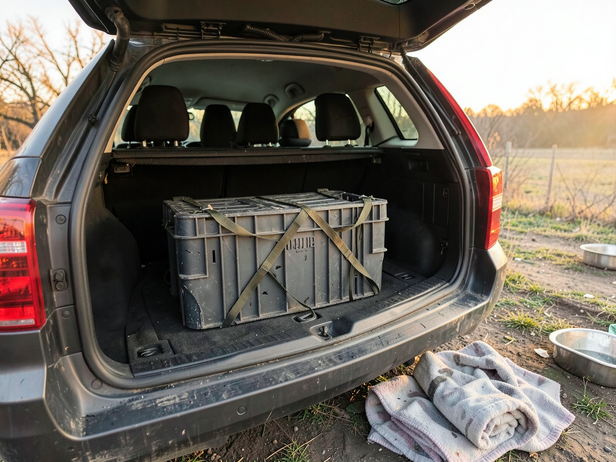
A rigid crate, metal or hard plastic, bolted or strapped into the boot of an SUV or estate car is the closest thing to a controlled safety cell. The crate absorbs and redirects impact energy, and a dog inside it cannot become a projectile. This is the standard used in professional dog transport and in working dog vehicles. For anxious dogs, a crate also provides a familiar enclosed space that many find genuinely calming, particularly if the dog has been crate-trained at home and associates it with rest rather than punishment. The practical constraints in an Indian context are real. A rigid crate large enough for a Labrador takes up most of a Fortuner's boot. In a hatchback or a sedan, a crate that fits a medium dog is often not large enough for the dog to stand and turn, which creates its own welfare problem on longer trips. Soft-sided crates are not a safety solution, they offer no structural protection in a collision. If you use a crate, it must be secured to the vehicle with straps or anchor points so the crate itself cannot slide or tip. A loose crate is only marginally safer than no crate.
![Secured Dog Crate in SUV]()
Secured Dog Crate in SUV
Image credit : AI
I've secured my dog's crate for safe travel. This is a key part of dog travel safety tips for Indian cars.
The seat belt tether alone
A seat belt tether, a short strap that clips from the dog's collar or harness to the seat belt buckle, is the most common restraint sold at pet stores in India and the least protective of the three options. Clipped to a collar, it transfers all collision force directly to the dog's neck and cervical spine. Clipped to a standard walking harness, it is somewhat better but still not crash-rated. Used as the only restraint, a tether is a partial measure. It keeps the dog from climbing into the front seat and reduces driver distraction, which has real value. As a crash protection device, it is not sufficient on its own. If a tether is what you have right now, use it, it is better than nothing, but treat it as a temporary arrangement while you assess a harness or crate.
Matching the option to your dog and your trip
Size, temperament, and trip length all affect which restraint works in practice. A small, calm dog who travels frequently does well in a crash-rated harness on the back seat. A large, anxious dog who has been crate-trained at home may genuinely prefer the crate on longer journeys, provided the crate is large enough for the dog to stand, turn, and lie down. A dog who has never been in a car before needs acclimatisation to any restraint before the first real trip, putting a harness on a dog for the first time in a moving vehicle and expecting calm is not realistic. Whatever you choose, introduce it at home first, then in a stationary car, then on short drives, before using it on a highway. Stops every two hours on longer trips give the dog a chance to move, drink, and relieve itself, this is not optional on drives over three hours. If your dog shows sustained distress, panting, drooling, vomiting, or attempting to escape the restraint, that is a conversation to have with your vet before the next trip, not something to push through.
The harness, the crate, and the tether each address a real part of the problem, and none of them works if the dog has never been taught to tolerate it. The restraint that keeps a dog safe is the one the dog will actually stay in, which means the decision starts at home, not in the car park before a long drive.