The first walk in a new neighbourhood is rarely pleasant. Your dog stops every few metres, nose pressed to the ground, trying to decode a place that carries none of the smells it knows. You are reading Google Maps. Neither of you is really walking.
That disorientation is normal, and it passes faster than most owners expect, but only if the walks that follow it are structured around what the dog actually needs, not just what is convenient for the schedule.
What your dog is doing on an unfamiliar street
Dogs map their world through scent, not sight. A familiar route is one where the dog knows which corner the stray marks, which gate has a German Shepherd behind it, and which patch of grass is worth investigating. In a new city, none of that information exists yet. The dog is not being difficult when it pulls in every direction or freezes at a junction, it is collecting data.
This means the first two or three weeks of walking in a new place will be slower and more mentally tiring for your dog than the same distance back home. A 20-minute walk that involves constant sniffing is more exhausting than a brisk 40-minute walk on a known route. Plan for shorter outings and do not push pace until the dog's body language settles: ears relaxed, tail at a neutral height, fewer hard stops.
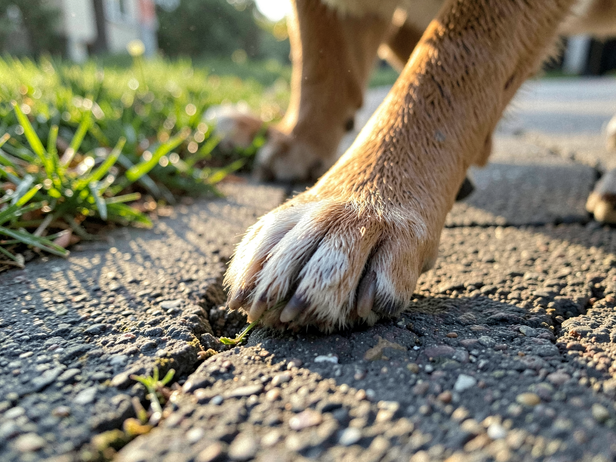
![Paw and Nose Detail]()
Paw and Nose Detail
Image credit : AI
My paw touches the ground as I explore new dog walking routes in this city.
How to scout a route before committing to it
Walk it alone first, without the dog. What you are looking for is not just distance but texture: where does the footpath narrow to nothing, forcing you onto the road? Where do stray dogs tend to gather? Is there a stretch where traffic noise peaks, a flyover, a main road crossing, a construction site? Dogs with noise sensitivity can have a setback from one bad crossing that takes days to undo.
In Indian cities, this scouting matters more than it might elsewhere. Footpaths are inconsistent, street dog presence varies sharply by pocket and time of day, and the same lane that is quiet at 6 a.m. can be a two-wheeler corridor by 7:30. Find the window, not just the route.
Once you have two or three candidate routes scouted, introduce them one at a time. Run the same route for four or five days before introducing the next. Repetition is not boring for a dog, it is how a route becomes familiar, which is what makes it feel safe.
Reading the route through your dog's signals
A route that looks fine on a map can be wrong for your specific dog. Watch for what the dog does in the first ten minutes: if it is scanning constantly, ears forward, body tense, the environment is too stimulating for a settling walk. That route might work later, once the dog is more anchored in the new place, but it is not the right starting route.
A good early route has moderate foot traffic, some sniff-worthy greenery, a park edge, a strip of grass, even a row of trees, and at least one section where the dog can move without being startled. If your building has a compound or a small garden, that is the first anchor. Build outward from there rather than starting with the widest loop you can manage.
Notice where the dog relaxes its pace and chooses to linger. Those spots become landmarks in the dog's internal map of the new neighbourhood. Over time, a walk that visits two or three of those anchors will feel more familiar to the dog than a longer walk that skips them.
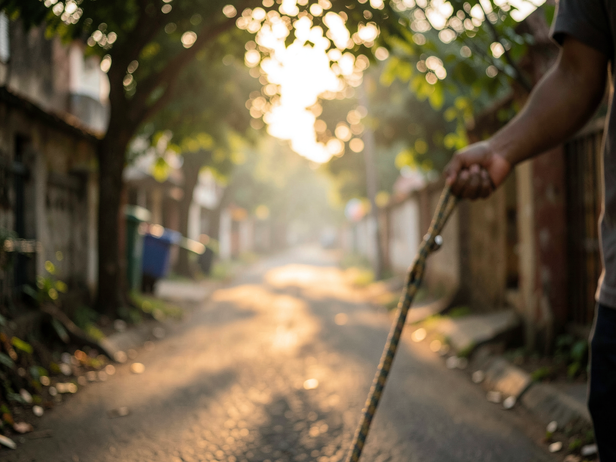
![Dawn Walk, Indian Lane]()
Dawn Walk, Indian Lane
Image credit : AI
Beginning my dog's adjustment after relocation on a peaceful Indian lane at dawn.
Handling street dogs and other dogs on new routes
Street dog dynamics vary enormously by area and are something you cannot fully predict from a scouting walk. In some pockets, the local dogs are habituated to pet dogs passing through and will watch without reacting. In others, a pet dog on a leash triggers territorial behaviour.
The practical approach: keep your dog on a short leash when passing a cluster of street dogs, do not let your dog make direct eye contact or pull toward them, and keep moving at a steady pace. Stopping or turning back sharply can escalate tension. If a street dog approaches and your dog is reactive, step between them, face the street dog calmly, and continue moving.
For encounters with other leashed dogs in the neighbourhood, the first few weeks are not the time to force greetings. Your dog is already processing a lot. A parallel walk, both dogs moving in the same direction with some distance between them, is a lower-pressure way to begin building familiarity with neighbourhood dogs than a face-to-face on-leash meeting.
Building a routine that settles the dog into the new place
Consistency of time matters as much as consistency of route. Dogs orient partly by circadian rhythm, they expect the walk at roughly the same hour each day. In the first month in a new city, keeping the walk time fixed gives the dog one reliable anchor even when everything else has changed: the smells, the sounds, the layout of the home.
Two walks a day at fixed times, on two or three rotating routes, is enough structure for most dogs to begin feeling at home within three to four weeks. The signs that the dog has settled into the new neighbourhood are the same signs it showed on familiar routes back home: it pulls less at the start, it has preferred sniff spots it returns to, and it walks with its body relaxed rather than scanning.
A dog that is still showing high anxiety, refusing to walk, trembling, excessive vocalisation, or loss of appetite, beyond the first two weeks in the new place is telling you the adjustment is harder than normal. That is a conversation worth having with a vet, because anxiety in dogs has physiological dimensions that go beyond what a better walking route can fix.