A reactive dog on a road trip isn't a problem to be solved before you leave, it's a variable to be managed at every stop along the way. The dog who lunges at passing vehicles or barks at a stranger who gets too close doesn't stop being reactive because you're 400 kilometres from home. What changes is the environment, and that's exactly what you can control.
What makes a rest stop hard for a reactive dog
Reactive dogs aren't unpredictable, they're predictable in the wrong direction. Most react to specific triggers: unfamiliar dogs, fast-moving people, sudden noise, or being approached without warning. A standard highway dhaba stop or a busy petrol station forecourt stacks several of these at once. Other travellers walk over without asking. Children run. Truck horns go off. A dog on a leash with nowhere to retreat has one option left, and it's the one that embarrasses you and frightens everyone nearby.
The physiological piece matters here. A dog that has been in a moving car for two or three hours is already mildly stressed, the vibration, the confinement, the visual blur of passing scenery all add low-level arousal. A reactive dog arriving at a chaotic rest stop is not starting from zero. It's starting from elevated, and the threshold for a reaction is lower than it would be at home.
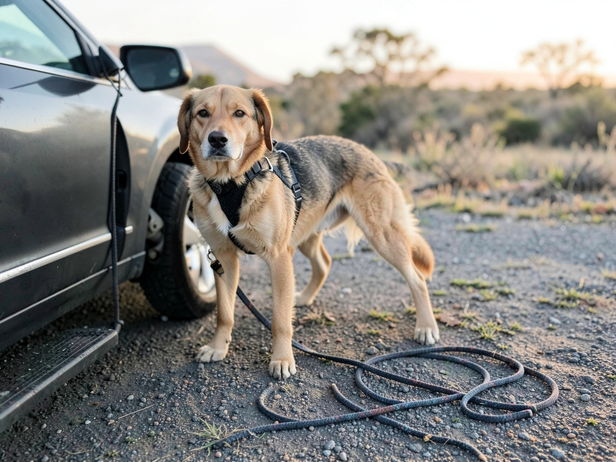
![Calm roadside dog rest]()
Calm roadside dog rest
Image credit : AI
Taking a peaceful break on our road trip, managing my reactive dog on long drives.
How to read a stop before you pull in
Slow down before you commit. Drive past the main entrance and look at the edges. A petrol station with a strip of unused land behind it, a service road that dead-ends into scrub, or a side lane with no foot traffic is worth more than a manicured lawn full of other travellers and their dogs.
Time of day changes everything. The same stop that's chaos at noon can be nearly empty at six in the morning or nine at night. If you're flexible on when you break, build stops around the quiet window rather than the convenient one. On long drives through Maharashtra or Rajasthan, the stretch between towns often has small pull-offs on state highways, not official rest areas, but flat verges with enough room to walk a dog in a circle without another soul nearby.
Look for natural barriers. A parked lorry between your car and the main area, a low wall, a line of trees, anything that breaks your dog's sightline to the trigger reduces the chance of a reaction. A dog that cannot see the other dog doesn't need to react to it.
What to do once you stop
Get the dog out on the far side of the car from any activity. Keep the leash short enough to prevent lunging but loose enough that the dog isn't already pulling against tension, a tight leash communicates your own anxiety straight down the lead. Walk away from the crowd first. Let the dog sniff, eliminate, and decompress before you ask for any obedience.
Bring high-value treats specifically for rest stops. The dog that ignores chicken at home will notice it in a stressful environment, and a few calm seconds rewarded immediately tells the dog that this unfamiliar place produces good things. You're not bribing the dog out of a reaction, you're building a small history of stops that end well.
Keep the stop short. Ten minutes of calm is worth more than twenty minutes that ends in a reaction. A reaction at a rest stop raises the dog's baseline for the next leg of the drive. A calm stop lowers it.
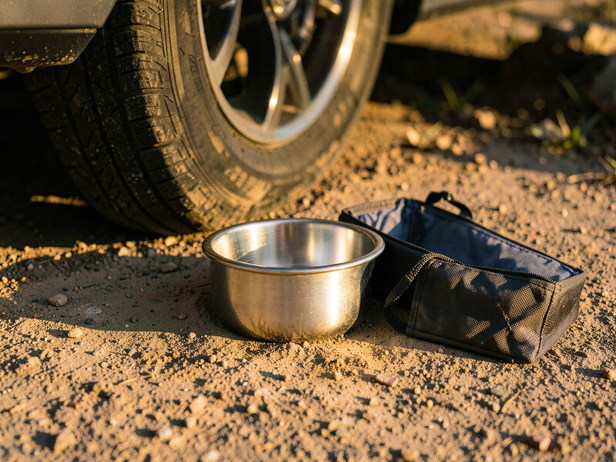
![Roadside Hydration Station]()
Roadside Hydration Station
Image credit : AI
Keeping my reactive dog hydrated on our road trip India highway rest stops is crucial. This setup makes it easy.
Gear that helps
A long line, five to seven metres, gives a reactive dog room to move without the freedom to reach another dog or person. Used in an open space with no other animals nearby, it lets the dog decompress more fully than a standard leash allows. Fold it flat before you put it back in the car so it doesn't tangle when you need it quickly.
A well-fitted harness distributes pressure across the chest rather than the throat. A dog that pulls hard toward a trigger and hits a collar puts strain on its trachea and larynx; the same pull on a harness is uncomfortable but not damaging. A front-clip harness also turns the dog back toward you when it lunges forward, which interrupts the momentum of a reaction without a correction.
A travel water bowl and a small cooler bag with the dog's usual food matter because a hungry, thirsty dog has a lower threshold for everything. Don't skip meals because you're on the road.
When the stop itself goes wrong
If another dog appears and your dog is already reacting, move, don't stand and wait for the other owner to control their animal. Turn and walk in the opposite direction at a normal pace. Running signals panic. A calm, purposeful exit is the fastest way to get below threshold.
If your dog has a history of redirecting onto the leash or onto you during a reaction, that behaviour warrants work with a qualified trainer or veterinary behaviourist before a long trip, not during one. A rest stop is not the place to work on reactivity, it's the place to avoid triggering it. The training happens at home, in controlled setups, over weeks.
A reactive dog that is also showing signs of extreme distress on car journeys, panting heavily, drooling, refusing to settle, vomiting, is telling you something beyond reactivity. That's a conversation with a vet before the next trip, not a problem managed with more treats at the stop.
The road is manageable. It just asks you to do the reading before you pull in, and to keep the stop smaller than your ambitions for it.