Dogs are enthusiastic travellers right up until their body has a quiet disagreement with the elevation. Most owners notice something is off, slower on the trail, less interested in food, breathing a little harder, but cannot name what changed. Altitude is rarely the first explanation that comes to mind. It should be.
What altitude actually does to a dog's body
At higher elevations, the air holds less oxygen per breath. The physiological term is hypobaric hypoxia: the same volume of air delivers less usable oxygen because atmospheric pressure drops as you climb. A dog at 3,500 metres is pulling in roughly 40 percent less oxygen per breath than at sea level. The body responds by breathing faster and the heart working harder to push what oxygen is available to tissues and organs. This is not a malfunction, it is the normal short-term response. The problem is that the response itself costs energy, and a dog that has just spent eight hours in a car and then stepped out at Rohtang or Khardung La has no buffer built up.
Red blood cell production ramps up over days to weeks as the body tries to carry more oxygen per unit of blood. That longer adaptation is what acclimatisation actually is. A weekend trip does not allow for it.
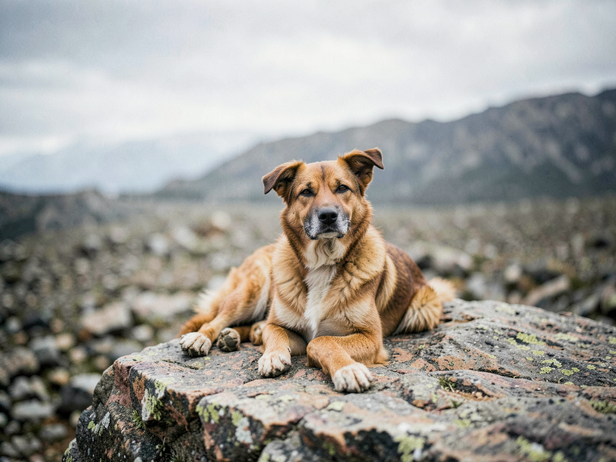
![Mountain Dog's Calm Vigil]()
Mountain Dog's Calm Vigil
Image credit : AI
My mountain trip to the Indian hills is peaceful. I'm watchful on this rocky plateau, enjoying the serene high altitude.
Signs that your dog is struggling
Mild altitude effects in dogs look like: reduced appetite, reluctance to move at the usual pace, more frequent rest stops, shallow or faster-than-normal breathing at rest, and mild lethargy. These are worth watching but not immediately alarming in the first few hours at a new elevation.
The signs that mean stop and get lower, or reach a vet, are different in quality: laboured or noisy breathing that does not settle after rest, pale or bluish gums, persistent coughing or a wet rattling sound in the chest, stumbling or loss of coordination, collapse, or a dog that cannot be roused to interest in anything including food and you. Fluid accumulating in the lungs, called high-altitude pulmonary oedema, is a real risk in dogs at significant elevation, particularly if they have an underlying heart or respiratory condition. It can develop within hours and it requires a vet, not a wait-and-see.
Dogs that carry more risk
Brachycephalic breeds, Pugs, French Bulldogs, English Bulldogs, Shih Tzus, Boxers, already move air through a compromised upper airway at sea level. At altitude, the reduced oxygen supply meets a system that was already working harder than it should. These dogs are poor candidates for high-altitude travel, and the decision to take one above 2,000 metres warrants a specific conversation with a vet before the trip is booked.
Dogs with any diagnosed heart condition, respiratory disease, or severe anaemia face the same compounding problem. Age matters too: a very young puppy and a senior dog both have less physiological reserve than a healthy adult. A dog that has never shown any symptoms may still have a subclinical condition that altitude unmasks. A pre-trip vet check is not overcaution, it is the one piece of information that changes what you should do.
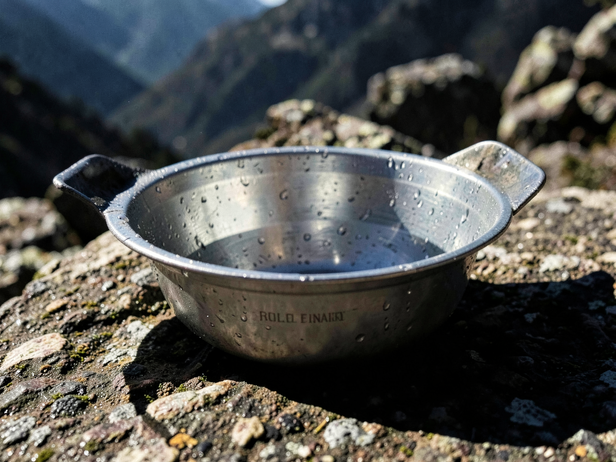
![Dewy Bowl on Stone]()
Dewy Bowl on Stone
Image credit : AI
This dew-kissed bowl on stone reminds me of our dog's mountain trip India, needing hydration.
What you can actually control on the trip
Ascend gradually where the road allows it. Driving from Delhi to Leh over two days via Manali gives the body more time than flying into a high-altitude airstrip and immediately hiking. Plan the first day at elevation as a rest day, not a trek day. Dogs acclimatise better when they are not also managing exertion on top of altitude stress.
Keep water available constantly. Altitude increases respiratory water loss because breathing is faster. Dehydration compounds the effects of low oxygen. Watch urine colour if you can, pale yellow is fine, dark amber is not.
Do not push pace on the trail. Let the dog set it. A dog that sits down mid-trail and does not want to move is not being difficult. It is communicating the only way it can.
Cold is a separate variable at altitude. Mountain temperatures drop sharply after dark and in shade, even when midday feels warm. Short-coated dogs and lean-bodied dogs, Greyhound types, Dobermanns, Indie dogs with little undercoat, lose heat faster than the cold-adapted mountain breeds. A dog shivering at rest is burning calories and energy it needs for other things. A light jacket or blanket matters more at 3,000 metres than it does in a Gurgaon winter.
Never give your dog any human altitude medication without explicit instruction from a vet who knows your dog's weight, health history, and the specific drug. Several commonly used human medicines are dangerous to dogs. The decision about whether any medication is appropriate belongs entirely to a vet.
When to turn back
If a dog shows laboured breathing, blue-tinged gums, a rattling cough, or collapse at any elevation, the right move is to descend immediately and reach veterinary care as fast as the road allows. Do not wait to see if it improves with rest at the same altitude. Descending even 500 to 1,000 metres can make a meaningful difference while you travel toward a vet. In remote mountain areas, know before you go where the nearest clinic is that sees dogs, in many high-altitude regions, that answer is several hours away.
A mountain trip with a dog can be genuinely good for both of you. The calculation is straightforward: know your dog's baseline health, ascend at a pace the body can manage, read what the dog is telling you, and have a plan for when the answer is to come back down.