The vet has done the hard part. Now you have a groggy, sore dog in a cone, a discharge sheet in your hand, and a car in the parking lot. What happens in the next thirty minutes is the part nobody prepares for.
Why the car ride is harder on a post-surgery dog than a normal one
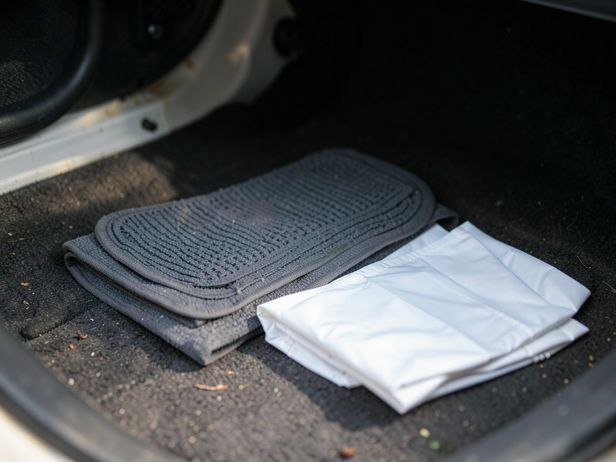
![Car Boot Prepared for Pet Transport]()
Car Boot Prepared for Pet Transport
Image credit : AI
Car boot essentials for transporting a dog post-surgery. Prepared for a safe and clean journey.
A dog coming out of general anaesthesia is still metabolising the drugs. Balance is off. Nausea is common. Pain medication may be active but incomplete. The vestibular system, the inner-ear mechanism that tells the brain where the body is in space, is working against a dog that cannot brace itself normally. Every corner, every pothole, every sudden brake sends a signal the dog cannot process the way a healthy animal would. A dog that would normally ride fine in the back seat is now a patient who needs to stay still.
Surgical sites are also under tension. Sutures and staples are designed for a resting body, not one sliding sideways across a car seat. Even a short trip on a smooth road can cause enough movement to stress a wound if the dog has nothing holding it in place.
Setting up the car before you leave home
Do this before you drive to the clinic, not in the parking lot afterwards.
Line the floor behind the front seats with a non-slip mat or a folded rubber-backed bathmat. Dogs that cannot stand steadily will try to stand anyway, and a slippery surface makes every attempt worse. Put an old bedsheet or a waterproof mattress protector over it, post-surgery dogs sometimes leak from wounds, drool heavily from the anaesthetic, or vomit from nausea.
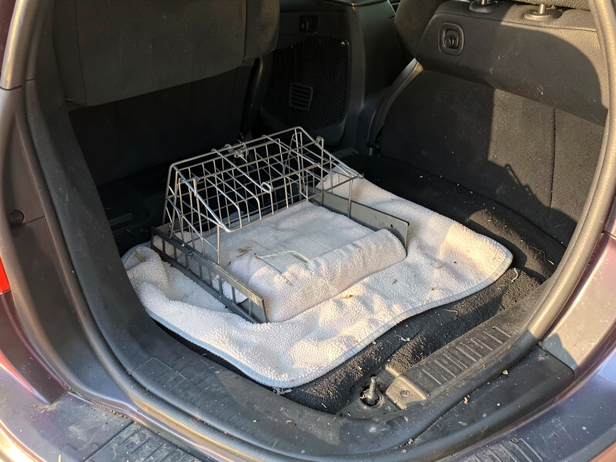
Bring a crate if your dog is crate-trained and the crate fits your car. A crate that is secured so it cannot slide is the safest option for a post-surgery dog because it limits movement in every direction. The crate should be lined with something soft and absorbent. Leave the door open and unlocked so the vet staff can help you load the dog without fuss.
If a crate is not possible, the footwell behind the passenger seat is better than the seat itself for a small dog, lower to the ground, harder to roll off. For a larger dog, the full boot with a fitted boot liner and a dog guard or cargo barrier behind the rear seats keeps the dog from lurching forward if you brake.
Turn the air conditioning on before you collect the dog. Anaesthesia interferes with thermoregulation. A hot car is a real risk.
At the clinic: what to ask before you walk out
![Empty Dog Crate in Car Boot]()
Empty Dog Crate in Car Boot
Image credit : AI
Preparing for a safe dog post-surgery car ride. Crate ready for transport, ensuring comfort and security.
Ask the vet or vet nurse to help you load the dog. This is normal. They do it regularly. Do not attempt to lift a large dog alone, and do not let the dog jump in, a jump lands with the full impact of body weight on a fresh surgical site.
Confirm whether the dog has been given any medication that causes sedation, and how long it is expected to last. This tells you what to expect on the drive and what is not normal. Ask whether there are any positions the dog must not be placed in, some abdominal surgeries have specific post-op positioning requirements.
Ask what counts as an emergency on the drive home: what bleeding looks like if the wound opens, what breathing trouble looks like if the anaesthetic is not clearing properly. Get a number to call if something happens before you reach home. Some clinics will tell you to come straight back; others will direct you to an emergency facility. Know which before you leave.
On the drive itself
Drive slowly. This is not the time to make up time on a highway. Choose the smoothest route, not the fastest one. Avoid roads you know are badly potholed.
Have someone sit in the back with the dog if at all possible. Their job is not to hold the dog down but to monitor: is the dog breathing steadily, is the dog trying to stand, is there any blood visible on the bedsheet. A dog that is vomiting needs its head supported and its airway kept clear.
Do not play music loudly. A dog under anaesthetic has no normal noise tolerance. Keep the car quiet.
If the dog is in a crate, check at red lights by glancing back. If the dog is loose in the boot, pull over somewhere safe if you need to check on it, do not reach back while driving.
Do not offer water on the drive. Most post-anaesthetic dogs cannot swallow reliably for the first hour or two. The clinic will have told you when water is safe to reintroduce.
When to pull over and call the vet
Stop the car and call the clinic or an emergency vet if the dog has a seizure, stops breathing normally, has pale or white gums, is bleeding through the bandage, or cannot be roused. These are not wait-and-see situations. Pale gums in a dog that has just had surgery can indicate internal bleeding and need immediate attention.
Heavy panting alone is common after anaesthesia and is usually not an emergency, but if it is combined with a distended abdomen, restlessness, and retching without producing anything, pull over immediately, this combination in a dog that has had abdominal surgery can indicate a serious complication.
The car ride home is one leg of recovery, not the end of it. Getting the dog into the vehicle safely, keeping it still, and arriving without incident is the whole job. The rest of recovery begins when you walk through your own front door.