Across India, a particular image turns up in unexpected places: a deity walking with four dogs at his heels, a cow behind him, and an eagle overhead. The deity is Dattatreya, one of the most composite figures in Hindu tradition, simultaneously an avatar of Brahma, Vishnu and Shiva. The dogs are not incidental. In the tradition that grew around Dattatreya, they carry a specific meaning that has been interpreted and reinterpreted across centuries of commentary.
Who Dattatreya is, and why the image is unusual
Dattatreya appears in the Mahabharata, the Puranas, and in the devotional literature of the Nath tradition. He is described as an avadhuta, a renunciant so complete that he is beyond the usual categories of purity and pollution that structure orthodox practice. This is why the dogs matter. Dogs in much of classical Sanskrit literature occupy an ambiguous position: they are associated with the margins, with outcaste communities, with the god Bhairava, and with the threshold between the living and the dead. For an avadhuta to walk with dogs is a deliberate statement about what he has moved beyond.
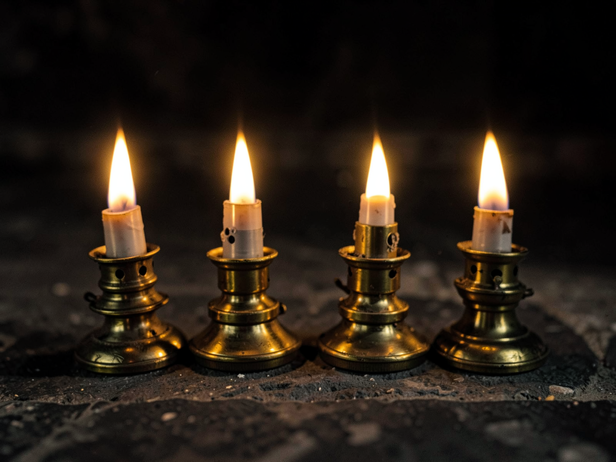
![Brass Lamps Illuminate Darkness]()
Brass Lamps Illuminate Darkness
Image credit : AI
Steady flames on a temple floor, evoking the symbolism of Dattatreya's four dogs.
What the four dogs are said to represent
The most widely cited interpretation in the Dattatreya tradition holds that the four dogs represent the four Vedas, Rigveda, Samaveda, Yajurveda and Atharvaveda. In this reading, the sacred texts follow Dattatreya rather than leading him; he is beyond scripture even as he embodies it. A second layer of interpretation, found in later devotional commentaries, reads the four dogs as the four states of consciousness described in Mandukya Upanishad: waking, dreaming, deep sleep and the fourth state, turiya. A third reading, common in folk tradition particularly in Maharashtra and Karnataka where Dattatreya worship is strongest, sees the dogs as four virtues, alertness, loyalty, fearlessness and the capacity to find sustenance anywhere, that the avadhuta cultivates and that the dogs model instinctively. None of these readings cancels the others. The tradition holds them simultaneously, which is itself a feature of how Dattatreya is understood: as a figure who contains contradictions rather than resolving them.
The cow and the eagle in the same image
The four dogs rarely appear alone in the iconography. The cow that accompanies Dattatreya is read as the earth, or as Kamadhenu, the wish-fulfilling cow of Puranic tradition. The eagle, identified as Jatayu's kin in some tellings, or simply as the vehicle of Vishnu, represents the sky and the capacity for vision at a distance. Together, the image places Dattatreya at a crossing point: earth below, sky above, the four Vedas at his feet, moving forward. The dogs' position, behind and beside, not ahead, is consistent across the iconographic tradition and is not accidental. They follow. They do not lead.
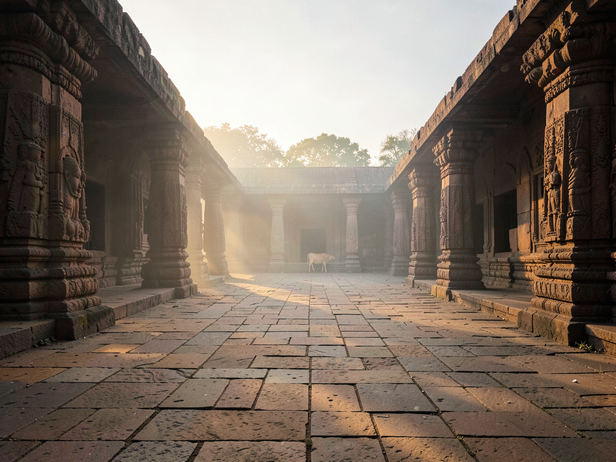
![Deccan Temple Dawn Mist]()
Deccan Temple Dawn Mist
Image credit : AI
I witness a tranquil Deccan temple courtyard bathed in warm dawn light, with mist and a lone cow.
Where this image appears in India today
Dattatreya worship is concentrated in Maharashtra, Karnataka, Andhra Pradesh and Gujarat, with Ganagapur in Karnataka and Narsobawadi in Maharashtra among the most significant pilgrimage sites. The image with the four dogs is the standard form of Dattatreya iconography at these sites, reproduced on printed calendars, metal plaques at roadside shrines, and in temple sanctums. Travellers moving through the Deccan will encounter it frequently. The image also appears in the iconography of the Nath Sampradaya, the tradition of yogis that includes figures like Gorakhnath, where Dattatreya is revered as an early master. In this context the dogs sometimes appear with collars of rudraksha beads, a detail added in later folk art that connects them explicitly to renunciant practice.
What the tradition says about dogs as teachers
The Avadhuta Gita, one of the key texts attributed to Dattatreya, does not mention the dogs directly. But the Dattatreya Upanishad and later hagiographic literature describe Dattatreya as having taken twenty-four gurus from the natural world, the earth, water, fire, wind, the python, the ocean, the moth, the elephant, the bee, and others. The dog does not appear in the standard list of twenty-four, but the tradition's logic is consistent: the natural world teaches, and what it teaches is available to anyone who watches without the filter of preference. A dog's loyalty without condition, its alertness without anxiety, its capacity to rest completely and wake completely, these are not romanticised in the tradition. They are observed. The image is not saying that dogs are sacred. It is saying that the avadhuta, who has learned from everything, walks with them as equals.