The first morning in a new city is usually the worst. You don't know which direction the sun rises from your window, the sounds outside are unfamiliar, and the flat feels like a hotel room that hasn't been checked out of yet. Then your dog needs a walk, and you go.
That walk is the beginning of something.
Why dogs are unusually good at this particular job
A dog doesn't experience a new city as foreign. It experiences it as new information, a cascade of smells, textures underfoot, sounds to place and file. Every lamppost, every drain, every patch of earth below a tree is data. What reads to you as an anonymous street reads to your dog as a map being drawn in real time.
This matters for you because you are walking the same street. You begin to see it through the dog's attention, which corner it slows at, which gate it wants to investigate, which chai stall's smoke it lifts its nose toward. You are building spatial memory without trying to. Within a week, you know three routes. Within two, you have a favourite.
The neurological explanation is straightforward: routine activates familiarity, and familiarity reduces the low-grade threat response that makes a new place feel exhausting. A dog enforces routine better than any app. It needs to go out at roughly the same times every day, and it will remind you. That rhythm becomes yours.
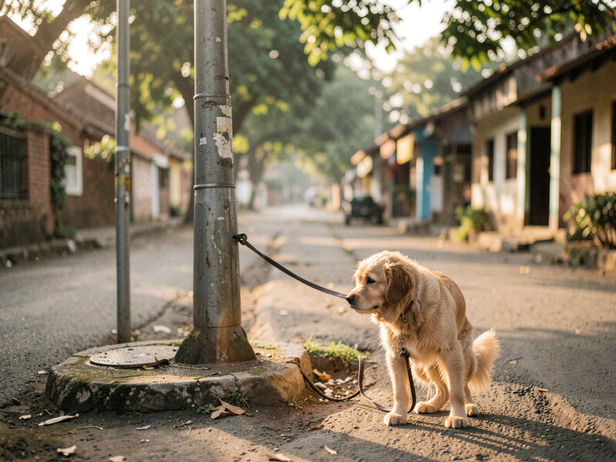
![Morning Street Corner Pause]()
Morning Street Corner Pause
Image credit : AI
My dog helps me adjust to this new city India, finding familiar scents on our morning walk.
The social function nobody talks about
Dogs are social infrastructure in a way that cats, fish, and most other pets are not. They require outdoor time, and outdoor time in a new city means contact with other people whether you plan for it or not.
The uncle walking his Labrador at six in the morning will nod. Then he will ask what breed yours is. Then, over a week, he will tell you which park has water, which road floods in the rain, which auto stand actually shows up. You did not set out to make a contact. You went out because the dog needed to go.
This is not incidental. Research in urban sociology has documented that dog owners in new neighbourhoods form social ties faster than non-owners, specifically because the dog creates a reason to be in the same place at the same time repeatedly. Regularity plus a shared subject, the dog, is enough. The city starts to have people in it you recognise, which is the first stage of it feeling like yours.
What the dog actually needs from you during a move
It is easy to assume the dog adjusts automatically while you are the one struggling. This is partly true and partly not. Dogs are adaptable, but a move is a significant disruption to the environmental cues they use to feel safe: the smell of the old flat, the known sounds, the familiar walk routes.
Most dogs settle within two to four weeks. Some take longer, particularly older dogs or those with a history of anxiety. Signs that the adjustment is taking longer than expected include a sustained drop in appetite beyond the first few days, prolonged hiding or withdrawal, or a return of house-training accidents in a dog that had been reliable for years. Any of these lasting more than two weeks is worth a conversation with a vet, because what looks like emotional adjustment can sometimes have a physical component, stress affects gut motility, immune function, and sleep in dogs much as it does in people.
What helps: keeping the dog's feeding times, walk times, and sleep location as consistent as possible from day one. Bring familiar objects, the old bed, a worn blanket, a toy. These carry smell, and smell is the dog's primary anchor. The new flat will start to smell like home faster than you think, but the familiar objects bridge the gap.
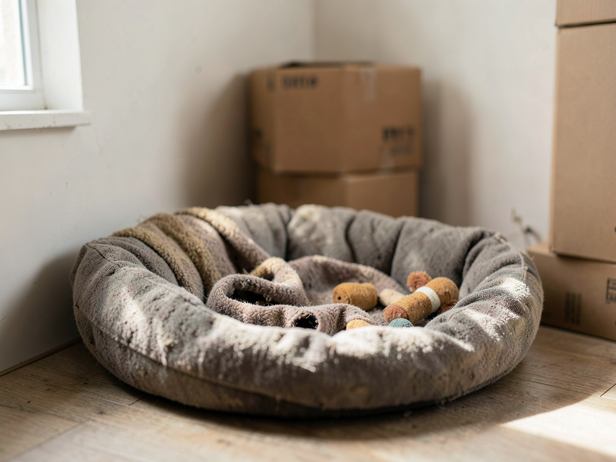
![Dog's New Home Comfort]()
Dog's New Home Comfort
Image credit : AI
My dog's familiar bed finds its spot in our new flat, a cozy anchor during our relocation.
The thing that actually happens to you
There is a version of relocation where you spend the first three months inside, ordering in, waiting to feel ready to engage with the city. A dog makes that version unavailable. You go out twice a day regardless of your mood, your social anxiety, or how behind you are on work. You see the same streets in different light. You learn which bakery opens early because you walked past it at seven. You find the small park two lanes in from the main road because the dog pulled you toward the trees.
None of this is dramatic. It accumulates. One morning you give someone directions without thinking about it, and you realise you knew the answer. The city is no longer a problem you are solving. It is a place you live.
The dog did not make the city familiar by doing anything remarkable. It made you leave the flat every day until the city became yours by repetition.