In the winter of 1923, a mud-caked, paw-worn collie scratched at the door of a house in Silverton, Oregon. His family had given him up for lost six months earlier, more than 4,000 kilometres away in Indiana. Bobbie the Wonder Dog had walked home.
What happened in Wolcott
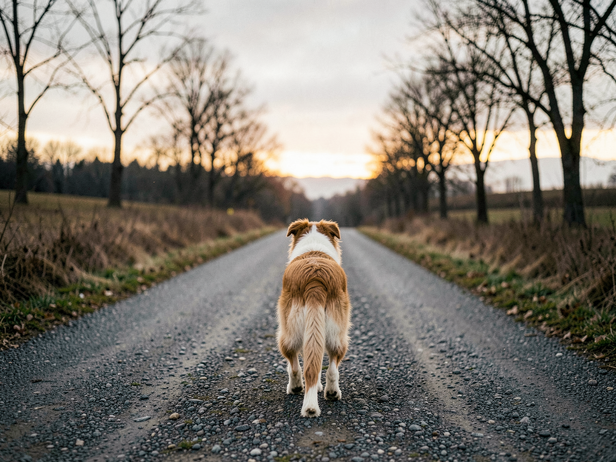
![Solitary Collie on Autumn Road]()
Solitary Collie on Autumn Road
Image credit : AI
A Scotch collie's solitary journey on a gravel road, evoking the spirit of how dogs find their way home.
The Brazier family, Frank, his wife, and their daughters, drove from Silverton to Indiana in the summer of 1923 to visit relatives. Bobbie, their two-year-old Scotch collie mix, came along. In Wolcott, he got into a fight with a group of local dogs and bolted. The family searched for days, asked around town, placed notices. Nothing. They drove home to Oregon without him, believing he was gone.
The journey back
Six months later, in February 1924, a thin, limping dog appeared at the Brazier home in Silverton. The family recognised him immediately, and so did he. His paws were worn to the bone. His coat was matted. He had crossed the Midwest in autumn, the Rocky Mountains in winter snow, and the Cascades before finally reaching the Willamette Valley.
People along what was later reconstructed as his route came forward after the story broke in newspapers. A woman in Indiana said she had fed a stray collie. A family in Colorado remembered one sleeping in their barn. A man in Idaho reported a dog matching his description crossing a frozen river. The Oregon Humane Society spent months collecting these accounts and traced a route that covered parts of Indiana, Illinois, Iowa, Nebraska, Colorado, Wyoming, Idaho, and Oregon. The distance, depending on the path, was somewhere between 3,500 and 4,500 kilometres.
What science says about canine navigation
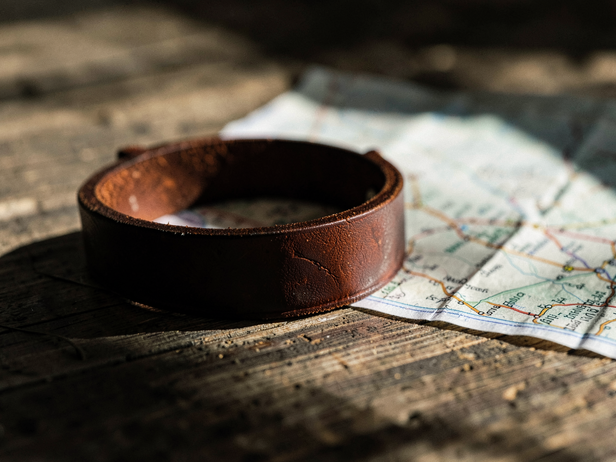
![Journey's End: Dog Collar & Map]()
Journey's End: Dog Collar & Map
Image credit : AI
A worn leather collar rests beside a folded map, hinting at a dog's incredible journey home. A silent echo of 'Bobbie the Wonder Dog story'.
Bobbie's journey has never been fully explained, and that honesty matters. Dogs do have navigational abilities that researchers are still mapping. They appear to use a combination of scent trails, the Earth's magnetic field, and spatial memory built from prior experience in a place. A 2020 study published in eLife found that dogs running off-lead in forests often used a short magnetic north-south compass run to orient themselves before finding a familiar route home, a behaviour the researchers called a "compass run." Whether this scales to thousands of kilometres across unknown terrain is not established.
What is known: dogs have an extraordinary olfactory system, with a sense of smell estimated to be 10,000 to 100,000 times more sensitive than a human's. They can detect and follow scent gradients across large distances under the right conditions. Bobbie had travelled the route once, westward, in a car. Whether any scent memory from that trip remained usable months later and over such a distance is genuinely unknown.
The honest answer is that no single mechanism explains what Bobbie did. The journey is documented, the accounts are real, and the explanation remains open.
The aftermath
Bobbie became a national story in 1924. He received fan mail, a jewelled collar, a miniature house built by schoolchildren, and a role in a silent film. The Oregon Humane Society published a pamphlet documenting the verified accounts of people who had seen him along the way. He died in 1927 and was buried in Portland with a ceremony. Rin Tin Tin, then Hollywood's most famous dog, reportedly placed a bone on his grave.
A statue of Bobbie stands in Silverton, Oregon, today. The town still holds an annual celebration in his name.
What it means for anyone who travels with a dog
Bobbie's story is remarkable precisely because it is not a template. Dogs do get separated from their families on trips, at highway dhabas, at rest stops, in unfamiliar cities, and the vast majority do not find their way home across a continent. A microchip, a well-fitted collar with a current contact number, and a photograph of your dog taken that day are the practical tools. If a dog goes missing in an unfamiliar place, contacting local shelters, posting in area-specific community groups, and returning to the spot where the dog was last seen in the hours immediately after are the steps most likely to help.
Bobbie crossed America. Most lost dogs need someone to open a shelter door and scan a chip. Both facts are true at the same time.