A dog that sits on cue in the kitchen and stares blankly at you on a busy street has not forgotten anything. It has learned the cue exactly as it was taught, and the lesson happened to be indoors, in a quiet room, with you standing in a familiar spot. The problem has a name in learning science: stimulus generalisation, or rather, the absence of it.
Why dogs do not automatically transfer cues across contexts
![Alert Dog on Urban Street]()
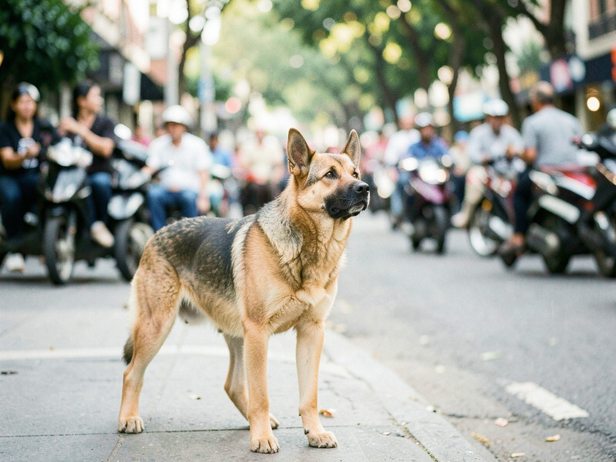
Alert Dog on Urban Street
Image credit : AI
Dog training in Indian apartments can be challenging; this canine remains focused on outdoor stimuli, ignoring commands.
Dogs learn by associating a cue, a word, a hand signal, a sound, with a specific outcome in a specific situation. The sit your dog knows at home is bundled with everything present when it was learned: the smell of your flat, the sound of the ceiling fan, your relaxed posture, the particular angle of afternoon light. Step outside and change most of those variables, and the cue is no longer the same cue from the dog's point of view. This is not a failure of intelligence. It is how associative learning works in most animals, including humans. A child who can multiply at a desk sometimes stalls when asked the same question mid-walk. Context is part of what gets encoded.
What distraction actually does to a trained behaviour
Outside, your dog is managing a flood of competing stimuli: scooter exhaust, a crow landing nearby, another dog's scent on a lamppost, the unfamiliar texture of pavement underfoot. Each of these raises what trainers call the dog's arousal level. As arousal climbs, the threshold at which the dog can respond to a trained cue rises with it. A sit that needed 20 percent of the dog's attention at home now needs 80 percent, and 80 percent is simply not available on a street in Pune or Bengaluru at seven in the morning. Distraction does not erase a trained behaviour. It temporarily prices it out of reach.
How to generalise a cue across environments
![Plain Chicken Treat on Palm]()
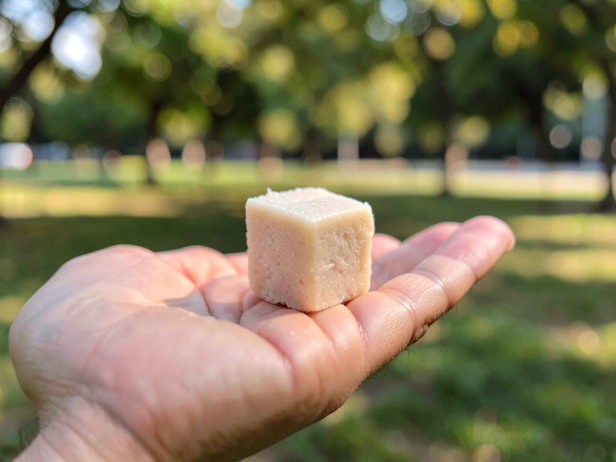
Plain Chicken Treat on Palm
Image credit : AI
A simple chicken treat offered, a common reward for dog training, even when a dog ignores commands outside. Focus on texture and natural light.
Generalisation is trained, not assumed. The method is systematic: take the cue to a new location, drop your expectation of performance back to zero, and rebuild it there as if you are starting fresh. Start with the least stimulating environment outside your home, a quiet stairwell landing, a parking basement, the building corridor at a low-traffic hour. Ask for the cue. Reward heavily when it lands. Over several short sessions, the dog begins to associate the cue with the outcome regardless of the surroundings. Then move to a slightly busier spot and repeat the process. Each new environment is a new training location, not a test of what the dog already knows. Trainers call this proofing. It is not remedial work. It is the second half of teaching any cue.
The role of reward value in new environments
The reward that works at home, a dry kibble piece, a quick pat, may not have enough pull to compete with a pigeon three metres away. In a high-distraction setting, the reward needs to be worth the dog's attention. Boiled chicken, small pieces of paneer, or a favourite toy tend to hold value in noisy environments where dry treats lose their appeal. Match the value of the reward to the difficulty of the environment. As the dog becomes reliable in that environment, you can gradually step the reward back down. This is not bribing the dog to behave. It is paying a fair wage for a harder job.
When to bring in a qualified trainer
If a dog is not responding to cues outside because it is lunging, barking intensely at other dogs or people, or showing signs of fear, freezing, tucking its tail, refusing to move, that is not a generalisation problem. That is a dog working at or past its stress threshold, and proofing exercises will not reach it there. A qualified trainer or veterinary behaviourist can assess whether the dog needs a desensitisation and counter-conditioning programme, and whether the starting point for that work is well outside the environments you have been trying. The gap between a dog that ignores sit on the street and a dog that cannot function on the street is significant, and the approach for each is different. Generalising a cue is steady, achievable work when the dog is simply under-proofed. It is the wrong tool when fear or reactivity is running the show.