Every dog owner has had this moment: you have practised sit and stay at home for two weeks, your dog has it perfectly, and then you take him to the park and he acts like he has never heard the word in his life. He is not being stubborn. He is not ignoring you. He has crossed his threshold, and at that point, the part of his brain that processes learning is no longer running the show.
What threshold actually means
A dog's threshold is the point at which arousal or stress tips from manageable into overwhelming. Below threshold, a dog can orient toward you, take food, follow a cue, and think. Above threshold, the nervous system has handed control to a much older, faster system, fight, flight, freeze, or bark, and no amount of treat-waving will reach him there.
The threshold is not a fixed line. It shifts with the dog's history, his health on a given day, how much sleep he got, whether the morning walk was calm or chaotic. A dog who copes with one barking dog across the street may fall apart when two appear at once. Distance, sound, movement, and novelty all push the line in different directions.
The practical consequence is this: a dog above threshold cannot learn. He can perform behaviours that are so deeply ingrained they run automatically, but he cannot form new associations, cannot generalise a cue to a new context, and cannot choose a calm response over a reactive one. Training above threshold does not build the skill. It burns the session.
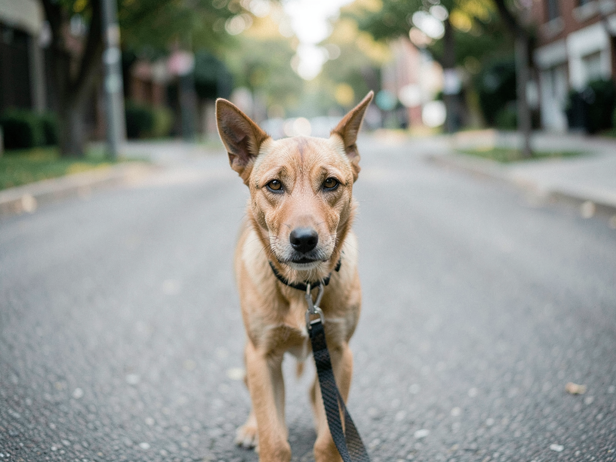
![Focused dog on morning walk]()
Focused dog on morning walk
Image credit : AI
My focus is absolute, working under threshold on this quiet morning walk. Every sense is engaged.
How most training sessions accidentally cross it
The most common mistake is starting too close, too fast, or too loud. An owner who wants to work on leash reactivity stands twenty metres from a busy road because that feels like a safe distance. For their dog, twenty metres from moving traffic is already above threshold. The dog is scanning, his body is stiff, his ears are forward, and he has stopped sniffing, all signs that the nervous system is already elevated. The treat the owner offers gets ignored not because the dog dislikes the treat, but because a stressed brain deprioritises food.
A second common pattern is stacking. A dog who had a difficult morning, saw a cat through the window, and pulled hard on the way to training class arrives at the session already partway up the arousal curve. Each stressor adds to the last. By the time the handler asks for a down-stay near a strange dog, the dog is at the top of the curve before the exercise begins. Trainers call this trigger stacking, and it explains why the same dog behaves very differently on different days.
A third pattern is the session that starts well and then escalates. The handler, encouraged by early success, moves closer to the distraction, increases the duration, or adds a new element. The dog's threshold gets crossed mid-session, the behaviour falls apart, and the handler ends the session frustrated. The dog ends it having practised being overwhelmed.
Reading the signs before the dog tips over
A dog above threshold is obvious, he is lunging, barking, spinning, or frozen solid. The more useful skill is reading the signs that he is approaching threshold, because that is when you still have time to move.
Early signs vary by dog but commonly include: stopping to sniff suddenly when there was no sniffing before (displacement behaviour, a way of managing internal pressure), yawning or lip-licking outside of a tired or hungry context, a stiffening of the body or a high, slow tail, ears that swivel forward and stay there, and a refusal of food that the dog normally takes readily. Some dogs show whale eye, the whites of the eyes visible, before they react. Some dogs get very still in a way that looks calm but is not.
The rule of thumb: if your dog stops taking food he normally loves, he is at or near threshold. Move him away from the trigger before asking for anything.
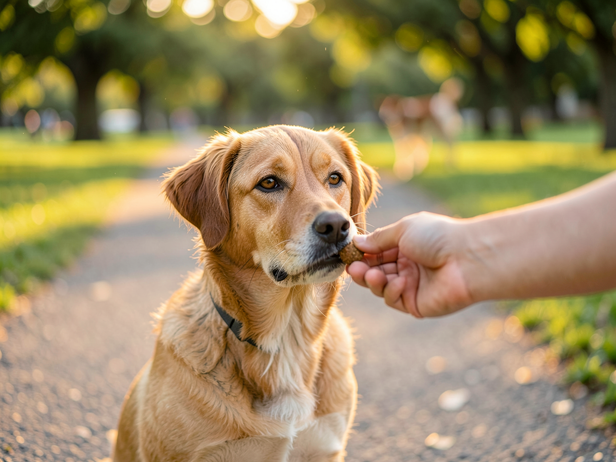
![Calm dog awaits treat]()
Calm dog awaits treat
Image credit : AI
Practicing working under threshold in the park. Patience rewarded with a treat.
What working under threshold looks like in practice
Under-threshold training means finding the distance, the intensity, or the context at which the dog is aware of the trigger but not overwhelmed by it. At that distance, he can still orient to you, take food, and respond to a known cue. That is the working zone.
For a dog reactive to other dogs, this might mean starting at fifty metres, further than feels necessary, and doing nothing more than marking and rewarding calm glances toward the other dog. The goal in early sessions is not the sit or the down. The goal is a positive association with the presence of the trigger at a distance where the dog can think. Over many sessions, that distance closes as the association builds.
The principle behind this is counter-conditioning paired with desensitisation. Desensitisation means gradual, controlled exposure to the trigger at an intensity the dog can handle. Counter-conditioning means pairing that exposure with something the dog values, so the trigger begins to predict good things rather than threat. Neither works above threshold. Both require patience with the pace, which is the dog's pace, not the owner's.
Progress is not linear. A dog who worked calmly at thirty metres last Tuesday may need forty metres on a day when he is tired or the trigger moves unexpectedly. That is not regression. That is threshold behaving as it should, shifting with context. The handler's job is to read the dog on that day and adjust the working distance accordingly, not to hold to last week's benchmark.
When to stop the session and when to get a professional involved
A session that has gone above threshold is over. Not paused, over. Trying to regain the dog's attention after he has tipped past the line teaches him that escalation is a reasonable response, because it ends the pressure. End the session, move the dog away from the trigger, give him time and space to come back down, and try again another day at a greater distance.
If a dog's threshold is so low that there is no working distance, if he reacts the moment any trigger appears, regardless of how far away it is, that is beyond what most owners can manage alone. A qualified trainer or a veterinary behaviourist can assess whether the dog's baseline arousal is manageable through behaviour modification alone, or whether anxiety is running at a level where a vet conversation is the right first step. Reactivity that includes biting, that escalates despite consistent training, or that is getting worse rather than better over months warrants a professional assessment, not a different YouTube video.