Most people assume rabbits are passive pets, something to watch, not something to teach. That assumption gets in the way of a genuinely responsive animal. Rabbits have strong memories, clear preferences, and the capacity to learn through positive association. Name recognition is one of the most practical things you can build, because it becomes the foundation for recall, for safety, and for trust.
Why name training works for rabbits
Rabbits learn through classical and operant conditioning, the same principles that underlie dog and cat training. They associate a sound with an outcome. When the outcome is reliably good, a piece of food they love, a stroke in a spot they enjoy, the association strengthens with each repetition. What rabbits do not respond to is correction, surprise, or anything that triggers their prey-animal startle reflex. A rabbit that is frightened during training does not learn the lesson you intended. It learns that approaching you carries risk.
This is why punishment-based methods do not apply here at all, and why patience is not optional. A session that ends with the rabbit retreating to a corner has gone too far. Short, calm, and predictable is the frame for everything that follows.
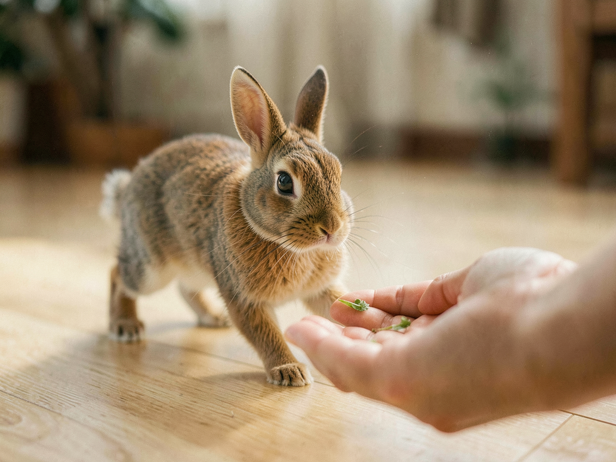
![Rabbit approaches offered treat]()
Rabbit approaches offered treat
Image credit : AI
I'm teaching my rabbit to come when called, using positive reinforcement. This little one is learning fast!
Choose the right reward before you start
The reward has to matter to your rabbit. Leafy greens, a small piece of coriander, a sliver of romaine, a fragment of parsley, work well for most rabbits. A tiny piece of fruit works for some, but fruit is high in sugar and should stay genuinely small: a piece the size of a fingernail is enough. Pellets can work if your rabbit is motivated by them. Whatever you choose, it should be something the rabbit does not get in unlimited supply, because a rabbit that is already full has no reason to move toward you.
Keep the pieces small. You are not feeding a meal; you are marking a behaviour. The rabbit takes the piece, the moment is complete, and you move to the next repetition. If the rabbit has to chew for thirty seconds, the timing link between the action and the reward blurs.
The steps, in order
Start in a small, enclosed space where your rabbit is already comfortable, a playpen, a room it knows well, not a new environment. Sit on the floor at the rabbit's level. Let it approach you on its own terms for a few minutes before beginning.
Step one: say the rabbit's name once, clearly, in a calm voice. Do not repeat it. Do not call louder if the rabbit does not respond. One clear sound, then wait.
Step two: the moment the rabbit looks toward you or takes one step in your direction, offer the reward immediately. At this stage you are not waiting for the rabbit to reach you. Any movement toward you counts. The marker, the moment the reward arrives, has to land within a second or two of the behaviour, or the rabbit cannot connect them.
Step three: repeat. Keep sessions to five minutes or fewer. Three to five repetitions per session is enough at the start. End before the rabbit loses interest, not after.
Over several sessions, typically across a week or two, gradually raise the bar. First the rabbit looks at you. Then it takes a step. Then it comes close enough to take the treat from your hand. Then it comes all the way to you. Each stage needs to be solid before you move to the next. Rushing the criteria is the most common reason this training stalls.
![Fresh Greens on Linen]()
Fresh Greens on Linen
Image credit : AI
I arranged these fresh greens, a sliver of romaine and coriander, on linen. Learning to train my rabbit is next!
Common problems and what they usually mean
The rabbit ignores the name entirely. This usually means the reward is not motivating enough, the environment has too many distractions, or the sessions are too long. Try a different reward, move to a quieter space, and cut the session to two minutes.
The rabbit comes partway and stops. You have raised the criteria too fast. Go back to rewarding the halfway point until that is completely reliable, then begin extending the distance again.
The rabbit used to come and has stopped. Check whether the reward has lost its value, if the rabbit is getting the same food in its regular diet, it has less reason to work for it. Also check whether anything has changed in the environment or routine that might be causing stress. A rabbit that is unwell, in pain, or anxious will disengage from training before showing other signs. If the behaviour change is sudden and unexplained, a vet check is worth doing.
The rabbit thumps and retreats when you call. The name has been associated with something the rabbit found unpleasant, being picked up when it did not want to be, a loud noise, a fright. You will need to rebuild the association from the beginning, with extra patience and no pressure.
Building on name recognition
Once a rabbit reliably comes to its name in a familiar space, you can begin practising across larger areas and with mild distractions. The principle stays the same: one clear call, wait, reward the approach. Never call the rabbit's name and then do something it dislikes, a bath, being put back in the enclosure when it wants to stay out, a medication it resists. If the name predicts something unpleasant, the recall breaks down. Keep the name paired with good outcomes, and the rabbit will keep responding to it.
Name training is also a practical safety tool. A rabbit that comes when called is easier to retrieve from a dangerous spot, easier to bring in from a free-roam area, and easier to handle calmly in a stressful situation. The ten minutes a day it takes to build this is paid back many times over.