A dog's nose has roughly 300 million olfactory receptors. A human's has about six million. That gap isn't trivia, it shapes everything about how a dog experiences a walk, and why a dog that hasn't been allowed to sniff is a harder dog to train.
What the nose is actually doing
Scent processing in dogs runs through the olfactory bulb, a brain structure proportionally forty times larger than the equivalent in humans. When a dog drops its head to a patch of grass, it isn't dawdling, it's reading a layered chemical record of who passed, when, their sex, their stress level, and what they ate. This is cognitively demanding work. A ten-minute sniff walk tires a dog more reliably than a thirty-minute trot on a tight leash, because the brain is doing the heavy lifting.
The practical consequence: a dog that arrives at a training session already mentally satisfied is operating below its arousal threshold. A dog that has been marched past every interesting smell for forty minutes arrives at that session frustrated and over-stimulated, which is exactly the state in which impulse control, focus, and response to cues deteriorate.
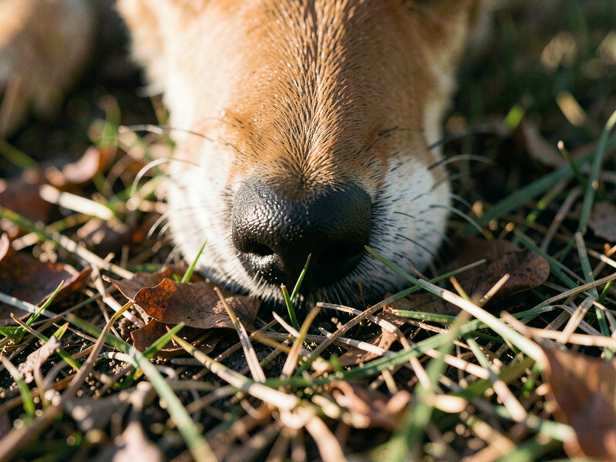
![Nose to the Earth]()
Nose to the Earth
Image credit : AI
My nose finds stories in the dry grass and fallen leaves. Every sniff is a discovery on my walks.
The learning principle behind it
Sniff walks work because of two mechanisms that sit at the core of reward-based training: threshold management and reinforcement history.
Threshold is the point at which a dog's arousal tips from manageable into reactive, the moment it stops being able to think and starts barking, lunging, or shutting down. Every dog has one, and every dog's threshold shifts depending on how much mental and physical load it is already carrying. A dog that has had thirty minutes of genuine olfactory engagement arrives at the training session with a lower baseline arousal. Its threshold is easier to stay under. Cues land cleaner.
Reinforcement history is the record the dog carries of what makes good things happen. A walk where the dog controls the pace and the sniffing is never interrupted builds an association between the owner's presence and genuine autonomy. That association makes the dog more willing to engage when the owner does ask for something, a sit, a loose-leash heel, a recall, because the relationship has a positive balance rather than a debt of constant redirection.
How to structure a sniff walk
A sniff walk is not the absence of structure. It is a different kind of structure, with the dog setting the agenda and the owner setting the boundaries.
Start with a long line, five to ten metres, rather than a standard leash. This gives the dog a real radius to work in without the owner losing control of where the dog goes. Let the dog choose direction. If it wants to circle back to a spot it already covered, let it. The nose found something the first pass didn't resolve.
The owner's job is to move with the dog, not ahead of it, and to stay quiet. Narrating the walk, calling the dog's name repeatedly, or offering treats to keep the dog moving all interrupt the cognitive state the walk is meant to build. The point is decompression, not compliance.
One clear rule is useful: the dog may sniff anything at ground level that is safe. It does not approach other dogs, people, or traffic without a cue from the owner. This keeps the sniff walk from becoming a social free-for-all that raises arousal rather than lowering it.
Ten to fifteen minutes of genuine sniff time before a training session is enough to shift the dog's state. It does not need to be the whole walk.
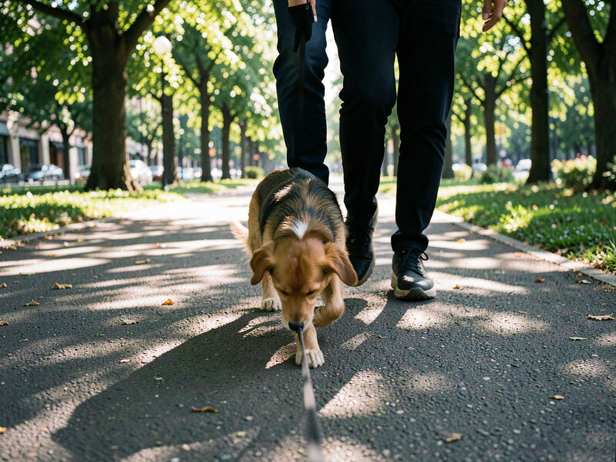
![Dog's Morning Sniffing Adventure]()
Dog's Morning Sniffing Adventure
Image credit : AI
Enjoying a decompression walk for dogs, letting his nose lead the way on this peaceful morning.
When sniff walks fit into a training plan
Sniff walks slot in at the start of a session, not the end. The sequence matters: sniff first, then ask for focused work, then end on a success. Reversing the order, training first, then sniff, gives the dog no reason to switch off after the session ends, and the sniff walk becomes a reward for a training session the dog may have found aversive.
For dogs working through leash reactivity or generalised anxiety, sniff walks are part of the desensitisation and counter-conditioning process, not a break from it. Moving through an environment at the dog's pace, below threshold, while the nose is engaged, teaches the dog that the outside world is a source of information rather than a source of threat. A qualified trainer or veterinary behaviourist should be part of any plan that involves reactivity, sniff walks support that work, they do not replace it.
For puppies learning what walks are, sniff walks establish from the beginning that the owner's pace is not the only pace. That early lesson is far easier to build on than it is to introduce later, after a dog has spent two years being hurried past everything interesting.
The dog that gets to use its nose on the way to training arrives ready to work. The dog that doesn't arrives ready to argue.