Most training problems are not about the command that failed. They are about the moment before it, when the dog's eyes were somewhere else entirely. A dog that has not learned to look at you on cue is working from a fraction of its attention, and no amount of repetition fixes that gap. Watch me solves it at the root.
What 'watch me' actually trains
The cue asks for one thing: eye contact, held for a beat, on request. That sounds simple, but the learning principle behind it is important to name. Watch me is built on positive reinforcement, the dog offers a behaviour, the behaviour gets marked at the exact moment it happens, and a reward follows. The marker (a clicker, or the word "yes" said in a flat, consistent tone) tells the dog precisely which moment earned the treat. Without that timing, the dog is guessing.
Eye contact is also a form of orientation. A dog looking at your face is, neurologically, attending to you rather than to the squirrel, the passing auto-rickshaw, or the other dog across the park. Every command that comes after, sit, stay, come, leave it, lands on a dog that is already tuned in. That is why this cue gets taught before anything else, and why trainers return to it whenever a dog's focus starts slipping in a new environment.
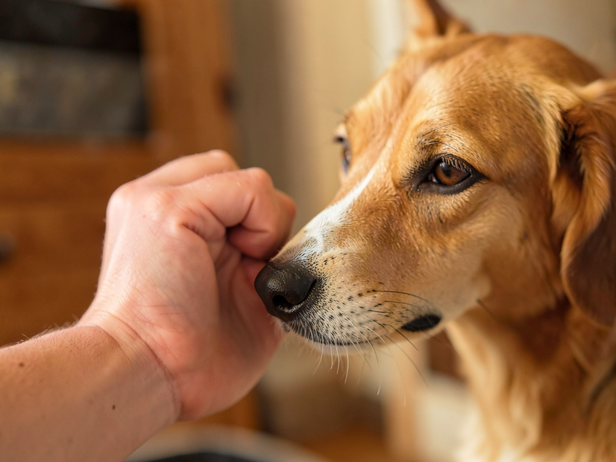
![Dog's Curious Sniff]()
Dog's Curious Sniff
Image credit : AI
I'm teaching my dog to focus, using positive reinforcement for this moment of curious sniffing.
How to teach it, step by step
Start indoors, in the quietest room you have. Distractions come later, after the behaviour is solid.
Hold a treat in your closed fist and bring it to your side, at your hip. Say "watch me" once, in a normal voice. Do not repeat it. The dog will sniff your fist, nudge it, paw at it. Wait. The moment the dog gives up on your hand and glances at your face, even for half a second, mark it immediately and open your fist. That half-second of eye contact is exactly what you are paying for.
Repeat this ten times in a session. Sessions should run two to three minutes at most. Dogs learn better across short, frequent repetitions than across long ones. Two sessions a day is enough in the first week.
Once the dog is reliably looking at your face within two or three seconds of the cue, start stretching the duration. Mark at one second of eye contact, then two, then three. Build slowly. If the dog looks away before you mark, say nothing, reset, and try again. The absence of a reward is information enough.
After five to seven days of indoor practice with consistent results, move to a slightly busier environment: a balcony, a corridor, outside your building's gate. The dog will struggle. This is expected and is not a failure. Drop back to one-second holds and rebuild from there. Generalisation, the ability to perform a behaviour across different environments, takes longer than the initial learning and needs its own patient repetition.
Common problems and what they mean
The dog looks at your hand, not your face. You are holding the treat too high or moving it toward your face as a lure. Keep the treat at your side. The dog needs to figure out that looking at your face, not your hand, is what opens the fist.
The dog looks away immediately after the mark. The reward is arriving too slowly, or the treat is not motivating enough in this environment. In a distracting setting, use something the dog finds genuinely exciting: small pieces of chicken or paneer tend to outperform dry kibble. Timing matters more than most owners realise, the mark must land within one second of the behaviour.
The dog will not engage at all. The environment is too stimulating for the dog's current threshold. Threshold is the point beyond which a dog is too aroused or anxious to learn. Move somewhere quieter. If the dog is consistently over threshold in all outdoor settings, or shows signs of anxiety, panting, yawning, lip-licking, scanning, this is worth discussing with a qualified trainer or veterinary behaviourist, not something to push through with more repetitions.
The dog learned it at home but ignores the cue outside. This is not stubbornness. Dogs do not generalise automatically the way humans do. A behaviour learned in the kitchen is, from the dog's perspective, a kitchen behaviour. Each new environment is a new lesson at a lower difficulty, then built back up.
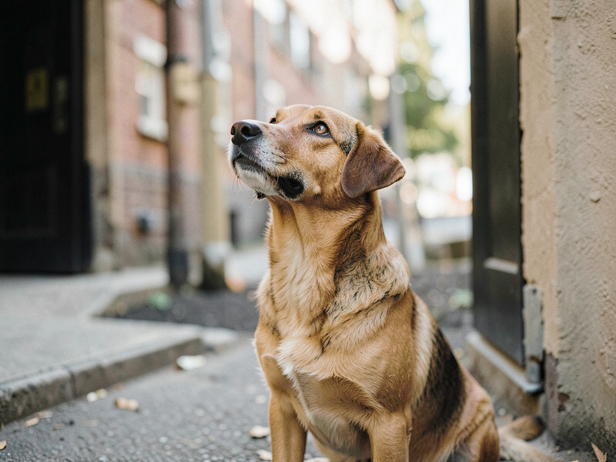
![Dog's Morning Vigil]()
Dog's Morning Vigil
Image credit : AI
I'm practicing my 'watch me' command, focusing intently on my human in the soft morning light.
When watch me is solid, what comes next
Once the dog holds eye contact for three to five seconds on cue, in at least three different environments, you have a working attention cue. Now it becomes the opening move in every training sequence. Before asking for a sit near a distraction, ask for watch me first. Before a recall in the park, get the eye contact, then call. The dog arrives at each command already oriented toward you rather than toward whatever pulled its attention a moment ago.
The cue also becomes a real-time tool. A dog that has learned watch me reliably will often offer eye contact unprompted in situations that used to trigger lunging or barking, not because the trigger has disappeared, but because looking at you has become the habit that pays. That is counter-conditioning working quietly in the background, built on the same marker-and-reward loop you started in your living room.
Attention is not a personality trait some dogs have and others lack. It is a skill, and like every skill, it is taught one marked moment at a time. Get the eye contact first, and the rest of the training has somewhere solid to land.