Most indoor cats eat the same meal from the same bowl in the same spot twice a day, and then have nothing to do. The bowl empties in under a minute. The cat walks away, sleeps, wakes up restless, and the cycle repeats. Food puzzles break that loop by turning the meal itself into the activity, the cat must sniff, paw, bat, or nudge to release each piece of kibble or lick of wet food. The result is a slower meal, a more engaged cat, and a low-effort way to give a flat-dwelling animal something its brain actually needs.
What food puzzles actually train
Food puzzles are not a trick. They sit inside a real learning framework: the cat is being asked to perform a behaviour, investigating an object, manipulating a surface, persisting through mild frustration, and the reward arrives immediately when it succeeds. That is positive reinforcement operating at the cat's own pace, with no human timing a clicker. The repetition across hundreds of meals builds what behaviourists call persistence and exploratory confidence: a cat that has learned that effort produces food is a cat more willing to try new things, less likely to give up when something is unfamiliar, and less likely to redirect boredom into scratching furniture or waking you at four in the morning.
There is a second mechanism worth naming. Cats are hunters that evolved to eat many small meals across a long period of activity. A single bowl collapses that pattern into one passive moment. A puzzle stretches the meal across ten or twenty minutes of low-level physical and cognitive effort, which is closer to what the animal's digestive and neurological systems expect. Cats that eat too fast and vomit immediately after are often candidates for food puzzles for this reason alone.
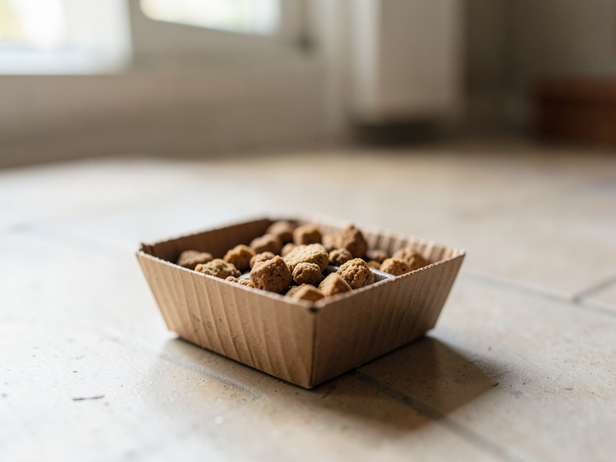
![Homemade Cat Food Puzzle]()
Homemade Cat Food Puzzle
Image credit : AI
This homemade cat food puzzle offers a simple solution for indoor cat boredom, encouraging slow feeding and mental stimulation.
Starting at the right level
The most common mistake is starting too hard. A cat that has never seen a puzzle will sniff it, fail to get anything out within thirty seconds, and walk away. That is not stubbornness, it is a cat that has not yet learned the association between the object and food. The first puzzle should be almost embarrassingly easy: kibble scattered on a lipped tray or a muffin tin with pieces sitting openly in each cup. The cat walks up, eats, and leaves with a successful experience. That is the foundation.
After two or three days of the easy version, cover the muffin tin cups with a tennis ball. The cat has to move the ball to reach the food. This is one step harder, not ten steps harder. The principle is the same one used in any desensitisation programme: keep the difficulty just above what is comfortable, not so far above it that the animal opts out. If the cat stops engaging, the puzzle is too hard. Go back one level and stay there longer.
Homemade options work well at the early stages. A cardboard egg carton, a toilet roll tube with the ends folded in, or a muffin tin are all functional puzzles. Wet food can go into ice cube trays or be smeared thinly across a licki mat, a flat textured surface the cat has to lick methodically. Licki mats are particularly useful for cats that are new to the concept, because licking is already a natural behaviour and the reward is continuous rather than intermittent.
Moving up: intermediate and advanced puzzles
Once a cat reliably works an easy puzzle without hesitation, it is ready for something that requires two steps rather than one. Intermediate puzzles ask the cat to lift a lid, pull a drawer, or reach through a hole. The key is that the cat must discover the mechanism, not be shown it. Place a piece of kibble just inside the opening so the smell draws the cat in, and let it figure out the rest. Intervening too quickly, moving the cat's paw, tipping the puzzle, removes the learning moment.
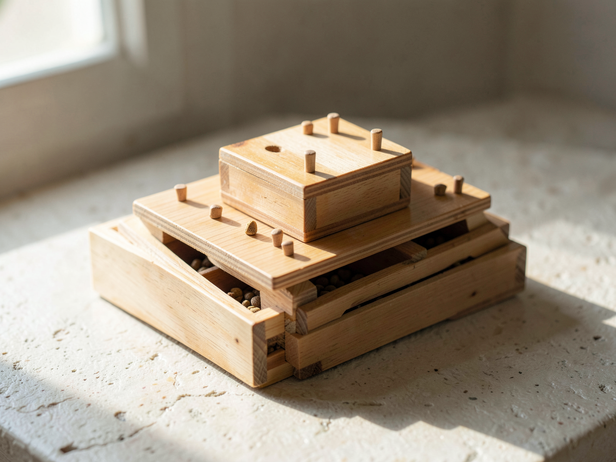
Advanced puzzles involve sequences: a ball must be moved to the right position before a drawer opens, or a series of pegs must be navigated to drop food to a lower level. These are commercially available as tiered puzzle boards. They are worth the cost for cats that have genuinely exhausted easier options, but they are not a starting point. A cat pushed to this level before it is ready will ignore the puzzle entirely, and the puzzle will gather dust.
Rotate puzzles rather than retiring them. A puzzle a cat has not seen for three weeks is effectively new again. Keeping four or five options and cycling them weekly maintains novelty without requiring constant new purchases.
![Tiered Cat Puzzle Board]()
Tiered Cat Puzzle Board
Image credit : AI
Engaging my cat with this tiered puzzle board, a great solution for indoor cat boredom.
What to watch for
Most cats take to food puzzles within a week. A cat that consistently refuses to engage after five or six days of easy-level puzzles may be telling you something worth paying attention to. Sudden disinterest in food, or in activities that previously engaged it, can be a sign of pain, dental discomfort, or an underlying health issue, none of which a puzzle will fix. If a cat that was working puzzles happily suddenly stops, and the change in behaviour persists for more than two or three days, that is a reason to call a vet rather than try a harder puzzle.