Most people assume cats cannot be trained. That assumption costs them one of the more rewarding things you can do with a cat at home. Cats learn through the same operant conditioning that works on dogs, they repeat behaviours that produce something good. The high-five works because it starts from a paw movement the cat makes on its own, then shapes that movement into something deliberate.
The principle: marker training and positive reinforcement
Cats learn fastest when the reward lands within one or two seconds of the behaviour. That window is too narrow for most treats to travel from your hand to the cat's mouth, which is why a marker, a click from a clicker, or a short sharp word like "yes", bridges the gap. The marker tells the cat exactly which moment earned the reward. Without it, you are rewarding whatever the cat happens to be doing when the treat arrives, which is often sniffing the floor.
Positive reinforcement means the cat gets something it wants for doing the right thing. No punishment, no pushing the paw into position, no scruffing. The cat has to choose to offer the behaviour. That choice is what makes the learning stick.
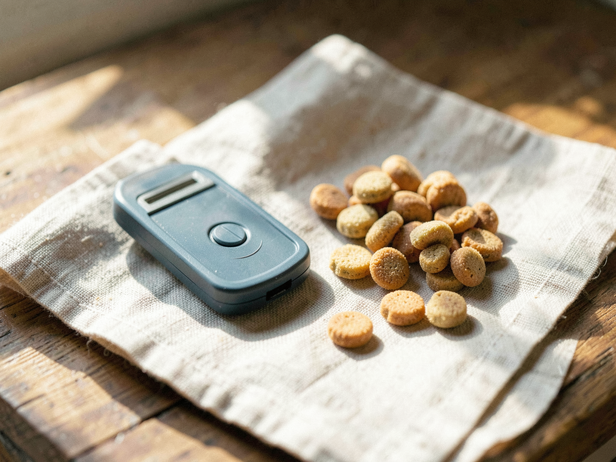
![Clicker Training Essentials]()
Clicker Training Essentials
Image credit : AI
I'm preparing for positive reinforcement cat training steps with my clicker and treats.
What you need before you start
A clicker or a consistent marker word. Small, soft treats the cat does not get at any other time, something with a strong smell works better than dry kibble. A quiet room with no other pets or distractions. Sessions of two to three minutes, not longer. Cats have short training attention spans, and ending while the cat is still engaged is better than pushing until it walks away. Three short sessions across a day will move faster than one long one.
Check that your cat is not full. A cat that has just eaten has no reason to work for food. Train before a meal, not after.
The five steps
Step one: load the clicker. Click once, give a treat. Repeat ten times across one session until the cat looks at you when it hears the click. This step teaches the cat that the click predicts food. Do nothing else until this is solid.
Step two: capture a paw lift. Hold a treat in your closed fist at the cat's shoulder height. Wait. The cat will sniff, then bat at your hand. The moment a paw leaves the ground and touches your fist, click and open your hand. Repeat until the cat is batting your fist reliably within a few seconds of you presenting it.
Step three: open your hand. Switch from a closed fist to an open flat palm, treat resting on it. The cat will bat at the palm to get the treat. Click the moment the paw touches your hand, then let the cat take the treat. The paw-to-palm contact is now the behaviour.
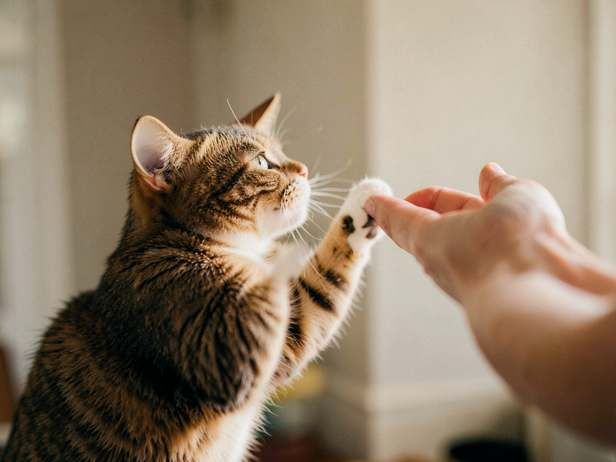
Step four: raise the palm. Gradually lift your open palm so the cat has to reach up slightly to make contact. Click and treat every successful touch. Do this across several sessions, raising the height a small amount each time. The cat is now reaching up to a raised palm, which is the high-five.
Step five: remove the treat from the palm. Present the open palm with no treat on it. The cat should reach up to touch it from habit. Click the moment it does, then produce the treat from your other hand. Once the cat is touching a bare palm reliably, you have a high-five on cue. You can add a verbal cue, say "high-five" just before you raise your palm, and the cat will eventually connect the word to the action.
![Cat reaching for palm]()
Cat reaching for palm
Image credit : AI
Learning to high-five, a gentle connection in our home.
When it stops working mid-session
If the cat stops responding, the session has gone too long, the treat is not interesting enough, or you jumped a step too quickly. End the session on whatever the cat last did correctly, even if that is just looking at you. Come back in an hour. If the cat is consistently not offering the paw bat in step two, try a slightly smellier treat, or try the session in a different spot. Some cats find a particular room or surface distracting.
If the cat bites or swipes with claws out rather than a soft paw touch, stop the session immediately and do not restart that day. This is not aggression toward you, it is usually frustration at a step that moved too fast. Go back one step at the next session and stay there longer.
How long it realistically takes
A cat with no prior clicker training can reach a reliable high-five in one to three weeks of consistent short sessions. Some cats get there in a few days. Others plateau at step three for a week before something clicks. The timeline depends on how food-motivated the cat is, how consistent the sessions are, and whether the marker timing is accurate. If your timing is off, clicking half a second after the paw lifts rather than during, the cat is learning something slightly different from what you intend. Slowing down and watching closely is faster than rushing through the steps.
The high-five is worth learning for its own sake, and also because it builds the foundation for every other trick. A cat that understands marker training and trusts that offering behaviour produces good things will learn a sit, a spin, or a target-stick follow far faster than a cat starting from scratch.