Cockatiels whistle before they talk, and many never bother with words at all. That is not a training failure, it is the species doing what it does best. A male cockatiel in the wild uses whistled phrases to mark territory and attract a mate, which means the drive to produce and repeat melodic sounds is already wired in. What training does is give that drive a specific target.
How cockatiels learn sounds
Cockatiels are vocal learners, which means they acquire sounds by listening and then practising, the same broad mechanism that underlies human speech. Young birds in their first year are in a sensitive period where new sounds are picked up fastest, but adult cockatiels can and do learn new whistles, it just takes more repetition. The bird does not understand the tune as music. It hears a pattern, attempts to reproduce it, and gets reinforced when the attempt is close. Over sessions, the approximation tightens. This is why the training method below is built around short, identical repetitions rather than long musical passages: the bird is pattern-matching, not performing.
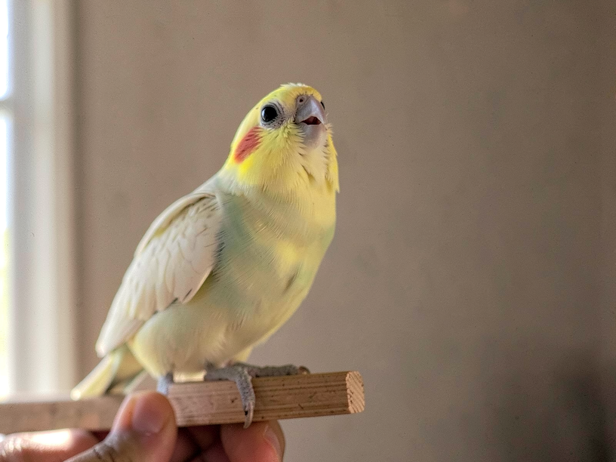
![Cockatiel Mid-Song]()
Cockatiel Mid-Song
Image credit : AI
I observe a cockatiel in mid-vocalization, its head tilted upwards. This candid shot highlights its true-to-life texture, perfect for understanding cockatiel vocal learning steps.
Choosing the right tune
Pick something short, distinct, and easy to reproduce consistently yourself. Four to six notes is a realistic target for a first tune. The opening bars of a simple melody work well; anything with a long run of similar notes in the middle will blur into noise for the bird. Avoid tunes that sound like other things in the environment, a phrase that resembles a door chime or a phone notification will confuse the association. Whistle it yourself rather than playing a recording. Live sound from a person the bird is bonded to carries more weight than a speaker, and you will naturally pause and watch for a response in a way a recording cannot.
The training sequence
Start in a quiet room with the bird out of its cage and settled, not immediately after waking, not when it is already vocalising at high volume. Sit at eye level, roughly an arm's length away. Whistle the tune once, clearly and at the same tempo every time. Then wait fifteen to twenty seconds. If the bird makes any sound, a partial phrase, a single note, a chirp, respond immediately with calm, warm praise and, if the bird accepts food rewards, a small piece of millet. Do not repeat the tune as the reward; that blurs what the reinforcer is. If there is no response after twenty seconds, whistle again and wait. Keep sessions to five minutes. Two or three sessions a day is enough; more than that and the bird stops treating it as an event worth paying attention to. Progress through cockatiels is rarely linear. A bird may produce a convincing first note within a few days and then seem to plateau for a week. That plateau is usually consolidation, not stalling, the pattern is being processed. Keep the sessions consistent and resist the urge to switch to a different tune. Changing the target mid-training resets the process.
![Millet Seeds for Birds]()
Millet Seeds for Birds
Image credit : AI
Preparing for cockatiel vocal learning steps with fresh millet seeds. This simple setup aids in training.
When it is not working
If there is no attempt at the sound after two to three weeks of daily sessions, check a few things. First, the bond: cockatiels learn most readily from people they are comfortable with. A bird that is still hand-shy or easily startled is not in a state to attend to training. Spend time on simple socialisation before returning to whistle work. Second, health: a bird that has gone quieter overall, is fluffed up, or has stopped its normal contact calls may be unwell. Reduced vocalisation is one of the earlier signs that something is off, and a vet check is the right next step before assuming a training problem. Third, the environment: background television, other birds calling, or a busy room will compete with the target sound. Simplify the setting. A bird that whistles confidently in one room and goes silent in another is responding to the environment, not forgetting the tune.