Most owners describe the same moment: the walk is going fine, then another dog appears fifty metres away and their dog transforms, lunging forward, barking, straining at the end of the leash until the other dog is out of sight. The dog that does this at home is calm, friendly, even lazy. On the leash, it looks like a different animal.
What leash reactivity actually is
A reactive dog is not an aggressive dog, though the two can overlap. Reactivity means the dog responds to a trigger, another dog, a stranger, a cyclist, a child, with behaviour that is out of proportion to the actual threat. The response is driven by arousal and frustration, or sometimes by fear, and the leash is a key part of why it looks so extreme.
Off leash, a dog has options. It can approach, sniff, circle, or leave. On a leash, all of those choices are removed. When a trigger appears, the dog cannot do any of the things that would normally resolve the situation. The tension in the leash adds physical arousal on top of the emotional arousal already building. The result is a dog that escalates fast and comes down slowly.
Fear and frustration produce the same outward behaviour, barking, lunging, hackles up, which is why the cause matters before the training starts. A dog that lunges because it desperately wants to greet other dogs needs a different approach from one that lunges because it is frightened of them.
![Golden Hour Park Encounter]()
Golden Hour Park Encounter
Image credit : AI
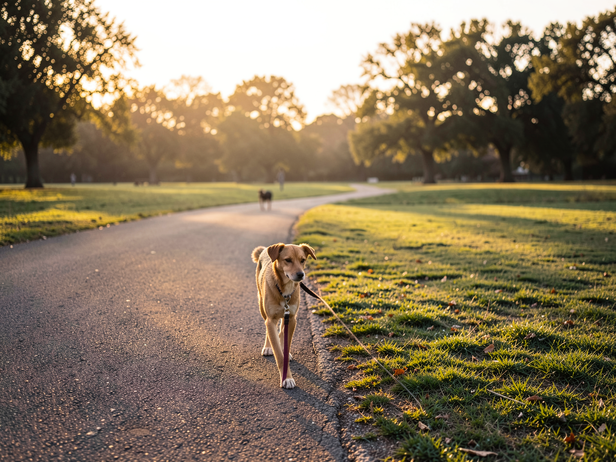
Observing a distant dog, I remain still, practicing leash reactivity awareness in the golden hour glow.
Why the leash makes everything worse
The concept that explains most of what happens on a walk is threshold. Every dog has a distance at which a trigger stops being manageable. Below that distance, the dog cannot think, cannot take a treat, cannot hear a cue. Above it, the dog notices the trigger but can still function. Trainers call this working above threshold, and it is where all useful learning happens.
The leash removes the dog's ability to control its own distance. A loose dog that feels uncomfortable with another dog approaching will curve away, sniff the ground, or simply leave. A leashed dog cannot do any of this. The owner, often without realising it, tightens the leash as the trigger approaches, which the dog reads as a signal that something is wrong, adding another layer of arousal.
Repeated exposure to triggers while over threshold does not teach the dog that triggers are safe. It does the opposite. Each episode where the dog cannot escape and the situation resolves only when the trigger leaves confirms the dog's belief that barking and lunging works. The behaviour is self-reinforcing.
Where to start: distance and observation
The first practical step is not a training exercise. It is finding the dog's threshold distance for its main trigger, and then managing every walk so the dog stays above it.
This means crossing the road when another dog appears, turning around before a trigger gets close, and choosing quieter routes or quieter times of day. This is not avoidance in the sense of giving up, it is management that stops the rehearsal of the reactive behaviour while the training work begins. Every lunge is a repetition that makes the next one more likely. Cutting the repetitions is itself progress.
Once the threshold distance is roughly known, the training approach is desensitisation paired with counter-conditioning. The dog is exposed to the trigger at a distance where it can still function, it notices the trigger but has not tipped over, and something it genuinely values, usually a high-value food, appears the moment the trigger comes into view and stops when the trigger disappears. Over many sessions, the trigger begins to predict good things rather than an unresolvable situation. The emotional response shifts, and with it the behaviour.
The steps take weeks, sometimes months. Progress is measured in metres: the dog can now cope at forty metres where it could not cope at sixty. That is real progress, even if it does not look dramatic.
![Calm dog awaits treat]()
Calm dog awaits treat
Image credit : AI
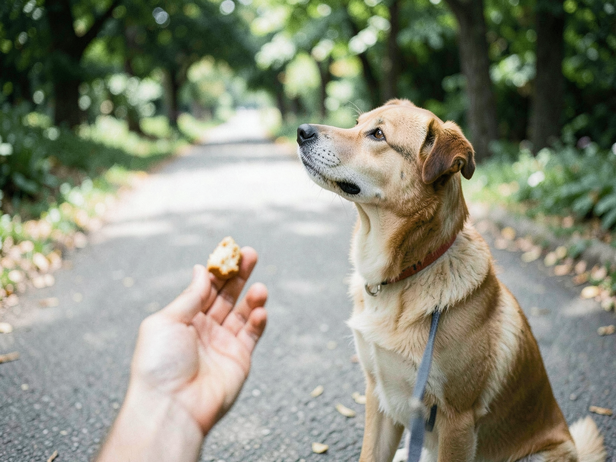
A quiet moment of trust and patience on our walk. Learning how to calm a reactive dog on leash is key to these peaceful interactions.
What not to do, and when to get help
Punishment, a leash jerk, a loud noise, a spray, applied when the dog lunges adds pain or fright to a moment when the dog is already overwhelmed. It does not teach the dog what to do instead. In a fearful dog, it reliably makes reactivity worse. Reward-based methods are the standard of care for reactivity because they address the emotional state driving the behaviour, not just the behaviour itself.
If the dog has made contact with another dog or a person, or if the reactivity is escalating rather than staying stable, a qualified trainer or veterinary behaviourist is the right next step, not a YouTube protocol. Reactivity that involves a bite history, or that is getting worse despite consistent management, can have a medical component: pain, thyroid dysfunction, or neurological changes can all raise a dog's reactivity. A vet check before or alongside the training work is reasonable whenever the onset was sudden or the escalation is unexplained.
Leash reactivity is one of the most common reasons owners stop walking their dogs, and one of the most successfully managed with the right approach. The leash did not create the problem, but understanding what it takes away from the dog is where every useful solution begins.