Rabbits are not random about where they go. Left to their own devices, they pick a corner and stick to it, sometimes two or three corners, but always the same ones. Litter training does not teach a rabbit a new behaviour; it redirects one that is already happening.
Start with the right box and the right litter
A litter box for a rabbit is not the same as one for a cat. It needs to be large enough for the rabbit to sit fully inside with room to turn, most cat litter boxes sold in India are actually a good size for a medium rabbit. Avoid covered boxes; rabbits do not like enclosed spaces for toileting and the ammonia builds up fast.
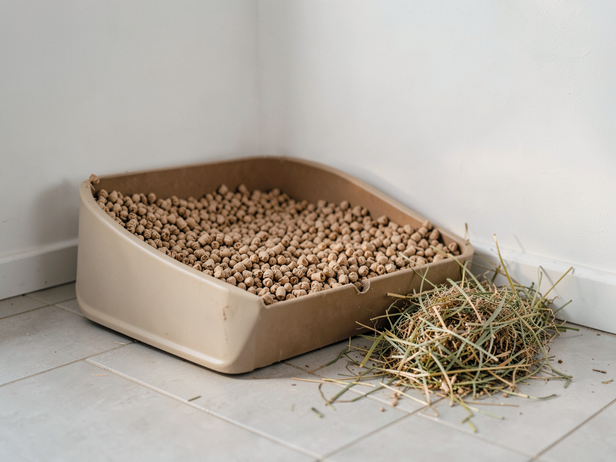
The litter itself matters more than most guides admit. Avoid clumping clay cat litter, rabbits dig in their boxes and will ingest it. Avoid cedar or pine shavings, which release phenols that stress the liver over time. Paper-based pellet litter, dried compressed sugarcane bagasse, or a thick layer of hay work well. Hay is the best option because rabbits eat while they toilet, a habit that is normal and useful, so placing a hay rack directly above or inside the box encourages the rabbit to spend time there.
![Rabbit Litter Box Setup]()
Rabbit Litter Box Setup
Image credit : AI
My rabbit's litter box setup, featuring paper pellets and hay. Essential for rabbit toilet training at home.
Watch where the rabbit already goes
Before placing the box, spend one or two days observing. Let the rabbit out in a limited space, one room, or one corner of the room, and note which corner it returns to. Place the box there. If it has chosen two corners, start with two boxes.
This step is skipped most often and is the reason most early attempts fail. A box placed where the owner wants it rather than where the rabbit has already decided is a box the rabbit will ignore.
Confine first, expand gradually
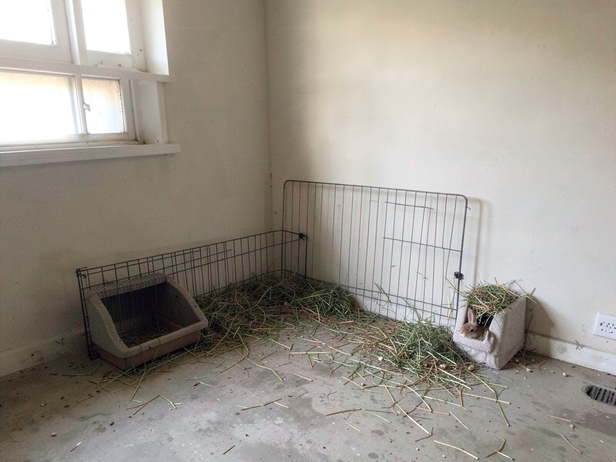
Free-roaming the whole flat from day one makes training much harder. Start with a pen or a single room. Once the rabbit is using the box reliably, meaning four or five days with no accidents outside it, expand the space by one room. If accidents reappear in the new space, add a second box in the corner the rabbit has chosen there.
The expansion-and-watch pattern continues until the rabbit has access to the full flat. Most rabbits reach this point within three to six weeks, though unneutered rabbits take longer and often plateau without neutering.
![Rabbit Pen Setup]()
Rabbit Pen Setup
Image credit : AI
I'm setting up my rabbit's pen, focusing on litter training with a hay-filled box.
Neutering makes a significant difference
An unneutered rabbit, male or female, has a strong hormonal drive to mark territory. Males spray urine; females scatter droppings as territorial signals. Neither is a training failure. Both are biology.
Neutering removes most of this drive. A neutered rabbit typically becomes reliable in the box within one to two weeks of recovery. If a rabbit that was previously trained suddenly starts marking again, a vet visit is worth making, pain, a urinary tract infection, or a new animal in the home can all trigger regression.
Handle accidents without punishment
When a rabbit toilets outside the box, clean it up without reaction. Rabbits do not connect a scolding delivered after the fact with the act itself, they connect it with the person delivering it, which damages trust without changing the behaviour.
Clean accidents with a diluted white vinegar solution rather than ammonia-based cleaners. Ammonia smells like urine to a rabbit and signals that this spot is an acceptable toilet. After cleaning, place a small amount of the rabbit's droppings inside the litter box to reinforce which location is correct.
Punishment-based methods, startling, chasing, or confining as a consequence, are not used here. They produce a rabbit that is afraid of its owner, not a rabbit that uses its box.
What to do when it stops working
Regression is common during adolescence, after a move, after a new animal arrives, or after any change in the rabbit's routine. It is not the training breaking down; it is the rabbit responding to stress or hormonal change.
Go back to the confinement step. Reduce the space, re-establish the habit, and expand again. Most rabbits return to reliable box use within a week once the space is managed again. If a rabbit that has been reliably trained suddenly begins straining, producing very small or misshapen droppings, or stops eating, those are signs for a vet, not a training problem.