Nail trims are one of the most reliably dreaded routines in dog ownership, and the dread usually belongs to both parties. The dog pulls away, the owner tightens the grip, and what follows is a struggle that makes the next session harder than the last. The problem is not the nail clipper. It is the absence of any training that gave the dog a reason to stay still and a way to say when it has had enough.
Why dogs resist, and why restraint makes it worse
Dogs do not arrive home afraid of nail trims. The fear is learned, usually through early experiences where the paw was grabbed without warning, held against resistance, or the quick was clipped and it hurt. The dog's nervous system files that sequence, sudden restraint, pain, no exit, and retrieves it the next time the clippers appear. Flooding, which means holding the dog until it stops struggling, does not teach tolerance. It teaches the dog that struggling is futile, and it leaves the underlying anxiety intact. The next session, the dog starts at a higher level of arousal because it remembers how the last one ended. Cooperative care works on a different principle: the dog is never held in place. It is trained to offer the behaviour, and it retains the ability to opt out. That opt-out is what makes the opt-in meaningful.
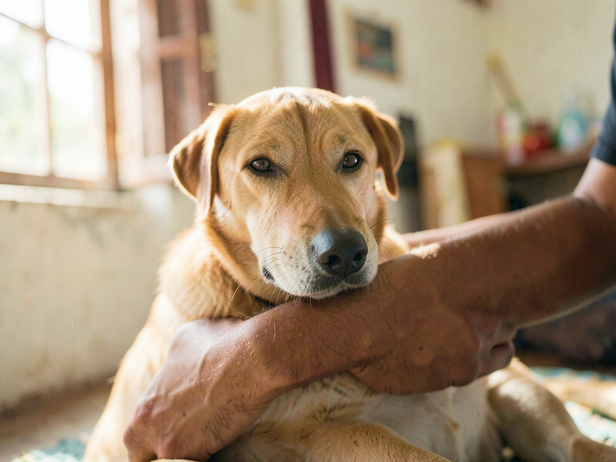
![Gentle Paw Handling Moment]()
Gentle Paw Handling Moment
Image credit : AI
Practicing cooperative care dog paw handling for a calm experience. Gentle touch and trust.
The foundation: a chin rest and a start button
Before the clippers come out, the dog needs two things: a position it can hold voluntarily, and a signal it controls that means the session continues. The chin rest is the position. Ask the dog to rest its chin on your open palm or on a low surface. Mark the moment it makes contact, a clicker or a short verbal marker like "yes", and reward with a small piece of food. Build duration slowly. The dog should be able to hold the chin rest for five to eight seconds before you move forward. The start button is a behaviour the dog offers to say it is ready for the next step. Many trainers use the chin rest itself: the dog lifts its chin to end a step, and puts it back down to begin the next one. Others use nose targeting to a hand or a mat. The specific behaviour matters less than the function, the dog controls the pace. Once the dog understands that putting its chin down starts something and lifting it stops something, you have a communication system. That system is the whole framework for what follows.
Desensitisation: working up to the clipper in stages
Desensitisation means introducing the stimulus gradually, at an intensity the dog can handle without going over threshold, the point where the dog stops thinking and starts reacting. Each stage is a separate training session, ideally on separate days, until the dog is relaxed before you move forward. Stage one: show the clipper at a distance. Mark and reward for calm attention. Stage two: bring the clipper closer. Mark and reward. Stage three: touch the clipper to the dog's leg, not the paw, while the dog holds the chin rest. Mark and reward. Stage four: hold the paw gently, no clipper, for one second. Mark and reward. Stage five: touch the clipper to one nail. Mark and reward. Stage six: clip one nail. Mark and reward, then end the session. One nail is a complete session in the early stages. This is not a shortcut being skipped, it is the training. Dogs that learn the process this way typically reach a full paw trim within two to four weeks of daily five-minute sessions, though individual dogs vary considerably and some take longer. If the dog is showing stress signals at any stage, yawning, lip licking, turning away, freezing, or trying to leave, you have moved too fast. Go back one stage and spend more time there.
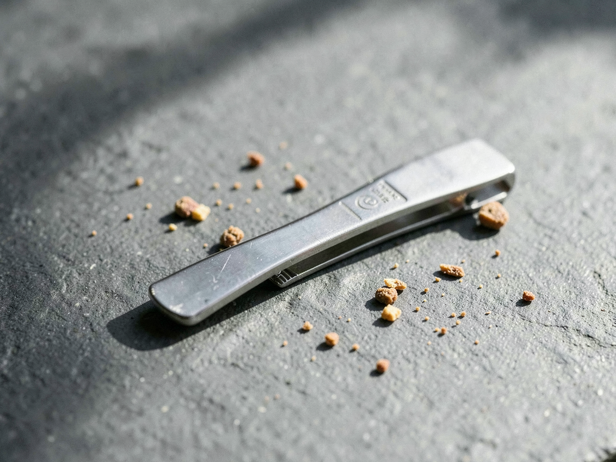
![Nail Care Essentials]()
Nail Care Essentials
Image credit : AI
Preparing for a dog nail trim training session with essential tools and positive reinforcement.
Counter-conditioning: changing what the clipper predicts
Desensitisation reduces the dog's reaction to the stimulus. Counter-conditioning changes the emotional association, from something that predicts discomfort to something that predicts good things. The two work together. Every time the clipper appears, something the dog genuinely values appears with it. High-value food works best: small pieces of chicken, cheese, or whatever the dog finds most motivating. The sequence matters. Clipper appears, food appears. Not the other way around. The dog's brain is making a prediction: clipper means food is coming. Over enough repetitions, the clipper stops being a threat cue. If the dog is already reactive to the clipper, backing away, barking, or shutting down when it appears, start counter-conditioning before you attempt any handling. The dog cannot learn a new association while it is over threshold.
When this needs a professional
Some dogs arrive at cooperative care training with a history that makes home training unsafe or genuinely ineffective. A dog that has bitten during nail trims, that shows extreme fear responses, trembling, attempting to escape, aggression, or that has not made progress after several weeks of consistent training needs a qualified veterinary behaviourist or a certified professional dog trainer with experience in cooperative care and fear-free handling. A vet visit is also warranted if the dog's nails have grown long enough to affect its gait or if the quick has extended significantly, which changes how the trim needs to be approached. Cooperative care is not a substitute for that assessment, it is what makes future trims manageable once the immediate problem is addressed.