The question comes up in every training conversation: how many days until this works? The number floating around social media is usually seven to ten days, which is optimistic for most behaviours and misleading for almost all of them. The actual range depends on what you are teaching, which species you are teaching, and whether the learning conditions are consistent enough for the animal to make the connection at all.
How animals learn: the principle behind the timeline
A new behaviour forms through positive reinforcement, the animal does something, a reward follows immediately, and the brain strengthens that neural pathway. The speed of that strengthening depends on three things: how precisely the reward lands after the behaviour (marker timing), how often the animal gets to practise in a session, and whether the environment stays consistent enough that the animal can predict the outcome. A clicker or a short marker word like "yes" closes the timing gap between behaviour and reward. Without a marker, the dog or cat is guessing which part of the last three seconds earned the treat. That gap alone can double training time. Desensitisation and counter-conditioning, used for fears, reactivity, and anything the animal already has a strong feeling about, work on a slower clock than simple cue-response training, because you are not just building a new pathway, you are also quieting an existing emotional response.
![Training Essentials Laid Out]()
Training Essentials Laid Out
Image credit : AI
Preparing for positive reinforcement training. Realistic expectations are key for pet behaviour training duration.
Realistic ranges for dogs
A basic sit from a dog with no prior training typically takes five to fifteen short sessions of three to five minutes each, spread across a few days, before the behaviour is reliably offered on cue in a low-distraction room. "Reliably" means eight or nine times out of ten, not every single time. Generalising that sit to a different room, a park, or a doorway takes additional repetitions, often as many again, because dogs do not automatically transfer a learnt behaviour across contexts. This is not stubbornness; it is how mammalian learning works. A recall from any distance, in any environment, with any distraction present is a behaviour that takes months of consistent practice to reach competition-level reliability. Most pet owners reach a functional recall, the dog comes when called in familiar outdoor spaces, in six to twelve weeks of daily short sessions. Loose-leash walking, one of the most requested behaviours, has no clean endpoint. Most dogs show meaningful improvement in three to four weeks of consistent practice, but the behaviour degrades quickly if the owner stops rewarding it. Separation anxiety and resource guarding are not training problems in the ordinary sense, they are emotional and physiological states that require a qualified trainer or veterinary behaviourist, and timelines of weeks to months are normal even with professional guidance.
Realistic ranges for cats
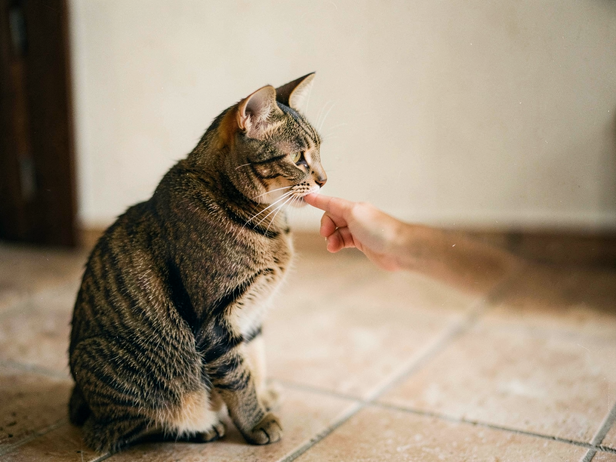
Cats learn through the same reinforcement principles as dogs, but they have shorter optimal session lengths, two to three minutes, sometimes less, and a narrower window of motivation. A cat that is not hungry, not curious, or not in the mood will not engage, and pushing past that point sets the behaviour back rather than forward. A simple target touch, where the cat taps a finger or a stick with its nose, can be established in three to five sessions for a food-motivated cat. Sit on cue follows a similar arc. Coming when called, the cat equivalent of a recall, is achievable in two to four weeks for most cats, but the reliability ceiling is lower than for dogs, and that is not a failure of the cat or the owner. Cats did not evolve in a social structure that made proximity to a caller rewarding in itself. The reward has to be real and immediate every time, for longer than it does with dogs. Litter training for a kitten is not operant conditioning in the usual sense, it relies on the cat's existing preference for loose substrate and a clean, accessible tray. Most kittens are using the tray reliably within days of arrival. If a cat that was litter-trained stops using the tray, that is a signal worth showing a vet before assuming it is a training problem.
![Cat's Curious Touch]()
Cat's Curious Touch
Image credit : AI
A tabby cat's gentle curiosity, a moment of connection. Understanding how long to train a cat is key to these interactions.
The variables that change every estimate
Age matters less than people assume for basic behaviours, adult dogs and cats learn new cues at a comparable rate to younger animals, though older animals may take longer to unlearn existing habits. What matters more is the animal's history: a dog that has been inadvertently rewarded for jumping for two years needs longer to stop than a puppy who has never tried it. Session length and frequency matter more than total hours. Five three-minute sessions across a day produce faster results than one fifteen-minute session, because fatigue and frustration erode the animal's ability to make the connection. Consistency across everyone in the household is the variable most owners underestimate. One person rewarding a behaviour that another person is trying to extinguish does not slow progress by half, it can stop it entirely, because the animal is now on a variable reinforcement schedule, which is the most powerful schedule for maintaining behaviour, not for changing it. Health is the variable that ends training conversations. Pain changes behaviour. A dog that suddenly cannot hold a sit, a cat that stops engaging with food rewards it previously loved, or any animal whose behaviour changes sharply without a change in training should be seen by a vet before the owner assumes the training has failed.