A dog that hoovers food off the kitchen platform is not being naughty. It found food there once, possibly twice, and its brain filed that surface under 'worth checking'. Every successful steal since then has made the habit stronger. That is positive reinforcement working against you, and the only way to reverse it is to make the same principle work for you.
Why dogs counter-surf in the first place
Counter-surfing is scent-driven. A dog's nose is thousands of times more sensitive than a human's, and a kitchen platform in an Indian home, dal simmering, roti on the tawa, yesterday's sabzi in a steel bowl, is broadcasting a continuous invitation. Tall dogs reach with ease. Medium dogs learn that jumping gives them access. Small dogs find the chair that gives them the step up. The size of the dog changes the method; the motivation is identical across all of them.
The behaviour is also self-reinforcing in a way that most unwanted behaviours are not. Every time the dog finds something, a crust, a spill, an unattended piece of paneer, the behaviour gets stronger without any input from you. This is why scolding after the fact does nothing useful. The dog has already had its reward, and the gap between the act and your reaction is too long for it to connect the two.
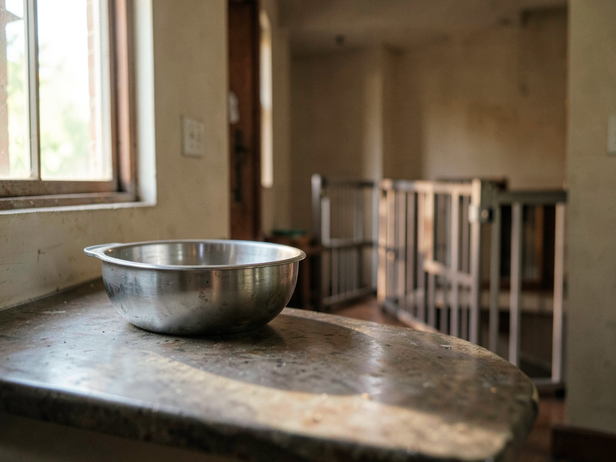
![Indian Kitchen Counter Still Life]()
Indian Kitchen Counter Still Life
Image credit : AI
A quiet moment on the kitchen counter, a reminder to stop dog jumping on kitchen counter India.
The management layer comes first
Training takes time. Management is what you do while training is working. These two run in parallel, not in sequence.
Remove the reward from the surface. Nothing edible stays on the platform when you are not in the kitchen. Covered pots, food in the fridge, bread in a cupboard. A dog that finds nothing on the counter for two weeks is a dog whose counter-checking habit starts to weaken on its own, because the behaviour is no longer being intermittently rewarded.
Limit access when you cannot supervise. A baby gate across the kitchen entrance is the simplest solution in a flat. It does not punish the dog; it simply removes the opportunity while you are not there to redirect.
The training steps, in order
The goal is to teach the dog that keeping four paws on the floor near the kitchen is the behaviour that pays. You are not teaching the dog that the counter is forbidden, that framing requires punishment, which does not work here and can damage trust. You are teaching it that the floor is where good things happen.
Step one: load the floor, not the counter. For one week, every time you are in the kitchen and the dog is nearby with all four paws on the floor, mark the moment with a short word, 'yes' works, and drop a small treat on the floor. You are not asking for anything. You are simply marking the default behaviour you want and paying for it. The dog will start to notice that standing near you in the kitchen, feet down, produces food from the sky.
Step two: add a cue. Once the dog is reliably keeping its feet on the floor while you cook, put the behaviour on a cue. 'Off' or 'floor' said once, calmly, the moment the dog approaches the counter with intent. If its feet stay down, mark and reward. If it jumps, say nothing, turn away, and wait. The moment all four paws return to the floor, mark and reward. Never repeat the cue more than once. Repeated cues teach the dog that the first one was optional.
Step three: raise the difficulty slowly. Start with low-value food on the counter, an empty bowl, a roti wrapper. Reward heavily for feet on the floor. Over several sessions, increase what is visible on the counter. This is called desensitisation: you are lowering the emotional charge of the stimulus by pairing it with something good happening at floor level.
Step four: proof in real cooking situations. Practice while you are actually cooking, not just during training sessions. Keep treats in a small bowl on a high shelf. The dog cannot reach the treats; you can. Every time it holds position while you move food around, reward it.
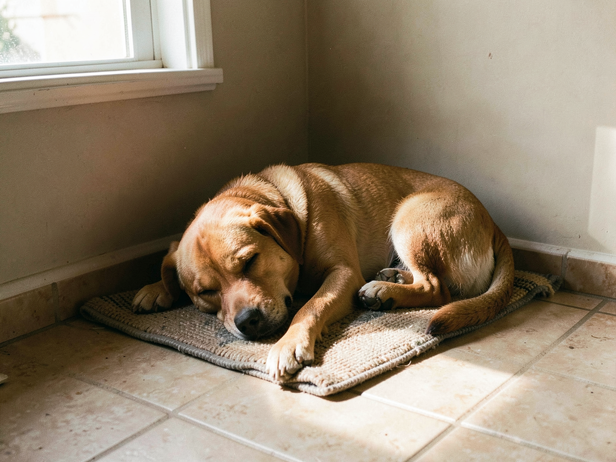
Step five: teach an incompatible behaviour. A dog lying on a mat in the corner of the kitchen cannot simultaneously be on the counter. 'Go to your mat' is a standard positive-reinforcement behaviour that takes two to three weeks of short daily sessions to build reliably. Once it is solid, sending the dog to the mat while you cook removes the problem entirely.
Step six: never reward jumping, even accidentally. This includes eye contact, pushing the dog down with your hands, or saying its name. All of these are attention, and attention is a reward for a social animal. Turn your back and wait for four paws on the floor.
![Relaxed Dog on Kitchen Mat]()
Relaxed Dog on Kitchen Mat
Image credit : AI
A peaceful moment for this dog, resting on its mat. Perfect for understanding positive reinforcement dog counter training.
What makes it harder, and what to do
Inconsistency across people in the flat is the single biggest reason counter-surfing training fails. If one person in the house finds it funny and lets it go, the dog is on a variable reinforcement schedule, the most powerful schedule for maintaining a behaviour. Everyone in the home needs to follow the same protocol.
Some dogs are more persistent than others, particularly breeds with strong food motivation or high energy and not enough physical exercise. A dog that is under-exercised is harder to train for anything, because its arousal level is already elevated. A thirty-minute walk before a training session is not a bonus; it is part of the method.
If the dog is jumping and grabbing food in a way that feels frantic or compulsive rather than opportunistic, or if it has guarded food it has stolen and shown teeth, that is a different situation. A qualified trainer or veterinary behaviourist is the right next step, not a stricter version of the same protocol.
A note on what not to do
Punishment-based methods, a shake can, a spray bottle, double-sided tape on the counter, a noise alarm, may suppress the behaviour when you are present and do nothing when you are not. They also introduce stress without teaching the dog what to do instead. Reward-based training takes longer to show results in the first week and produces a more durable outcome in the second month.
The kitchen platform in most Indian flats is also a safety issue beyond the training question. Onion, garlic, grapes, certain spices, and cooked bones are genuinely dangerous to dogs. A dog that has learned the counter is worth checking will eventually find something that harms it. The training is not about manners. It is about keeping the dog safe in a space full of things that are not safe for it.