Most cat owners in Indian flats discover the same thing within the first few months: the apartment is quiet all day, and then, somewhere between 10 pm and 2 am, the cat decides it is time to sprint, yowl, and knock things off shelves. This is not misbehaviour. It is a cat doing exactly what its body is built to do, at exactly the wrong time for everyone else trying to sleep.
Why cats are loud and active at night
Cats are crepuscular, meaning their nervous system is wired for peak activity at dusk and dawn. In the wild, this is when small prey is most active. A domestic cat living in a flat retains that wiring completely. The yowling specifically can mean several things: pent-up predatory energy with no outlet, a request for social interaction, or, in unspayed or unneutered cats, a hormonal call that has nothing to do with boredom and everything to do with reproduction. Before starting any training approach, rule out the last one. An intact cat yowling at night is not a training problem, it is a veterinary and welfare one. Spaying or neutering resolves it far more reliably than any behavioural technique.
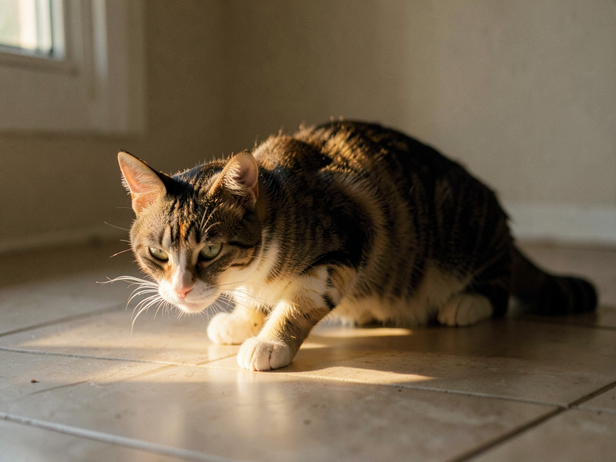
![Cat's Evening Stalk]()
Cat's Evening Stalk
Image credit : AI
I am in my evening energy, a silent hunter on the tiled floor. This is my cat night-time behaviour.
The session before bed: using predatory play to drain the tank
The single most effective intervention is a structured play session thirty to forty-five minutes before you want the cat to settle. The principle is predatory sequence completion: cats are wired to stalk, chase, catch, and then rest. A play session that runs through all four stages, slow stalk-like movement of a wand toy, faster chase, a final catch where the cat pins the toy, ends with a cat that is physiologically ready to groom and sleep. A session that stops mid-chase leaves the predatory drive activated. Use a wand toy or a laser pointer followed by a physical toy the cat can actually catch and hold. Ten to fifteen minutes of active engagement is usually enough. The timing matters: too early and the energy rebuilds before you sleep; too close to bedtime and the cat is still aroused when you turn off the light.
Feeding after play, not before
Pair the end of the play session with the cat's largest meal of the day. This replicates the natural sequence of hunt, catch, eat, groom, sleep. A cat that has eaten after exertion is far more likely to settle than one that ate two hours earlier and has been lying around since. If you use an automatic feeder, set it to dispense a small portion at the time you want the cat quiet, the anticipation of food can itself reduce vocalisation. Puzzle feeders used during the evening extend mental engagement and slow eating, which helps the settling process.
![Kibble and Puzzle Feeder]()
Kibble and Puzzle Feeder
Image credit : AI
A quiet moment before evening energy. This scene hints at cat night-time behaviour.
What not to do when the yowling starts
Positive reinforcement is the only training method this publication recommends, and it matters here because the mistake most owners make is the opposite: they respond to yowling. Talking to the cat, getting up to feed it, letting it into the bedroom, or even shouting at it all reinforce the behaviour. The cat learns that yowling at 1 am produces a result. Extinction, stopping all reinforcement, is the counter-conditioning approach, and it is genuinely hard to execute because the yowling often gets louder before it gets quieter. This is a normal part of the process called an extinction burst. Consistency is what ends it. If one person in the household responds on night three, the training resets. Everyone in the flat needs to hold the same line.
Environmental enrichment as the long game
A cat that has nothing to do between your play session and the next morning will find something to do. Vertical space, a tall cat tree near a window, gives a cat a territory to patrol and a vantage point that satisfies its need to survey. A window with a view of a balcony, a street, or even a bird feeder placed outside gives the cat something to watch. Rotating toys so the same ones are not always available keeps novelty in the environment. These changes do not replace the pre-bed play session; they reduce the baseline restlessness that makes the evening surge worse.
When to stop troubleshooting and call for help
If a cat that previously slept through the night starts yowling without any change in routine, that shift is a clinical signal, not a training problem. Hyperthyroidism, high blood pressure, cognitive dysfunction in older cats, and pain from arthritis or dental disease all present as increased night-time vocalisation. A sudden change in a previously settled cat warrants a vet visit before any behavioural approach. Similarly, if the yowling is accompanied by disorientation, circling, or changes in eating and drinking, see a vet promptly. If the behaviour is severe, long-standing, and not responding to consistent environmental and routine changes, a veterinary behaviourist is the appropriate next step, not more of the same at home.
The evening energy surge is not something you train away; it is something you redirect. A cat that has hunted a wand toy, caught its prey, eaten, and groomed is doing exactly what its biology expects it to do, it just happens to be asleep by the time you need it to be.