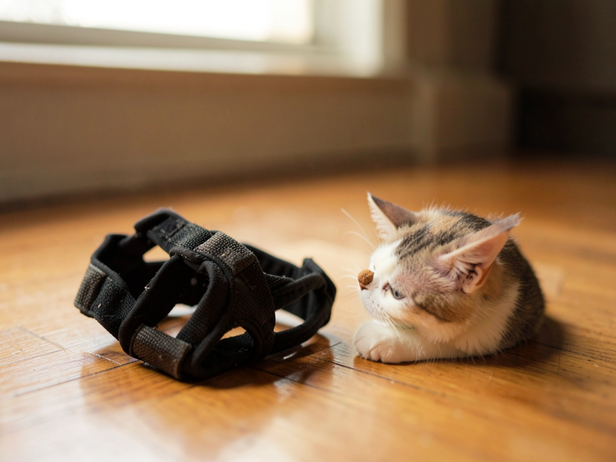
A cat that has never worn anything on its body treats a harness like a trap. That first freeze, the dramatic flop to the floor, the refusal to move, is not stubbornness. It is a sensory system in full alarm. The training process works by shrinking that alarm response one small step at a time, until the harness becomes background noise and the world outside becomes the interesting part.
Choose the right harness before you start
A standard collar is not safe for leash walking. Cats have flexible spines and narrow skulls; they can back out of a collar in seconds. You need a harness that fits snugly without restricting breathing, you should be able to slide two fingers underneath but no more. Two designs work well for cats: the H-harness, which has a strap across the chest and one across the back connected by a spine strap, and the vest harness, which distributes pressure across a broader surface and is often easier for anxious cats to tolerate. Avoid retractable leashes. A fixed leash of roughly 1.5 to 1.8 metres gives you control without jerking the cat when it stops suddenly. Measure your cat's girth just behind the front legs before buying. Most adult cats fall between 28 and 38 centimetres, but measure rather than guess.
![Cat harness and treat ready]()
Cat harness and treat ready
Image credit : AI
Preparing for harness training a cat with a tasty treat. Essential for leash training a cat in a flat.
Phase one: introduction without wearing it
Leave the harness near your cat's sleeping spot for several days. Do not push it toward the cat or drape it over the cat. Let the cat sniff it, rub against it, ignore it. This step uses a learning principle called habituation, repeated, neutral exposure to a stimulus until it stops triggering a response. It sounds too passive to matter. It matters. Once the cat shows no reaction to the harness sitting nearby, move to brief, positive associations. Hold the harness open near the cat and immediately offer a small, high-value treat, cooked chicken, a lick of plain tuna, whatever your cat finds genuinely exciting. Repeat this several times a day for three to five days. The harness predicts something good. That is the whole lesson at this stage.
Phase two: putting it on and taking it off
The first time you fasten the harness, do it quickly and calmly, give a treat the moment it is on, and take it off within thirty seconds. The cat does not need to do anything. It just needs to not panic. Gradually extend the time the harness stays on across sessions over one to two weeks. Most cats go through a predictable sequence: freeze, flop, attempt to shake it off, walk stiffly, eventually walk normally. Do not skip ahead because a session went well. A cat that walks normally in the harness indoors for five minutes across several sessions is ready for the next phase. A cat that is still flopping after two weeks may need a different harness design or a slower pace, not more pressure. Desensitisation cannot be rushed. If the cat struggles, scratches to remove the harness, or vocalises in distress, end the session, give a treat anyway, and start shorter the next day. A bad session sets the process back further than a slow one.
![Leash on Tiled Floor]()
Leash on Tiled Floor
Image credit : AI
Preparing for harness training cat adventures. This leash awaits its furry companion.
Phase three: the leash indoors
Attach the leash to the harness while the cat is indoors and let it drag. Do not hold the other end yet. Let the cat get used to the weight and the sound of it moving across the floor. After a few sessions, pick up the end of the leash and follow the cat wherever it goes. You are not steering, you are just adding light tension so the cat learns the leash is there without learning that it restricts. Counter-conditioning applies here: every time the cat moves forward with the leash attached and does not freeze, reward it. Over several sessions, begin introducing very gentle directional guidance, a slight change of direction, a pause. Keep sessions under ten minutes. Cats do not have the working attention span of dogs, and a bored or tired cat will begin to associate the harness with frustration.
Phase four: the first outdoor session
The first time outside should be in a quiet, enclosed space, a balcony, a small courtyard, or a low-traffic area early in the morning. Carry the cat out rather than walking it to the door. Let it sit in your arms and observe before setting it down. Some cats will explore immediately. Most will crouch low and watch for several minutes. Both responses are normal. Do not pull the leash to move the cat. Let it lead. Keep the first session to five minutes. Gradually extend duration and introduce more complex environments only after the cat moves confidently and relaxed in the simpler one. Busy streets, other animals, and loud sounds are advanced environments. Many cats never reach them, and that is fine. A calm ten minutes on a quiet terrace is a successful outcome. If at any point the cat shows signs of acute stress, pupils fully dilated, ears flat, tail tucked, attempting to bolt, end the session immediately. A frightened cat can injure itself trying to escape, and a harness that fits well will hold, which means a panicked cat at the end of a leash is a genuine safety risk. When you are back indoors, let the cat decompress in a quiet room before removing the harness.
Harness training works for many cats and does not work for some. A cat that remains distressed after weeks of patient, incremental work is telling you something real. The goal is a cat that tolerates and then enjoys outdoor time, not a cat that endures it. If your cat's stress responses are intense or persist despite slow, reward-based work, a qualified cat behaviourist or veterinary behaviourist can assess whether the training approach needs to change or whether outdoor access is the right goal for that particular animal.