A dog that treats an open door as a starting pistol is not being dominant or wilful. It has simply never been taught that the threshold is a place to pause, and every time it has charged through and nothing bad happened, the behaviour got a little more practised. The good news is that door-dashing is one of the cleaner problems to train out, because the environment does most of the work for you: the door is always in the same place, the cue is always the same, and success is visible the moment it happens.
Understand what you are actually training
The skill here is impulse control at a high-excitement trigger. A dog near a door is often already aroused, it can hear the corridor, smell what is outside, and anticipate a walk. You are not asking it to suppress excitement; you are teaching it to hold a specific behaviour (standing or sitting still behind a line) until it gets a release cue. The learning principle is positive reinforcement combined with the absence of reward for the wrong choice. The door opening is not a reward. Your release word, followed by movement together, is the reward. That distinction matters, because if the dog learns that the door opening is what releases it, any open door anywhere becomes a green light.
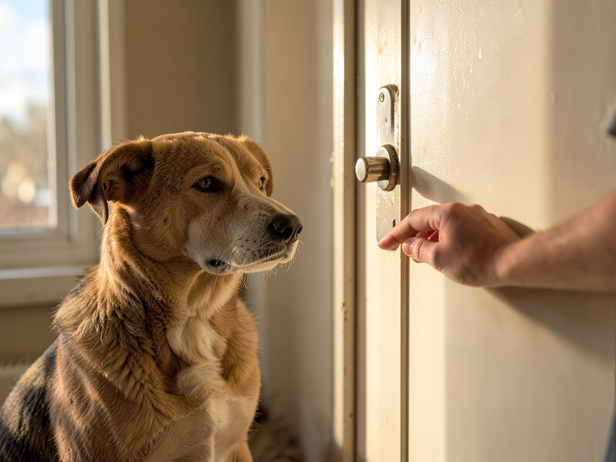
![Dog waits patiently at door]()
Dog waits patiently at door
Image credit : AI
Practicing door manners: teaching my dog to wait at the door is crucial for impulse control training.
What you need before the first session
A marker, a clicker or a short word like "yes" said the same way every time. High-value treats the dog does not get at other times. A door that opens inward is slightly easier to start with because you can use your body to block the gap, but any door works. Keep sessions to three to five minutes. Door training is mentally tiring because the dog is fighting an urge, and a tired dog starts making errors that feel like defiance but are just fatigue.
The six steps, in order
Step one: establish a marker and a release word in a low-distraction setting before you go anywhere near the door. The release word, "free", "okay", "go", means movement is now allowed. Practise this away from the door for a day or two so the words are already loaded when you need them.
Step two: approach the door with the dog on a loose lead. Ask for a sit or a stand-stay, whichever the dog already knows. The moment the dog holds position, mark and treat. Do not touch the door yet. Repeat until the dog settles quickly when you stop at the door.
Step three: reach for the door handle. If the dog holds, mark and treat. If it moves toward the door, your hand comes off the handle and you wait. No correction, no verbal reprimand. The door handle going still is the consequence of moving. Try again. Most dogs figure this out within five to ten repetitions.
Step four: open the door one centimetre. Mark and treat if the dog holds. Close it. Open it two centimetres. Mark and treat. You are building the picture gradually: an open door is not a signal to move. This is desensitisation to the door's movement, and rushing it is the most common reason the training stalls.
Step five: open the door fully. The dog holds. You step through first, turn back, and release with your release word, then let the dog walk through calmly beside you. The sequence, dog holds, you go first, you release, becomes the ritual. It does not mean you are asserting rank; it means the dog has a clear picture of what comes next and can relax into it.
Step six: practise with real-world variation. Different people opening the door. The door opening when the dog is not expecting it. Guests arriving. The training is only solid when it holds under conditions the dog finds genuinely exciting.
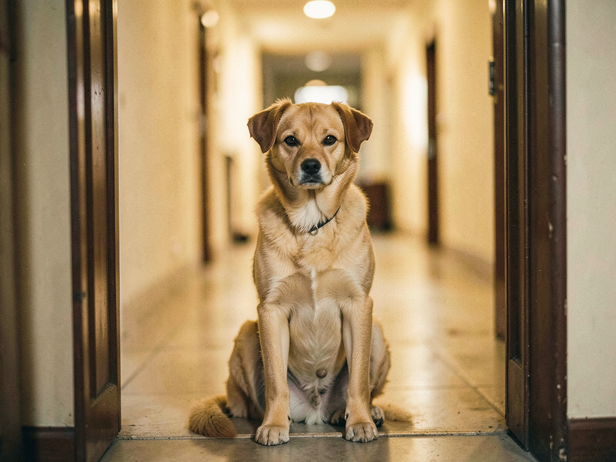
![Dog waits calmly in doorway]()
Dog waits calmly in doorway
Image credit : AI
Practicing door manners for my dog, teaching them to wait at the door is crucial for safety.
When it stops working and what to do
If the dog regresses after several reliable sessions, look at what changed. A new person in the household, a dog in heat nearby, or a change in routine can temporarily raise the arousal level past what the dog can manage. Drop back two steps, not one. Rebuild from a point where the dog is succeeding easily, and raise criteria more slowly this time.
If the dog is lunging, barking, or showing any behaviour that feels like it is about to redirect onto a person or another animal when the door opens, that is a different problem. Stop door training and contact a qualified trainer or veterinary behaviourist. Impulse-control training done incorrectly on a dog that is already over threshold can make arousal-based behaviour worse, not better.
Keeping it reliable long-term
The wait at the door only stays solid if it is practised regularly, not just during the initial training window. Once a week, run through the steps as a short refresher. Reward generously when the dog gets it right after a gap, that unpredictability of reward is exactly what keeps the behaviour strong. A dog that has been waiting reliably for months can still dash if the behaviour has gone unrewarded long enough to fade. Maintenance is not a sign the training failed. It is how trained behaviour works.