If you have two cats and one feeding area, you already know the drill: one cat plants herself in front of both bowls, the other hovers at the edge of the room waiting for a gap. Or they both descend at once and someone gets a swat before the first bite. The food itself is rarely the problem. What you are managing is resource competition, and it follows predictable rules that a structured routine can change.
Why cats struggle to share meals
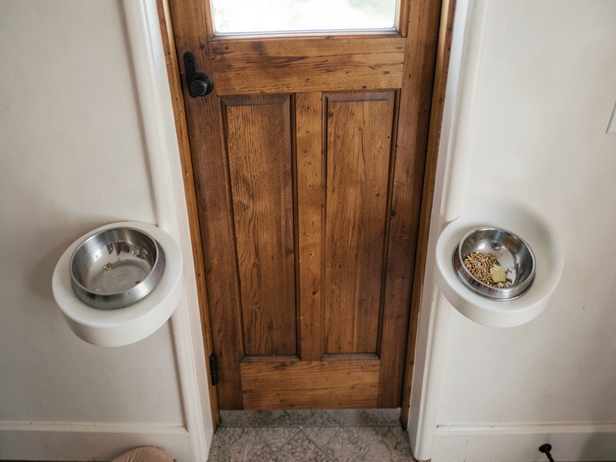
![Dual Food Bowls, Empty Doorway]()
Dual Food Bowls, Empty Doorway
Image credit : AI
A serene scene of two food bowls, hinting at shared meals. Ideal for illustrating how to stop cats fighting over food bowls.
Cats are solitary hunters by nature. In the wild, a cat catches one prey item and eats it alone. There is no social meal, no shared carcass, no taking turns. When two cats live together and eat from adjacent bowls, you are asking them to override a deeply wired instinct. Some pairs manage it easily. Others never fully relax unless the setup removes the need to compete at all.
The trigger is usually proximity, not hunger. A cat that has eaten half her bowl will still guard it if another cat comes within a certain distance, called the threshold. Inside that threshold, she feels the resource is under threat. Outside it, she ignores it. Your job is to find that threshold and build the feeding routine around it.
Start with separation, not togetherness
The most common mistake is trying to get two cats eating side by side before either of them is ready. Start by feeding them in completely separate rooms with the door closed. Both cats eat without any awareness of the other. This is not a step backward. It is the baseline you build from.
Once both cats finish their meals calmly and without scanning the room for the other, you have established that eating itself is a relaxed activity. That calm state is what you will carry forward into the next stage. Rushing past this step means you are stacking stress onto stress.
Keep meal portions consistent and timed. Free-feeding, where dry food is left out all day, makes resource guarding worse because the bowl is always present and always worth defending. Scheduled meals, typically two per day, mean the resource appears, gets eaten, and disappears. That rhythm reduces the perceived value of the bowl between meals.
Reduce the threshold distance gradually
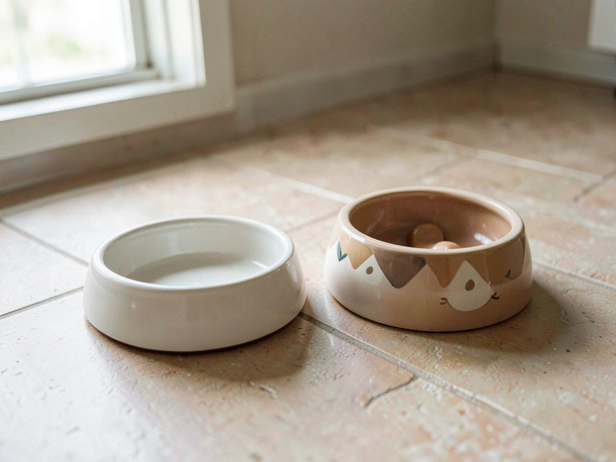
![Empty Cat Bowls and Puzzle Feeder]()
Empty Cat Bowls and Puzzle Feeder
Image credit : AI
Preparing for a calm mealtime. This setup aids in teaching two cats to eat together peacefully.
This is the core of the process, and it uses a principle called desensitisation: repeated, controlled exposure at a level that produces no stress response, followed by very slow increases in intensity.
After a week of calm separate meals, move the bowls to either side of the same door, still closed. Each cat eats near the door but cannot see the other. The smell of the other cat is present; the visual trigger is not. Do this for several days until both cats eat without pawing at the door or vocalising.
Next, feed them with the door open a crack, just enough to see through. If either cat stops eating, stiffens, or stares at the gap, the crack is too wide. Close it slightly. The rule is: if you see tension, you have moved too fast. Go back one step, hold it for longer, and try again.
Over days to weeks, widen the gap until the door is fully open and both cats eat on opposite sides of the doorway. Then move the bowls a few centimetres closer together every few days, watching for the same tension signals each time. The whole process from separate rooms to side-by-side eating can take two to six weeks depending on the cats. Some pairs plateau at a metre apart and stay there comfortably. That is a success.
What to do when one cat finishes first
The moment one cat finishes and walks toward the other's bowl is where most progress collapses. The cat still eating either guards or retreats, and you are back to square one.
The fix is timing and removal. Feed equal portions sized so both cats finish within roughly the same window. The moment the faster eater finishes, pick up her bowl immediately. Do not wait for her to investigate the other bowl. The bowl disappearing is the signal that the meal is over. Over time, the faster cat learns that finishing means the resource ends, not that a second bowl is available.
If one cat is significantly faster than the other, a slow-feeder bowl or a puzzle feeder for the faster cat extends her meal time without changing the food amount. This is a management tool, not a training step, but it buys the slower cat enough time to finish without pressure.
When calm eating needs more than a routine
Some cats never settle into shared mealtimes no matter how gradual the process. If one cat stops eating entirely when the other is in the same room, loses weight, or shows signs of chronic stress such as over-grooming, hiding, or changes in litter box use, the issue is broader than food competition. A veterinary behaviourist can assess whether the cats are genuinely incompatible at close quarters or whether an underlying anxiety is driving the response.
Aggression that goes beyond a warning swat, including chasing, cornering, or sustained attacks around the food area, is a signal to consult a qualified cat behaviourist before continuing any feeding protocol. Trying to push through that level of conflict with desensitisation alone can make it worse.