Deafness in dogs, whether congenital, age-related, or from chronic ear infection, changes the medium, not the method. The learning principles are identical: a clear signal, a marker the dog can see, and a reward that arrives within a second or two of the right behaviour. What shifts is how you get the dog's attention and how you keep it.
Getting attention before anything else
A deaf dog cannot hear you call its name. Before any signal means anything, the dog needs a reliable way to look at you. The standard method is a hand wave in the dog's peripheral vision, a gentle side-to-side motion at mid-height, not a sudden lunge that startles. Pair this wave with an immediate food reward every time the dog turns toward you. Do this thirty or forty times across a few sessions and the wave becomes the dog's name. From that point, every training sequence starts with the wave, a look, then the signal.
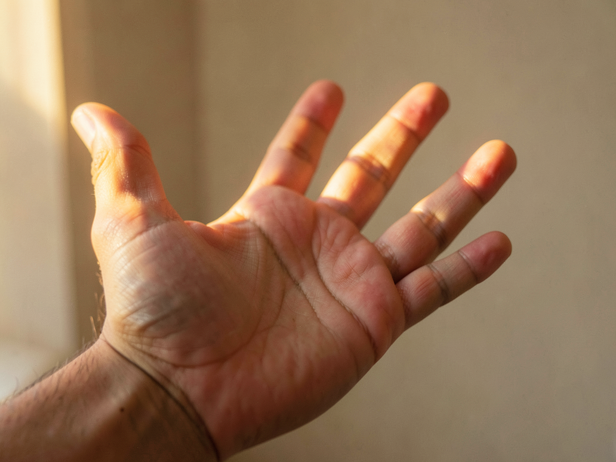
![Open Hand, Morning Light]()
Open Hand, Morning Light
Image credit : AI
I offer a clear hand signal, a vital part of training a deaf dog. This gesture communicates a 'stay' command with gentle morning light.
The visual marker: your substitute for a clicker
A clicker is useless here, but the principle behind it, marking the exact moment the correct behaviour happens, is not. Most trainers working with deaf dogs use a thumbs-up as the marker. The moment the dog does the right thing, thumbs-up, then reward. The marker must be consistent and fast: if it arrives two seconds after the sit, you have marked the dog standing back up. A small LED pen light flashed briefly works as an alternative marker for dogs who are also visually impaired at distance, but a clear thumbs-up is enough for most.
Seven signals worth teaching first
These are not arbitrary, they are the seven that give you the most control in daily life and in an emergency. Each one is described as it looks from the dog's point of view, facing you.
Sit: Index finger pointing up, held still. Lure the dog into position with food the first few times, then fade the lure and keep the signal.
Down: Open palm facing the floor, pressed downward. Start from a sit, lure the nose toward the ground, mark and reward the moment elbows touch.
Stay: Open palm held flat toward the dog, like a stop sign. Build duration in small steps, one second, three seconds, five, before adding distance.
Come: Both arms swept inward toward the chest in one smooth motion. This is the most important recall signal. Practise it at short distances first, always reward generously, and never use it to end something the dog enjoys.
Leave it: A quick horizontal wave of one hand across the body, like clearing a surface. Pair it with covering the object with your foot or hand, then reward the dog for looking away.
Good / Yes (marker): Thumbs-up, as described above. Keep this signal for the dog alone, do not use it in conversation with people around the dog or it loses meaning.
No / Stop: A flat hand held up, palm out, held still for a beat. This is not a punishment, it is information. Follow it immediately with a redirect signal so the dog knows what to do instead.
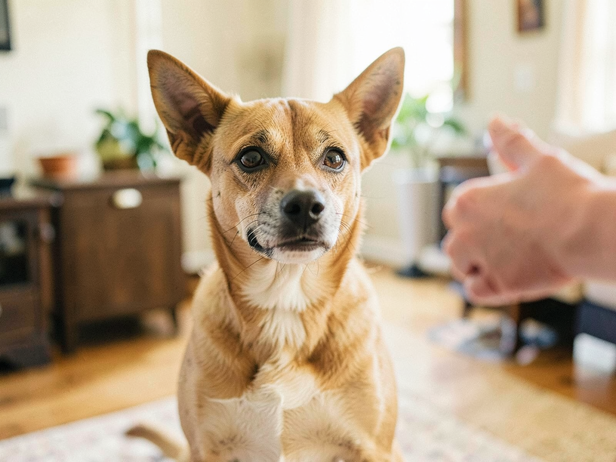
![Dog Responds to Hand Signal]()
Dog Responds to Hand Signal
Image credit : AI
My dog eagerly awaits the next command, responding to a clear hand signal. This is part of our positive reinforcement training.
Keeping sessions effective
Deaf dogs rely entirely on visual information, which means they tire from sustained eye contact faster than hearing dogs do. Keep sessions to five minutes or under. End every session on a behaviour the dog knows well and can succeed at, this keeps motivation high for the next one. Work in good light; a signal your dog cannot see clearly is no signal at all. If you train outdoors, position yourself so the dog is not squinting into the sun to read your hands. Consistency matters more than creativity: every person in the household uses the same signal for the same behaviour. A sit that looks different from two different people is two different cues the dog has to learn separately.
When to bring in a qualified trainer
The signals above will take most deaf dogs a long way. Where to stop and ask for help: if the dog shows any sign of aggression when startled from behind, a snap, a growl, a hard stare, that is a safety issue that needs a qualified trainer or veterinary behaviourist before training continues. Startle responses are common in deaf dogs and almost always manageable, but managing them correctly requires someone who can observe the dog in person. Teaching the dog to accept a tap on the shoulder as a neutral attention signal, rather than a threat, is part of that work, and it is worth doing properly.