A dog that crashes into its bowl the moment you lift it is not being greedy, it is doing exactly what an untrained dog does when something it wants appears. The behaviour is normal. The skill you are building is impulse control: the ability to pause between wanting something and acting on it. That pause, once learned at the food bowl, transfers to doors, roads, and strangers, which is why this is worth the ten minutes a day it takes.
The learning principle behind the wait
Impulse control is trained through a combination of positive reinforcement and marker timing. The dog learns that holding still, not lunging, is what releases the reward. The food bowl becomes the cue, not the starting gun. You are using the thing the dog wants most as the training tool, which makes this faster than most skills to build.
Marker timing matters here. The marker, a clipped word like "yes" or a clicker, lands the instant the dog is still, not after you have already set the bowl down. That half-second gap between stillness and the marker is where the dog reads what it did right. If your timing is late, the dog learns that shuffling its feet works just as well as standing still.
![Waiting for the Meal]()
Waiting for the Meal
Image credit : AI
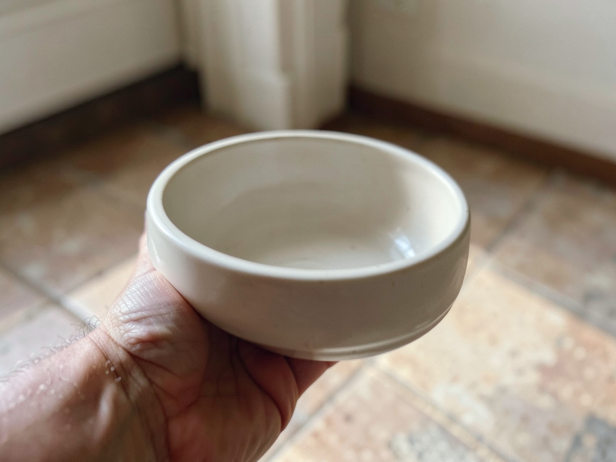
I'm practicing dog food bowl manners training, waiting patiently for my food. This impulse control is key!
The steps, in order
Start with the bowl empty. This matters. A bowl with food in it is a much higher-value distraction, and starting there sets the dog up to fail. Pick a spot where the dog usually eats and ask it to sit. If it does not have a reliable sit yet, spend a few sessions on that first before adding the bowl.
Hold the empty bowl at waist height. If the dog stays sitting, mark and reward with a treat from your pocket, not from the bowl. Repeat this five times in a session. Once the dog is reliably holding the sit while you hold the empty bowl, begin lowering it slowly toward the floor. The moment the dog breaks the sit and moves toward the bowl, lift it back to waist height. Say nothing. No corrections, no "no", no pushing the dog back. The bowl going up is the information. When the dog resets and sits again, start lowering once more.
Over three to five sessions, work toward placing the empty bowl on the floor while the dog holds the sit. When that is solid, meaning the dog waits without breaking across five consecutive repetitions, add a small amount of food to the bowl and repeat the sequence from the beginning. Most dogs need two to four sessions to generalise from empty to loaded bowl.
The release cue is as important as the wait. Pick one word, "okay" or "go", and use it consistently. The dog eats only when it hears that word. Without a release cue, the dog is guessing when it is allowed to move, and a dog that is guessing will eventually lunge to test the boundary.
What to do when it stops working
If the dog is breaking the sit repeatedly at the same point in the lowering sequence, you have moved too fast. Go back two steps and rebuild from a height where the dog succeeds. Rushing through early steps is the most common reason this skill stalls.
If the dog has the wait solid at home but falls apart when it is very hungry or when there are other dogs nearby, those are separate contexts that need their own training passes. A skill learned in one context does not automatically transfer to a harder one. Start easy, raise difficulty gradually.
Some dogs become frantic around food because of resource guarding, not excitement. Signs that this is guarding rather than impulse control: stiffening, a hard stare at the bowl, growling, or snapping when you approach during the session. If you see any of these, stop the training and consult a qualified trainer or veterinary behaviourist before continuing. Resource guarding has a different protocol and attempting to suppress it with the wait exercise can make it worse.
![Dog waits patiently for food]()
Dog waits patiently for food
Image credit : AI
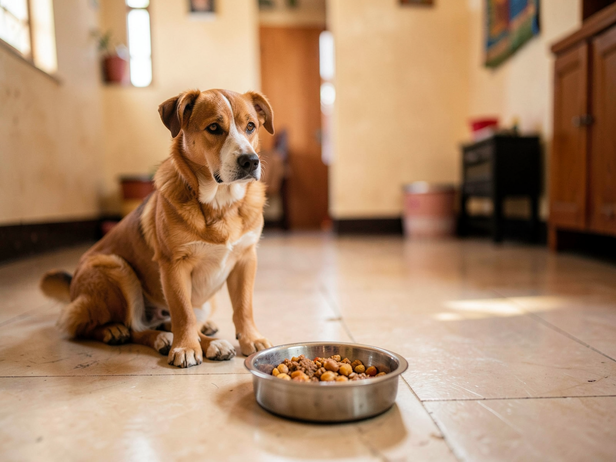
Practicing good dog impulse control training India, I wait calmly for my meal. Patience is key!
Building the duration and the distance
Once the dog waits reliably while you set the bowl down, extend the wait in small steps. Ask for three seconds before the release cue, then five, then ten. After that, add distance: place the bowl, take one step back, release. Then two steps. Then walk to the other side of the room before calling the release.
Vary the duration unpredictably once the dog is confident. A dog that always waits exactly five seconds learns to count, not to wait. Randomising between two seconds and fifteen seconds keeps the dog reading you rather than the clock.
A dog that has this skill reliably, bowl down, owner steps back, waits until released, has learned something that goes beyond mealtimes. It has learned that pausing and checking in with you is what makes good things happen. That is the foundation most other impulse-control training builds on.