A dog learns through repetition: the same action, paired with the same word, followed by the same outcome. When that chain breaks, because your mother-in-law says 'no no' while you say 'leave it', or your teenager lets the dog on the sofa after you've spent a week keeping it off, the dog isn't being difficult. It's reading a genuinely inconsistent environment and doing its best.
Why mixed signals slow learning down
In positive reinforcement training, the marker matters as much as the reward. A dog builds an association between a cue and a behaviour across many repetitions. Each time a different word is used for the same behaviour, that repetition count resets, or worse, the dog learns that the cue is optional, sometimes it means something, sometimes it doesn't. This is called variable reinforcement on the cue itself, and it makes the behaviour unreliable. A sit that works for one person but not another isn't a trained sit. It's a guess the dog makes based on who's asking.
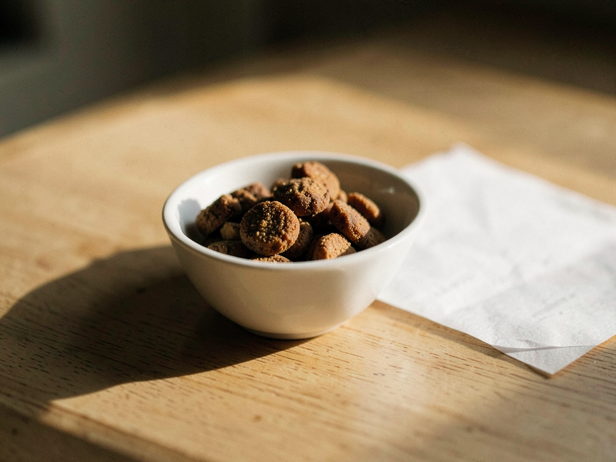
![Morning Dog Treat Still Life]()
Morning Dog Treat Still Life
Image credit : AI
My dog's favorite treats, ready for some positive reinforcement dog training.
Start with a cue sheet, not a family meeting
A long discussion about training philosophy tends to end in disagreement or glazed eyes. A short, specific list tends to get used. Write down the five or six behaviours your dog is currently learning or needs to know: sit, stay, come, off, leave it, crate. Next to each, write the exact word your household will use, one word per behaviour, agreed once, written down. Stick it on the fridge. The goal is not that everyone becomes a trainer. The goal is that everyone uses the same word.
Decide on the reward too. If you use a treat and your child uses a piece of roti, that's fine, the food is not the problem. If you reward a sit and your partner ignores it, that's the inconsistency that costs you. Everyone who interacts with the dog needs to know: when the dog does the thing, it gets something good, immediately.
Handle the 'but I don't want to train' family member
Not everyone in a household wants to participate in active training sessions, and that's a reasonable position. The ask is smaller than they think. They don't need to run drills. They need to use the agreed word when they want the dog to do something, and to not reward the behaviour they don't want. If your father doesn't want to ask the dog to sit before feeding it, the minimum is that he doesn't feed it while it's jumping. One rule, clearly stated, is easier to keep than a whole system.
Children need a slightly different approach. A child under six or seven is not reliably able to time a reward well enough to train a behaviour, and asking them to do so sets both the child and the dog up to fail. The more useful frame: teach the child the cue word, teach them to ask the dog to do it when the dog already knows it well, and let them be the one who gives the treat. That builds a real relationship without putting the training load on someone who can't carry it.
![Dog Training Essentials Ready]()
Dog Training Essentials Ready
Image credit : AI
My dog training essentials are laid out, ready for some positive reinforcement dog training.
What to do when someone breaks the rules
This will happen. The dog will get on the sofa because a guest didn't know, or your teenager will let the dog jump up because it's funny once. The training does not collapse. Positive reinforcement builds behaviour that is robust to occasional inconsistency, what it cannot survive is sustained inconsistency from the people the dog lives with every day.
When a rule gets broken, the response is not a reprimand of the person. It's a quiet reset: put the dog back in the position you want, ask for the behaviour, reward it. Then, separately, have the conversation about why the consistency matters. A dog that has learned 'off' reliably from one person will generalise faster to others once those others start using the word and rewarding the outcome. The work done is not lost.
When progress stalls despite household agreement
If your household is using the same cues, rewarding consistently, and the dog still isn't picking up a behaviour after several weeks of regular practice, the issue is likely in the training mechanics rather than the consistency. Marker timing, how quickly the reward follows the behaviour, is the most common culprit. A reward that arrives three seconds after a sit is not reinforcing the sit; it's reinforcing whatever the dog did in those three seconds. This is the point at which a qualified trainer or veterinary behaviourist is worth a session. One good session that fixes the timing saves months of well-intentioned but ineffective repetition.
Consistency across a household is genuinely achievable, but it requires treating it as a logistics problem rather than a motivation problem. The family doesn't need to care about dog training theory. They need a short list, a shared vocabulary, and a clear picture of what they're each being asked to do. The dog will show you, fairly quickly, whether it's working.