A budgie that bolts to the curtain rod the moment you reach for it is not being difficult. It has learned, accurately, that a hand coming toward it means free time is over. The cage is associated with loss, and you are associated with the hand that ends things. Reversing that association is the whole job, and it takes patience, a consistent cue, and a reason for the bird to want to go in.
Why chasing makes it worse every time
Every chase is a training session, and the budgie is the one getting trained. It learns that flight works: the longer it stays out of reach, the longer it stays out. It also learns that the cage entrance is a trap, not a destination. After enough repetitions, even a bird that was once easy to return will start pre-emptively avoiding you the moment the cage door opens. The fix is not a faster hand or a darker room. The fix is changing what the cage predicts.
![Millet on Open Cage Door]()
Millet on Open Cage Door
Image credit : AI
A sprig of dried millet invites a budgie back into its cage, a gentle reminder for budgie recall training.
Step one: make the cage the best place in the room
Before any training begins, spend a week making the cage worth entering voluntarily. The bird's favourite food, millet spray works for most budgies, goes inside the cage and only inside the cage, for short periods while the door stays open. The bird goes in, eats, comes back out. Nothing happens. No door closing, no reaching. Repeat this several times a day. The cage stops being a one-way door and starts being a location the bird chooses. This step cannot be rushed. If the bird is reluctant to enter at all during free flight, stay at this stage until it enters without hesitation at least three times in a row across two separate sessions.
Step two: build a reliable recall cue
A recall cue is a sound the bird learns to associate with something good happening right now. A short, consistent whistle or a clicker works better than a word, because the sound is distinct and you will make it the same way every time. The sequence is: make the sound, immediately offer millet or the bird's preferred treat from your hand near the cage entrance, bird approaches, bird gets the treat. Do not move to the next step until the bird turns toward you reliably when it hears the cue. This typically takes five to ten short sessions of two or three minutes each, spread across several days. Sessions longer than five minutes produce diminishing returns with budgies.
![Budgie in Open Cage]()
Budgie in Open Cage
Image credit : AI
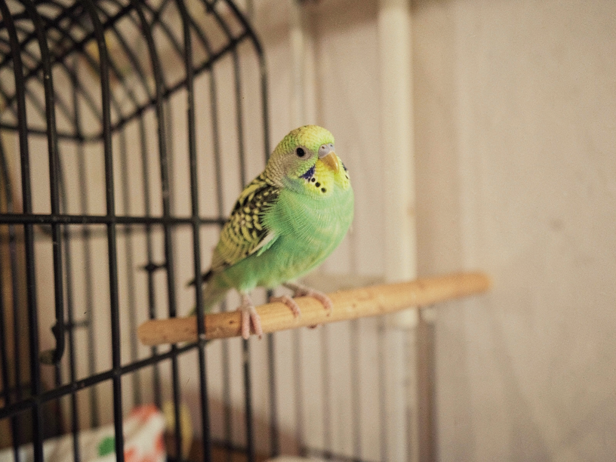
My budgie sits calmly in its open cage, a moment of peace. I'm learning budgie recall training steps to keep it safe.
Step three: pair the cue with the cage entrance
Once the recall cue is working, use it only at the cage entrance. Sound the cue, hold the treat just inside the cage door. The bird lands at the entrance, reaches in for the treat, you do not close the door. After several repetitions across a few days, the bird will begin entering fully to reach the treat. Only at this point, when the bird is entering on its own, do you begin closing the door, and only after it has eaten and settled, not the instant it crosses the threshold. Closing the door the moment the bird enters teaches it that entry triggers confinement. Waiting a few seconds first keeps the association softer.
Step four: fade the treat, keep the cue
Once the bird enters reliably on cue, begin fading the treat on a variable schedule: reward every entry for a week, then every other entry, then randomly. Variable reinforcement produces the most durable behaviour in birds, as in most animals. The cue stays consistent. The treat becomes occasional but never disappears entirely, a budgie that is never rewarded for returning will stop returning. A small piece of millet every third or fourth recall is enough to maintain the behaviour long-term.
The one mistake that resets everything
Chasing the bird even once during the training period undoes several sessions of progress. If the bird is out and not responding to the cue, the answer is not to reach for it. Turn off the overhead lights and open the cage with the interior light on if you have one, or simply wait. A budgie that is tired and calm will eventually land somewhere reachable. Let it step onto your finger voluntarily, carry it to the cage entrance, and use the cue and treat there. If you are short on time and need the bird in quickly, that is a management problem, not a training one, build more buffer into out-of-cage sessions so you are never in a hurry.