The first few weeks with a puppy feel relentless for a reason. A young dog has come from a litter where it was never truly alone, and your flat in Gurgaon or Bengaluru is the first place it has had to manage solitude. The crying when you leave is not manipulation. It is a dog that has not yet learned that your absence ends in your return. Alone-time training teaches exactly that, and it works best when it starts before the panic becomes a habit.
Why separation distress develops so quickly
Most owners spend the first week at home with a new puppy almost constantly. Then work resumes, the door closes, and the puppy goes from zero alone-time to four or six hours in a single day. That gap is where distress takes root. A puppy's nervous system is still forming, and an abrupt shift from constant company to long stretches of silence teaches it that departures are unpredictable and frightening, not that they are ordinary. The goal of alone-time training is to make departure so unremarkable, so gradual, that the puppy stops tracking it as an event worth worrying about.
![Puppy waits patiently]()
Puppy waits patiently
Image credit : AI
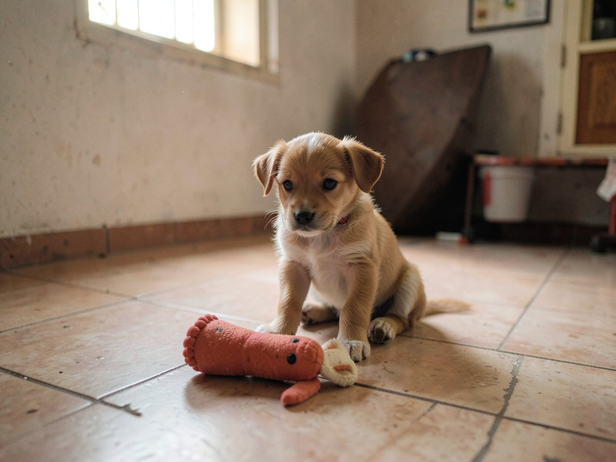
Teaching puppy to be alone in India, this little one waits with its toy. A quiet moment of independence.
The foundation: short absences before long ones
Start with absences measured in seconds, not minutes. Walk out of the room. Come back before the puppy has time to escalate. Repeat this ten or fifteen times across a morning, varying the gap, two seconds, five seconds, twelve seconds, three seconds. The randomness matters. A puppy that cannot predict when you return stops predicting altogether and starts to relax. Once it can hold calm through thirty-second absences reliably over two or three days, stretch to a minute. Then five. Then ten. Each step only moves forward when the previous one is settled, no whining, no scratching at the door, no frantic greeting when you return. A calm return is part of the lesson: greet the puppy quietly rather than with a rush of excitement that signals your return as a major event.
Marker timing and what you are actually reinforcing
The learning principle here is a combination of systematic desensitisation and counter-conditioning. You are reducing the emotional charge of the departure cue, the keys, the shoes, the bag, while pairing your absence with something the puppy values. A stuffed Kong or a long-lasting chew given only when you leave creates a positive association with solitude. The puppy begins to anticipate the treat when it sees the departure ritual, rather than anticipating distress. The marker moment is before you leave, not when you return. Rewarding a calm puppy as you prepare to go out reinforces the state you want it to stay in. Rewarding it the moment you walk back in reinforces the act of greeting, which is not the behaviour you are building.
![Morning Light on Indian Door]()
Morning Light on Indian Door
Image credit : AI
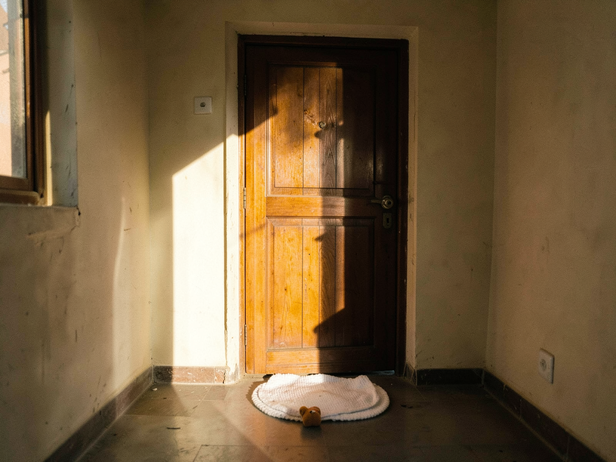
Preparing for alone time training for puppies. This quiet moment before the day begins.
What slowing down looks like in practice
Regression is not failure. A puppy that coped with five-minute absences on Tuesday and falls apart on Thursday is telling you something changed, it is tired, unwell, or the previous step was not as solid as it looked. Go back to the last duration it handled without distress and rebuild from there. If a puppy is consistently unable to hold calm past a certain threshold despite a week of careful work at that level, a qualified trainer or veterinary behaviourist is the right next step. Some dogs have a temperament or an early history that makes this harder, and a professional can assess whether what you are seeing is normal developmental anxiety or something that needs a different approach. Never punish a puppy for vocalising when alone. It is not being defiant. Punishment adds fear to a situation that already has too much of it, and it does not teach the puppy what to do instead.
Building a routine the puppy can read
Dogs are pattern animals. A predictable daily shape, a walk or play session before you leave, the chew appearing, the door closing, becomes a script the puppy learns to follow rather than a source of uncertainty. Keep departures and arrivals low-key. Avoid long goodbyes. The calmer the ritual, the calmer the puppy. Most puppies, with consistent training that moves at their pace rather than the owner's schedule, can hold two to three hours of calm solitude by four to five months of age. Longer stretches than that are hard on a young bladder regardless of emotional readiness, so the physical limit and the behavioural one tend to converge at roughly the same point. The training does not end there, it just stops needing daily attention once the pattern is established.