For a dog living in an Indian home, the pressure cooker whistle is not background noise. It is sudden, high-pitched, and comes with no warning the dog can read. A dog that bolts behind the sofa, barks continuously, or trembles at the sound is not being dramatic, it is responding to a noise that sits well within the frequency range dogs find aversive, delivered at volumes that regularly exceed 90 decibels at close range. The good news is that fear responses to specific sounds are among the most trainable problems in companion dogs, and a kitchen whistle is a particularly workable case because you control when it happens.
What is actually happening when your dog reacts
The reaction is a conditioned fear response. At some point, the whistle startled your dog, the startle triggered a stress hormone release, and the dog's brain filed the sound under threat. Every subsequent whistle confirmed that filing. The behaviour you see, barking, hiding, panting, pacing, is the dog attempting to cope with or escape a perceived threat. Desensitisation works by exposing the dog to the sound at an intensity too low to trigger that stress response, then pairing it with something the dog genuinely wants, so the brain re-files the sound under neutral or even good. Counter-conditioning is that second part: changing the emotional association, not just the volume. Both have to happen together for the change to hold.
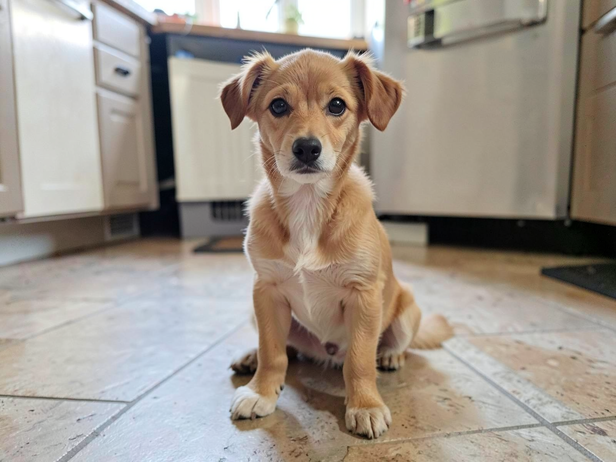
![Calm Dog on Kitchen Floor]()
Calm Dog on Kitchen Floor
Image credit : AI
This dog's calm demeanor on the kitchen floor is a good sign. We're working on desensitise dog to pressure cooker whistle.
Before you start: set a realistic timeline
Most dogs with a moderate sound sensitivity, they react but recover within a few minutes, show meaningful improvement in three to six weeks of consistent daily sessions. Dogs with severe reactions, meaning they do not settle for an hour or more after a whistle, or show physical signs like loss of bladder control, should be assessed by a veterinary behaviourist before you begin. A behaviour problem rooted in extreme fear can be made worse by poorly timed exposure, and a professional can help you calibrate the starting point. For dogs in the moderate range, the steps below work well if you stick to the pace the dog sets, not the pace you want.
The six-step plan
Step 1: Record the whistle. Use your phone to record three to five whistles from your own cooker. You need a recording, not the real thing, because a recording gives you volume control the actual cooker does not. Play it back through a phone speaker in a different room first to check it sounds realistic.
Step 2: Find your dog's threshold. Play the recording at the lowest volume your phone allows, from across the room. Watch your dog. If it continues what it was doing, lying down, sniffing, chewing, that volume is below threshold. That is your starting point. If it reacts at minimum volume, move the phone further away, or place it outside the room with the door open a crack. You need a level where the dog hears it and does not react.
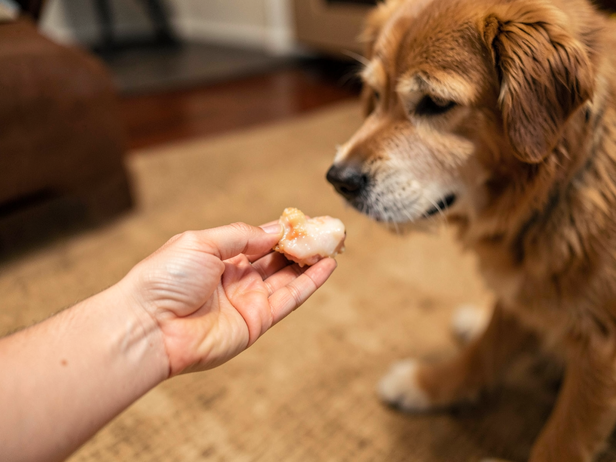
Step 3: Pair sound with food. The moment the recording plays, give your dog a high-value treat, something it does not get at other times. Boiled chicken, a small piece of paneer, or a portion of its favourite kibble all work. The sequence is: sound starts, treat appears immediately. Sound stops, treat stops. Repeat five to eight times per session. Keep sessions short, under five minutes. You are teaching the dog that the sound predicts something good, not that sitting still earns a treat.
Step 4: Raise volume slowly. After three to four sessions where your dog shows no stress response, ears relaxed, body loose, orienting toward you for the treat rather than away from the sound, increase volume by one notch. If the dog reacts at the new level, drop back one notch and spend another two or three sessions there. Progress is not linear. A bad day does not erase the work; rushing does.
Step 5: Move toward the source. Once your dog is comfortable with the recording at near-realistic volume on a phone speaker, begin moving the speaker closer to where the cooker sits in the kitchen. Continue pairing with food. The goal is for the dog to hear the sound from its normal listening position in the home and remain relaxed.
Step 6: Introduce the real cooker, with you in control. Cook something that requires only one or two whistles to start, rice, for instance, with your dog outside the kitchen and a family member ready to deliver treats the moment the whistle sounds. Keep the kitchen door open so the dog can hear but is not trapped near the source. Watch body language. A dog that orients toward the kitchen and then returns to what it was doing has made the shift. A dog that hides or shakes needs more time at the recording stage.
![Offering Chicken to Dog]()
Offering Chicken to Dog
Image credit : AI
I provide a treat to help with counter-conditioning dog sound fear. Gentle training builds trust.
What to do when a session goes wrong
If your dog reacts during a session, you have gone too fast. Stop the session, let the dog settle fully, no treats, no comfort-talk, just calm presence, and at the next session drop back two steps in volume or distance. Comforting a dog mid-reaction does not reinforce fear, but it also does not help the dog learn; what helps is preventing the reaction from happening in the first place by staying below threshold. If your dog is not taking treats during sessions, it is already over threshold. That is a sign to lower the intensity before trying again. A dog that will not eat is a dog that is too stressed to learn.
Marker timing and why it matters
The treat must arrive within one to two seconds of the sound starting. Beyond that window, the dog's brain cannot reliably connect the two events. If you are slow with the treat, use a marker word, a short, consistent word said the instant the sound plays, followed by the treat, to bridge the gap. The marker does the time-sensitive work; the treat confirms it. This is basic positive reinforcement: the timing of the consequence is what teaches, not the consequence alone.
A dog that has learned to hear the cooker whistle and look at you for a treat has done something genuinely difficult: it has updated a fear memory with a new one. That does not happen by accident or by waiting for the dog to get used to it. It happens through repetition at the right intensity, with food arriving at the right moment, at a pace the dog's nervous system can absorb.