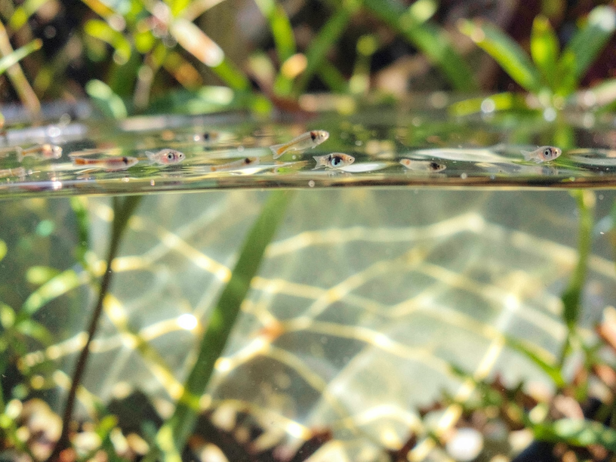
Watch a well-kept aquarium at feeding time and you will notice the fish are already waiting. They cluster near the surface or at the front glass minutes before the food arrives. If you have been feeding at the same hour each day, you trained them to do that, and the mechanism behind it is the same one that shapes behaviour in far more complex animals.
What conditioning actually means for fish
Fish do not learn the way mammals do, but they are capable of associative learning. When a stimulus, the sound of a lid, a shadow passing over the tank, a light switching on, reliably precedes food, the fish begin to associate that cue with feeding. Over repeated exposures, the anticipatory behaviour appears: the gathering, the surface activity, the increased movement. This is classical conditioning, the same principle Ivan Pavlov documented in dogs, applied to an animal with a brain the size of a lentil. The nervous system doing the work is simpler, but the process is real.
![Fish Near Aquarium Surface]()
Fish Near Aquarium Surface
Image credit : AI
I'm learning about fish feeding schedule in India by watching these little ones.
Why a fixed schedule matters beyond the theory
A consistent feeding time does more than produce a predictable crowd at the glass. It regulates the fish's internal rhythm. Many species have circadian patterns, cycles of activity and rest tied to light and time, and a fixed feeding window anchors one of the strongest cues in that cycle. Fish fed on a reliable schedule tend to be more active during feeding windows and calmer outside them. That calm matters in a community tank: a fish that is not constantly searching for food is less likely to nip at tank mates or disturb slower feeders.
There is a practical benefit for water quality too. When fish anticipate feeding, they are at the surface and alert when food enters the water. They eat quickly and efficiently. Uneaten food that sinks and decomposes is one of the most common causes of ammonia spikes in home aquariums. A conditioned fish wastes less food, which means less organic matter breaking down at the bottom of the tank.
How to build the routine
Choose one or two fixed times and hold them. Morning and early evening work well because they align with natural light cycles and with most owners' schedules. Pick a cue that will be consistent: the same sound when you open the lid, the same spot at the glass where you drop food. That cue becomes part of the conditioning chain, over two to three weeks, most fish will begin responding to it before the food appears.
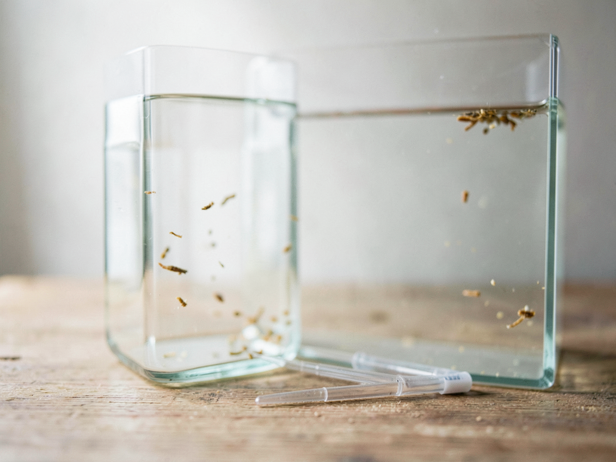
Feed small amounts the fish can consume in two to three minutes. Remove anything uneaten after five minutes. This keeps the water clean and reinforces the window: food is available now, not indefinitely. If you have a community tank with fish that feed at different levels, surface feeders, mid-water swimmers, and bottom dwellers like corydoras, drop food in two stages, a few seconds apart, so slower feeders reach their portion before the faster ones circle back.
![Morning Feeding Ritual]()
Morning Feeding Ritual
Image credit : AI
I'm setting up for the daily fish feeding routine, ensuring my aquatic friends get their meal.
What changes in the fish, and what it tells you
Once a routine is established, deviations become informative. A fish that normally rushes to the surface and does not appear at feeding time is telling you something. Loss of appetite is one of the earliest signs of illness, stress, or a water quality problem in aquarium fish. When you know what normal looks like for your tank, you catch problems earlier. A conditioned feeding routine gives you a daily health check built into your schedule.
It also makes medicating easier when it is needed. Fish accustomed to eating at a set time and from a set spot are easier to target-feed medicated food or to observe individually during treatment. That familiarity with the routine reduces stress on the fish during an already stressful process.
Conditioning aquarium fish through a feeding routine is not a trick. It is the practical application of how fish actually process their environment, and it makes the tank easier to manage, the fish easier to observe, and the daily feed something both of you show up for.