Most dogs that jump on guests are not trying to dominate anyone. They are doing something that worked: a human looked at them, touched them, or made a sound, and the dog learned that four paws off the floor is how you get that response. The behaviour is self-reinforcing, which is why telling guests to ignore it while you do nothing else rarely changes anything. Stopping it requires teaching the dog what to do instead, then making that alternative more rewarding than the jump.
Why dogs jump, and why scolding makes it worse
Jumping is an attention-seeking behaviour rooted in how dogs greet each other. Puppies lick the faces of adult dogs; reaching up toward a human face is the same impulse scaled to a larger body. Every time a guest squeals, pushes the dog away, or even makes eye contact while saying "no", the dog gets what it was after: a reaction. Negative attention is still attention. Punishment, a knee to the chest, a scruff, a loud correction, adds stress without teaching the dog what the correct behaviour looks like. It also makes the dog less predictable around strangers, which is the opposite of what most owners want.
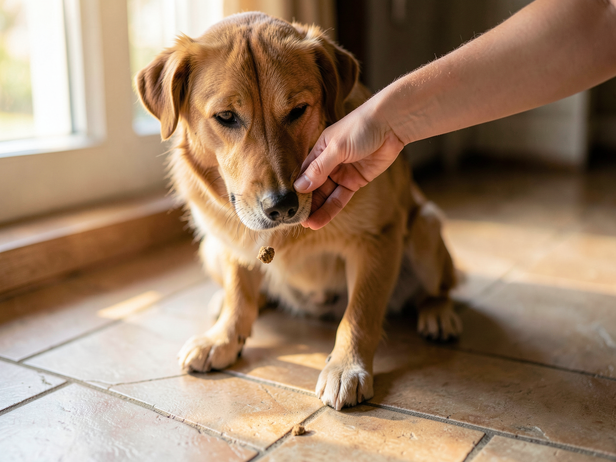
![Dog Accepts Treat Calmly]()
Dog Accepts Treat Calmly
Image credit : AI
Teaching a dog not to jump requires patience and positive reinforcement. This moment captures a successful training step.
The behaviour you are training toward
Before the first practice session, decide what "good greeting" looks like for your dog and your home. The two most reliable options are a sit at the door or four paws on the floor with no jumping. A sit is easier to cue and easier for guests to reward consistently. Four paws on the floor is a looser criterion but works well for dogs who find sitting while excited genuinely difficult. Pick one and stick to it, mixed criteria across sessions slow learning considerably.
The step-by-step plan, one visit at a time
This plan uses positive reinforcement and a technique called differential reinforcement: you reward the behaviour you want and remove the reward for the behaviour you don't. You will need small, high-value treats, a leash for early sessions, and guests who are willing to follow one instruction.
Step one, before the guest arrives: put your dog on a leash and have treats ready in your pocket. A dog on leash cannot complete a full jump, which means the unwanted behaviour stops producing a result immediately.
Step two, at the door: ask your dog to sit before you open it. If it sits, open the door. If it cannot sit, keep the door closed and wait. The door opening is the reward for calm behaviour, not something that happens regardless.
Step three, the greeting: ask your guest to turn their back and fold their arms the moment the dog moves toward them. No eye contact, no speech, no touch. When the dog's paws return to the floor, even for a second, the guest turns around, crouches to the dog's level, and offers calm praise or a treat. If the dog jumps again, the guest turns away again. This is extinction of the jumping behaviour paired with reinforcement of four paws down.
Step four, building duration: once the dog is reliably keeping four paws on the floor for a few seconds, extend the time before the guest rewards. Five seconds, then ten, then the length of a normal hello. You are building the dog's ability to hold the calm state, not just flash it briefly.
Step five, fading the leash: after three or four sessions where the dog is consistent on leash, try the same sequence off leash with the door kept narrow enough that you can block a full bolt. If the dog jumps, the guest turns away and you quietly move the dog back to a sit without scolding.
Step six, generalising: a dog trained with one guest needs practice with several different people before the behaviour becomes reliable. Children, people in hats, people who move quickly, each is a new context. Budget several weeks of real visits before expecting the behaviour to hold with an unfamiliar person who has not been briefed.
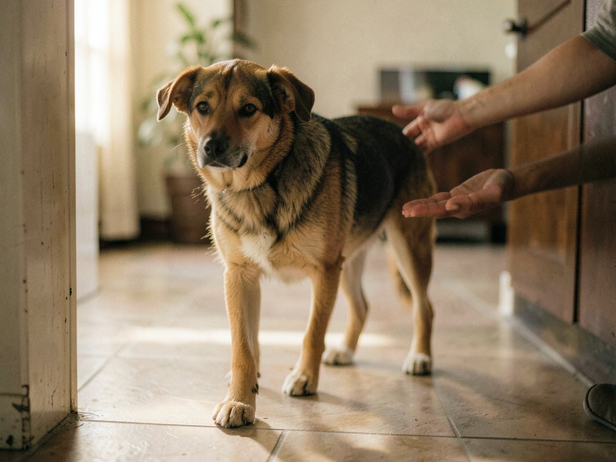
![Calm Dog by the Door]()
Calm Dog by the Door
Image credit : AI
Practicing calm greetings. Teaching a dog not to jump is key for peaceful welcomes.
What to tell your guests
The most common reason this training fails is inconsistent guest behaviour. One person who lets the dog jump, because it's cute, because they don't mind, because they forgot, resets several sessions of progress. Keep the instruction simple: "Turn your back if she jumps. Reward her when all four paws are on the floor." Give guests a treat to hold so they have something to do with their hands. Most people are happy to help once they understand that their reaction is the training variable.
When progress stalls
If the dog is still jumping consistently after four to six weeks of structured practice, consider two things. First, check whether the behaviour is being rewarded anywhere else, on walks, in the garden, by family members at home. Jumping that works in one context stays alive across all contexts. Second, if the dog's jumping is accompanied by mouthing, growling, or a level of arousal that seems hard to interrupt, a qualified trainer or veterinary behaviourist is the right next step. High arousal at the door can have an anxiety component that a training plan alone does not address.